SYMPOSIUMS
LECTURE
No. 2 – THE VIEW OF SCIENCE ON THE AFTERLIFE
No. 2 – THE VIEW OF SCIENCE ON THE AFTERLIFE
Life after death: this is a question that has challenged humanity for several millennia. Until a time that is recent in historical terms, death was the domain of the religions, each of which offered its own answer. Today scientists are studying the question.
In this talk we will consider the following points:
I – A new attitude towards death
II – Near-death experiences recorded by scientists
III – A revolution concerning the invisible
1. The sound barrier
2. The light barrier
3. The superluminal world
IV – A new conception of consciousness
V – Conclusion
I – A NEW ATTITUDE TOWARDS DEATH
Today the religions are no longer the only ones interested in death. Major universities have set up teams of researchers to study the phenomenon of death scientifically. Books and publications devoted to the question keep multiplying. Today human beings no longer die at home in their familiar surroundings, wrapped in the warm and reassuring atmosphere of the family. With the progress of science and medicine, the situation has changed considerably. People die more and more often in hospital. In hospital, patients benefit from specialised medical teams, the latest advances in medicine and sophisticated means of resuscitation. As a result, the number of patients who have been resuscitated after a clinical death, with cardiac arrest and a flat electroencephalogram, has increased. After their resuscitation, a growing number of these patients remember perfectly the experiences they lived through in the state of clinical death. They are able to recount, with surprising precision, every detail of their experience to the medical team that treated them. As the great majority of these accounts are strikingly similar, researchers began to take an interest in the question. Among the very first was Raymond Moody, doctor of philosophy and of medicine, who published a book entitled Life After Life (French edition: Robert Laffont, 1977), bringing together more than 150 testimonies.
“By revealing that thousands of people, in every corner of the world, had lived and experienced this type of phenomenon every day” (B-B p. 43), R. Moody’s book caused a great stir in medical and scientific circles and among the general public. R. Moody “was booed, criticised, torn to pieces and judged scandalous by his own peers, from which he suffered greatly” (B-B p. 155).
The very serious Gallup institute revealed that in 1982 eight million Americans had had an NDE (near-death experience), “that is, almost one person in twenty” (B-B p. 88). With today’s extremely powerful means of analysis, the most recent research shows that a certain form of consciousness remains active after the brain has stopped functioning, and that this consciousness seems more efficient in this other state. “Some scientists speak of an expansion of consciousness” (B-B p. 88). In his book La vie au-delà de la mort, Bernard Baudouin writes (p. 155): “The existence of a consciousness after physical death is now doubted only by people who are poorly informed.”
II – NEAR-DEATH EXPERIENCES RECORDED BY SCIENTISTS
From the medical point of view, the state of death is very well defined. For Doctor Jean-Jacques Charbonier (B-B p. 88), who has studied the question at length: “15 seconds after cardiac arrest, the electroencephalogram is flat and there is no longer any brain activity.” Within the two minutes following cardiac arrest, a heart cannot be revived, even in the optimal conditions of an intensive care unit. People who come back to life after a cardiac arrest have therefore come back from death. More and more health professionals have collected, by the dozen and then by the hundred, testimonies from people who, after having known death, have come back to life.
According to Raymond Moody, these investigations show that, whatever the age, nationality, religion, culture or way of life, the testimonies agree. Patients unanimously report that during the experience they had the sensation of being outside their body, floating above the bed where their physical envelope lay. From there, they watched every detail of their resuscitation, seeing and hearing everything the specialists said and did. In the following phases, patients say they heard “an unpleasant noise, like a loud ringing or a buzzing”. At the same time they are carried away at great speed through a long dark tunnel. The subject then realises “that he has a body, but of a very particular nature” (R-M p. 36).
According to the testimonies, this new body enjoys faculties far superior to those of the physical body the patient has just left. This new body has the “ability to move instantly over any distance and to pass through solid matter (objects and human beings)”, with a new perception of time. Soon other beings with a body similar to that of the person having the experience come towards him. He often recognises among them relatives or friends who died before. They come, as it were, to welcome him. Then an intense light fills the patient, who discovers a state of total bliss. He has the impression that from this light emanates the spiritual presence of a being of Love and Light, “a spirit of warm tenderness”, which awakens in him a deep questioning and leads him to review the life he has lived. He then has an instantaneous, panoramic vision of all the events of his life and judges them at their true value. After this vision, he seems to come up against a barrier, a kind of ultimate frontier, a point of no return between life and death. Most of the time he tries to cross this barrier, for he feels so happy in his new state that he does not wish to go back to the world of the living. But suddenly he feels pushed back, drawn towards his physical body, which he re-enters and in which he recovers life and consciousness (R-D p. 126).
Bernard Baudouin (B-B p. 84) notes that “the men and women who have thus crossed the threshold of death come back from it transformed for ever”, in the sense of a deep peace and serenity. These discoveries about near-death states, made by “specialists, notably eminent scientists”, reveal to us something quite different from the nothingness of materialist theories, for which consciousness is merely the result of a chemical process.
In his book La vie au-delà de la mort. Quand la science trouve des réponses, Bernard Baudouin writes: “Death is only a passage, a transition from one state to another, which implies the preservation of what constituted a being in its own right” (B-B p. 17). “Passing into the afterlife clearly means entering another world” (B-B p. 22). Death is said to be only a link, a passage, a transition from one state to another (B-B p. 17).
In this 21st century, the revelation that “physical death is not the end of life” is a revolution in human thought that makes death acceptable and brings a real message of hope to all human beings (B-B p. 72).
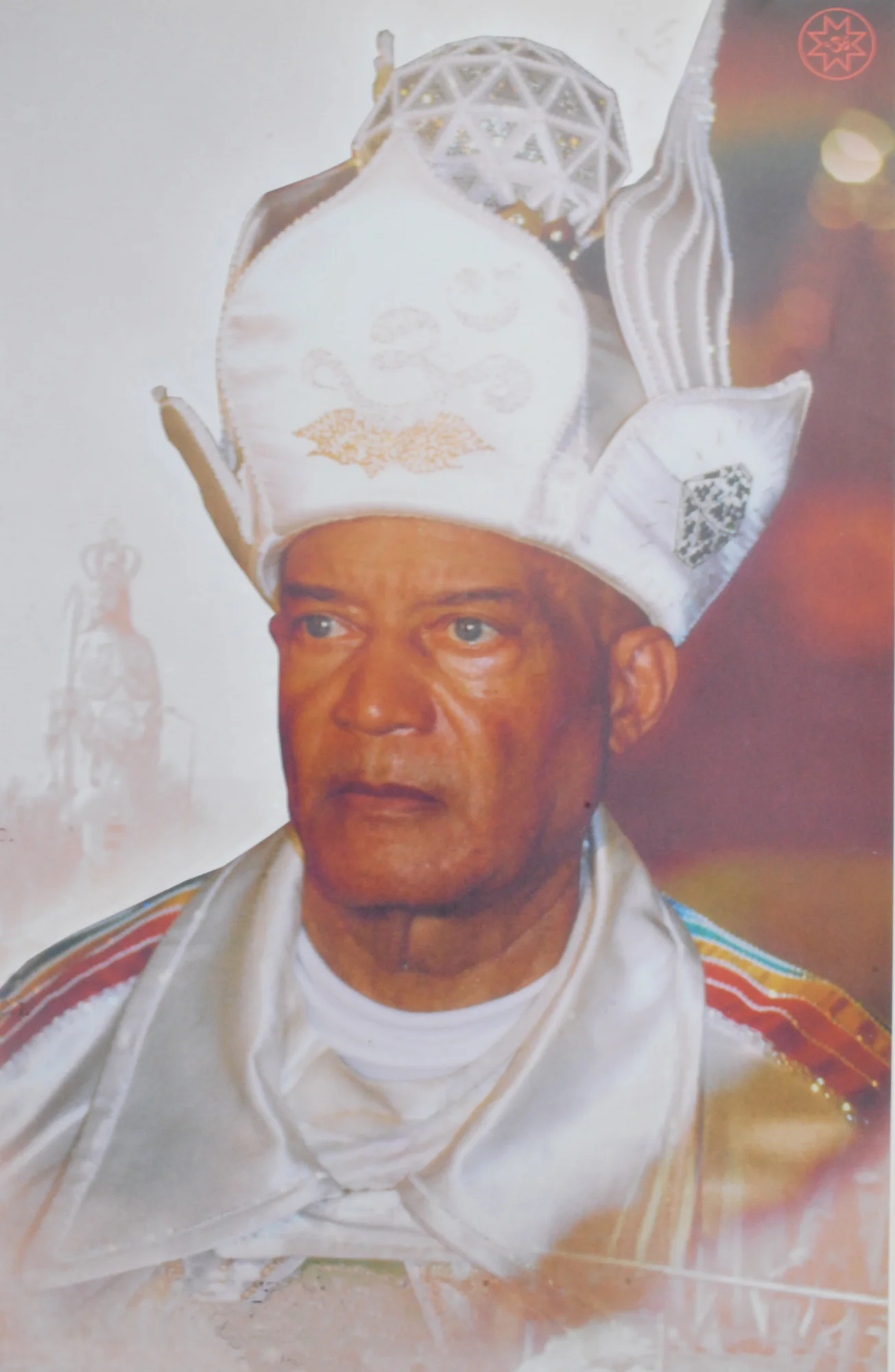
His Holiness the Lord HAMSAH MANARAH teaches that “death is only a change of state”.
III – A REVOLUTION CONCERNING THE INVISIBLE
Research on near-death experiences tends to show that Reality is not limited to the phenomenal and material world perceived by our five senses. Beyond this sensory world there exists another, subtler world that some describe as spiritual. This world is at least as complex as the material world, if not more so. Because the physical senses predominate in human beings, they have no difficulty grasping the so-called material world. It is much more difficult for them, and for some even impossible, to conceive of the existence of the spiritual world during their earthly existence. This handicap leads many of our contemporaries, in all good faith, to deny the existence of a spiritual world.
The many near-death experiences recorded throughout the world show that it is only once the physical body and the physical senses have withdrawn that unusual functions of consciousness appear, giving a glimpse of the existence of a world hitherto unknown.
The phenomenal world that we consider to be reality is only the result of a series of pieces of information recorded by our physical senses and transmitted to our brain, which processes them. The brain analyses this information according to the acuity of our senses, our culture and our knowledge. Each person perceives their own reality of the world. What we consider to be reality is only a visible and limited part of our universe. But beyond this limit there exists another truth. The materialist’s state of mind is an obstacle to knowledge of this universe (B-B p. 59).
1. The sound barrier
In the 1940s, when an aircraft approached the speed of sound, which is 340 metres per second, aerodynamic phenomena compressed the layers of air and a powerful shock wave could be heard. Aircraft that tried to exceed this speed came up against a real rigid wall, which was called the “sound barrier”. Understanding the laws involved in this phenomenon, and technical progress, now allow our modern aircraft to cross the sound barrier safely and to fly at supersonic speeds. For some researchers, by analogy with the sound barrier, there is a “light barrier” that human beings cross at the moment of death to reach a world unknown to most.
2. The light barrier
In physics, “no body can exceed the speed of light”, which is 300,000 km per second. By analogy with the sound barrier, researchers came up with the idea that there is a “light barrier” and that beyond this barrier nothing material can exist. It was not until the 1960s that some American physicists began to put forward the idea that particles travelling faster than light might exist in a beyond which, under normal conditions, remains inaccessible to the great majority of human beings.
3. The superluminal world
Professor Dutheil’s research led him to conceive that beyond this light barrier there exists a superluminal world.
“The light barrier would therefore be a frontier separating two universes”, two realities:
- a world of subluminal particles, that is, the material world in which all human beings live;
- a superluminal world to which it would be more difficult, or even impossible, for us to gain access in normal conditions of life.
The frontier between these two worlds, subluminal and superluminal, would be formed by an intermediate space, which could be the ultimate barrier and frontier that those who have a near-death experience come up against, the barrier mentioned in the testimonies. “Most of the time,” Régis Dutheil relates, “(the patient) tries to cross the barrier, for he feels so happy that he does not wish to go back. But suddenly he feels pushed back, drawn towards life, and re-enters his physical body. He regains consciousness” (R-D p. 126).
IV – A NEW CONCEPTION OF CONSCIOUSNESS
The essence of the recent research we have just touched on lies in the idea that there may be a mode of consciousness different from the one we usually know. This state of consciousness would have properties superior to anything we know. These properties would explain all the phenomena that occur at the moment of death, with the survival of consciousness beyond the physical death of the body and the brain. Consciousness, as Bernard Baudouin writes, would no longer be “a mere product of the brain, destined to disappear when death occurs, as materialist theories envisage” (B-B p. 161). Consciousness would remain active on the invisible planes after the death of the body.
“At the moment of death, local consciousness would detach itself from the physical body to join and unite with superluminal consciousness”, and would continue life in a superluminal world, invisible to physical eyes. Gary Schwartz of the University of Arizona raises the question “of a possible universal intelligent consciousness guiding and organising the evolution of the universe, and therefore of humanity, in what he considers a concept of intelligent evolution” (R-D p. 94).
In the same spirit, the Aumist religion considers the Universal Law of EVOLUTION, which governs matter, to be the reason for being, the driving force and the foundation of Life and of Creation.
V – CONCLUSION
Bernard Baudouin writes in his book (p. 181): “In the light of scientific discoveries, life and death now take on another meaning.” “Today we are reaching the threshold of a new era in which the human mind will take on a scope out of all proportion to what was known before.”
For Hubert Reeves, the famous Canadian astrophysicist, science explains “how it works, how it functions”, while religious discourse “is philosophical and moral; its mission is to give meaning”. These two ways of seeking the truth are not incompatible; they are complementary.
In his book Les preuves scientifiques d’une vie après la vie, Doctor Jean-Jacques Charbonier, anaesthetist and intensive care physician, writes: “Today more scientific texts are published that tend to prove the existence of an afterlife than publications presenting death as absolute nothingness… Given the progress of science, it now seems entirely logical to accept the existence of a life after death.”
Researchers’ recent discoveries increasingly tend to join the viewpoint of the religions, and in particular here that of Aumism.
In summary, the Lord HAMSAH MANARAH teaches that at the death of the body the soul leaves the physical body and the world of matter to join the world of the spirit in the Column of Light, where it continues to perfect and purify itself in the direction of the divinisation of the Human Being.
To close, let us recall this important Teaching of Aumism:
“Death is only a change of state.” (His Holiness the Lord HAMSAH MANARAH)
*******
BIBLIOGRAPHY
– All the works of His Holiness the Lord HAMSAH MANARAH, published by Le Mandarom and Albin Michel. In particular:
La Révolution du Monde des Vivants et des Morts. La Justice Divine
La Loi d’Évolution des Âmes. De l’esclavage à la vraie Libération
– Independent authors:
Bernard Baudouin (B-B): La vie au-delà de la mort. Quand la science trouve des réponses. Éditions Trajectoire.
Dr Jean-Jacques Charbonier: Les preuves scientifiques d’une vie après la vie. Éditions Exergue.
Professor Régis Dutheil (R-D): L’Univers super lumineux – Science et conscience. Éditions Sand.
Raymond Moody (R-M): La vie après la vie (Life After Life). Éditions Robert Laffont.
Hubert Reeves: Les secrets de l’Univers. Éditions Robert Laffont.