SYMPOSIUMS
LECTURE
No. 3 – THE FOUNDATIONS OF A FAIRER SOCIETY WITH GREATER SOLIDARITY
No. 3 – THE FOUNDATIONS OF A FAIRER SOCIETY WITH GREATER SOLIDARITY
Justice and solidarity: two words that for too long expressed a utopia.
Today, two words heavy with meaning that ring out as an emergency for the future of humanity.
While we travel into space and master technology, why do so many inequalities continue to fracture our humanity? It is not acceptable.
After a quick review of inequalities, we will see how to move towards greater solidarity. For, according to the Aumist Teaching, there is no justice without solidarity. And these two values are the pillars of the Golden Age.
I – A BRIEF REVIEW OF INEQUALITIES
A few examples:
Economic inequalities
– The richest 1% of the planet hold half of the world’s wealth[1].
– Half of the world’s population lives on less than 5.50 dollars a day[2], or EUR 4.70.
Covid has increased inequalities.
According to the Oxfam report of July 2021, “The Hunger Virus Multiplies”[3], 11 people currently die of hunger every minute because of the explosive cocktail of the three Cs: conflict, Covid and the climate crisis. This rate is higher than the current death rate from the pandemic, which is 7 people per minute. The longer we wait, the wider the gap becomes!
The fortunes of billionaires reportedly increased by nearly 30% in the spring of 2020, during the first wave of Covid-19. The health crisis has highlighted “an increase in wealth inequalities, not only because the rich have become richer, but because the poor, at the same time, have become poorer”[4]. According to the Oxfam report of January 2022, “Inequality Kills”[5], “inequality contributes to the death of at least 21,300 people each day”. It is not acceptable.
On top of economic inequalities comes the weight of discrimination.
The weight of discrimination
On top of economic inequalities come the injustices of cultural, racial, sexist, religious and many other forms of discrimination, which prevent certain social groups from gaining access to education and work.
According to Amnesty International, “Millions of men and women suffer all kinds of discrimination all over the world. They are deprived of essential rights because they are ‘different’.”[6]
Women are the first victims of discrimination:
– In education: 132 million girls between the ages of 6 and 17 have no access to schooling[7].
This is not acceptable, when we know that education is a factor of emancipation, freedom, employment and poverty reduction.
– In pay: worldwide, women are paid 20% less than men[8].
All these inequalities also weigh on the very length of life.
Inequalities in life expectancy
Life expectancy is an indicator of injustice. It expresses the suffering of deprived populations with regard to health (diagnosis and care), infant mortality, undernourishment, lack of hygiene, etc.
Life expectancy: 83 years in Iceland, 59 years in Mali[9].
According to the WHO, life expectancy in low-income countries is 16 years lower than in rich countries[10]. Can we accept that the length of a human being’s life should be cut short in this way for lack of resources?
This, then, is a non-exhaustive review of the disparities that are delaying the growth of a better, more fraternal world, which we call the Golden Age.
Clearly, human justice has its limits, its flaws, its corruption, its injustices and its selfishness.
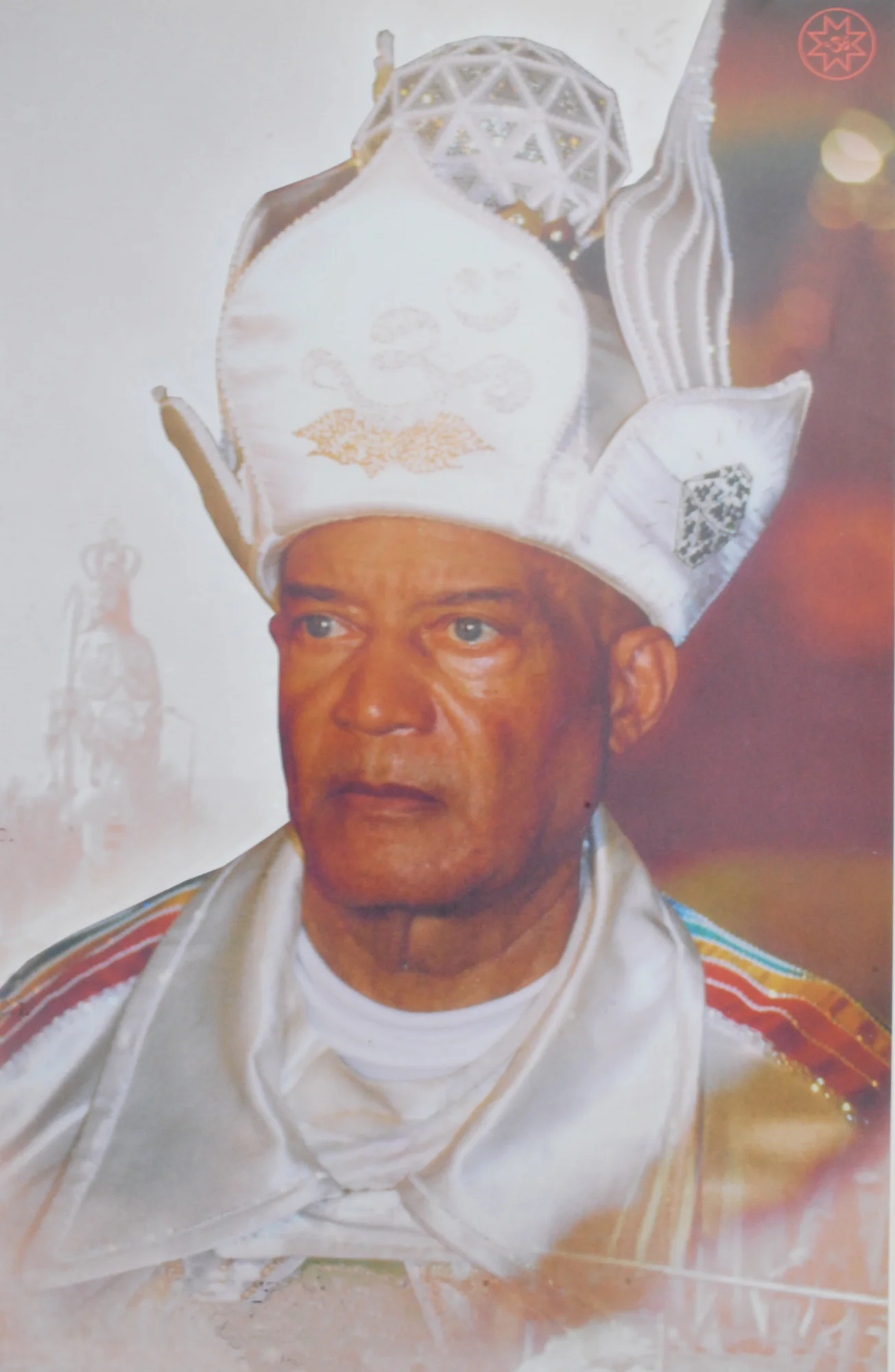
His Holiness Lord HAMSAH MANARAH warns us: “The Golden Age cannot be built on a world of social and economic injustice.”[11]
He confronts us with the cause of inequalities: “You have built your human justice on disrespect for the Laws of God.”[12]
In the face of these inequalities, the need to reinvent justice and solidarity appears indispensable to the survival of humanity. Let us now look at:
II – JUSTICE AND SOLIDARITY: AN URGENT NECESSITY!
“True justice is what fosters the protection of the collective interest (…) True justice is synonymous with solidarity.”[13]
What is the foundation of this justice and this solidarity? According to Aumism, the source of unity is the presence of the Divine in each person.
If God is present in each person, everyone has the same value and all human beings have the same rights, wherever they are on the planet, whatever their race or their fortune. We can understand why justice and solidarity are indispensable.
This is also a principle of the 1948 Universal Declaration of Human Rights.
Article 1 states: “All human beings are born free and equal in dignity and rights. They are endowed with reason and conscience and should act towards one another in a spirit of brotherhood.”
This principle is in harmony with Aumist thought: “Express within yourself that universal solidarity which transcends the notions of races, nations, civilisations and religions.”[14]
It is therefore essential to contribute in various ways to reducing inequalities in the world.
Putting solidarity into practice means knowing how to:
Share wealth better
Insufficient redistribution is one of the causes of inequality. A better distribution of wealth must be considered.
800 million people are undernourished! A tenth of humanity does not have enough to eat!
And yet we produce more than is needed to feed the planet, according to a UN population specialist[15]. So it is quite simply a question of distribution.
Admittedly, major efforts are being made. A salutary awakening has given rise to local, national and international bodies and admirable associations working for greater justice and solidarity. Those engaged in humanitarian aid, whether or not their path is a spiritual one, put into practice the solidarity that is a key to the Golden Age.
In 2015, the 193 member countries of the United Nations adopted a sustainable development agenda for a fairer world by 2030. The UN report published on 13 July 2020 on “The State of Food Security and Nutrition in the World” warned that the goal of “Zero Hunger” by 2030 was not on track to be met[16].
It is time to speed things up, so that sharing becomes everyone’s aspiration; so that a breath of humanity sweeps away all obstacles, all reluctance, all selfishness, and the convenient excuse of fate.
In the Aumist Teaching, sharing is one of the Laws of the Golden Age: “You will never be like the miser sitting on his treasure chest while the world starves.”
“States must help the deprived,” says Lord HAMSAH MANARAH, “while helping the citizens of each nation to take charge of themselves.”
I will mention a few of the actions to be encouraged:
– developing natural resources and using them rationally and intelligently
– moderation of aspirations
– foresight, leading us to avoid waste and to build up reserves
– redistribution within each country according to circumstances, in connection with economic crises, natural or other disasters, shortages…
I refer you to the chapter “The economic and the social in the Golden Age” in L’Aumisme, la Doctrine de l’Âge d’Or.
Rethink the place of money in society
– Money and profit
“Evil appears when the appetite for money for its own sake makes us forget all spiritual values.”[17]
But regarded as a means and not an end, money should neither be despised nor made a source of guilt. It allows us to live decently, and it can be shared and used wisely to help others.
Profit, without being abolished, can be reduced to help the most deprived.
– Tax justice
Tax justice is an important factor in reducing inequality. Taxation means taking from each according to their means in order to redistribute to each according to their needs.
Things are moving forward: in October 2021, more than 130 countries sat down at the same table to agree on a single global tax, setting a 15% rate for multinationals located in tax havens where they paid only around 1%, sometimes 3%, in tax.
Until then, this was unthinkable. It is a historic step forward, born of the various crises and of an awakening of consciences! An exemplary step forward: what is possible in one field is possible in all the others…
– Justice in financial markets
During financial crises, for example the crisis of 2008, decades of economic progress were wiped out in a few hours. The most deprived are on the front line in economic crises.
The bursting of financial bubbles can have serious consequences for the most vulnerable, particularly on unemployment.
It is therefore important to regulate the financial markets in order to reduce injustice.
Move beyond national selfishness
Countries have long felt the need to unite. To name only the League of Nations after the war (1919) and the UN (1945). This is a step towards international unity.
International meetings, the G2, G5, G7 and G20, have come into being. Today we see meetings between more than 130 countries.
More recently, States, compelled by perils that threaten not just one country but the entire planet (financial, health and climate crises…), have come together for a common solution. Another step in the right direction.
This is a fine advance, but we must go further and make the most of this dynamic of international cooperation.
We must move beyond the national selfishness that keeps the gulf of inequality open. We have seen the limits of international solidarity during recent events: Covid, migration, conflicts, COP26 (some progress, but States have diverging interests). All these events have put solidarity to the test and exposed its limits!
In all these international meetings, what was lacking was strong unity, international governance.
We must think about organising a community of peoples, a world Federalism founded on a programme of international solidarity, as Lord HAMSAH MANARAH writes[18].
Indeed, given the need for cooperation between peoples to overcome planetary trials, only an international body that is economically and politically effective will be able to transcend national selfishness[19].
Transform ourselves
This key contributes to the Golden Age change of mentality.
We are not spectators of the world but actors in it. That too is the new era!
If we always apply the same principles, we will always have the same problems.
Let us put into practice the acceptance of differences, mutual aid and solidarity through action, thought and prayer.
Through thought and prayer we can help heads of State and governments “so that they take the right decisions for the happiness of the country, helping to prepare a favourable future and the reign of peace on this Earth”[20].
According to Aumism, while respecting the laws of the country in which we live, we should regard ourselves as citizens of the whole Earth.
“It is not a parochial solidarity that we call for, but an international and interreligious solidarity, a solidarity that ignores borders and the barriers of race and religion.”[21]
CONCLUSION
Never has the interdependence of human beings been so obvious! What affects one country concerns the whole planet: economic crisis, global warming, disasters, migration, pandemics, wars… Never has solidarity, a Law of the Golden Age, been so indispensable and so urgent!
Lord HAMSAH MANARAH shows us the way of a solidarity founded on both mutual respect and the general interest, in which mutual aid fosters autonomy:
“May economic and social justice be restored, and may each people be able to be self-sufficient.
May the law of sharing and solidarity become planetary, so that the Golden Age of fraternity may come.”[22]
V. Shambara
Lecturer
*******
[1] Oxfam France, Inégalités : pourquoi les 1 % les plus riches du monde sont un problème selon Oxfam, 8 October 2021.
[2] World Bank, press release of 17 October 2018: Nearly Half the World Lives on Less than $5.50 a Day.
[3] Oxfam press kit, The Hunger Virus Multiplies, 9 July 2021.
[4] www.franceculture.fr, podcast “Les Idées claires”, 16 December 2020: interview with Anne-Laure Delatte, economist and research fellow at the CNRS.
[5] Oxfam report, January 2022, Inequality Kills, www.oxfam.org.
[6] www.amnesty.fr/discriminations: “Discriminations et racismes dans le monde. Nul ne doit être privé de ses droits parce qu’il est différent.”
[7] www.plan-international.fr: “Causes et conséquences des discriminations des filles face à l’éducation”, 27 September 2020.
[8] United Nations, www.un.org: International Equal Pay Day, 18 September.
[9] https://data.worldbank.org: Life expectancy at birth, 2019.
[10] www.who.int, 6 April 2021: WHO calls on countries to build a fairer, healthier post-COVID-19 world.
[11] L’Aumisme, la Doctrine de l’Âge d’Or, p. 283.
[12] Ibid., p. 134.
[13] Vers un Âge d’Or d’Unité, p. 477.
[14] Une Loi pour détruire le Mal, p. 81.
[15] www.un.org/development/desa: “Can we feed the billions?”, 19 April 2021, Cheryl Sawyer, population specialist at UN DESA.
[16] news.un.org, 13 July 2020: “World not on track to achieve Zero Hunger by 2030, says UN”.
[17] Le Yoga de la vie pratique, p. 244.
[18] L’Aumisme, la Doctrine de l’Âge d’Or, pp. 279-280.
[19] Une Loi pour détruire le Mal, p. 83.
[20] La Voix de Lumière, p. 458.
[21] Une Loi pour détruire le Mal, p. 88.
[22] Vers un Âge d’Or d’Unité, p. 44.