SYMPOSIUMS
LECTURE
No. 5 – CULTIVATING THE SPIRIT OF JUSTICE
CULTIVATING THE SPIRIT OF JUSTICE
In October 2007, the Secretary-General of the United Nations, the South Korean Mr Ban Ki-moon, declared in a speech given in the presence of Ms Souhayr Belhassen, President of the International Federation for Human Rights: “Justice is a condition for peace” and “peace and justice are indivisible”.
Indeed, the spirit of justice prevails only when solidarity and sharing are present: the current conflicts shaking the planet prove that poverty and injustice are at the root of many conflicts.
At the beginning of this 21st century, unsettled by the consequences of human actions in which the short term takes precedence over the moral values that guarantee shared and lasting happiness, the Aumist religion recognises the need to restore the spirit of justice and peace at every level.
This talk will therefore discuss the following points:
- Cultivating the spirit of justice in human society;
- Cultivating the spirit of justice towards nature;
- Combining right prayer and right action.
I. CULTIVATING THE SPIRIT OF JUSTICE IN HUMAN SOCIETY
Learning to share
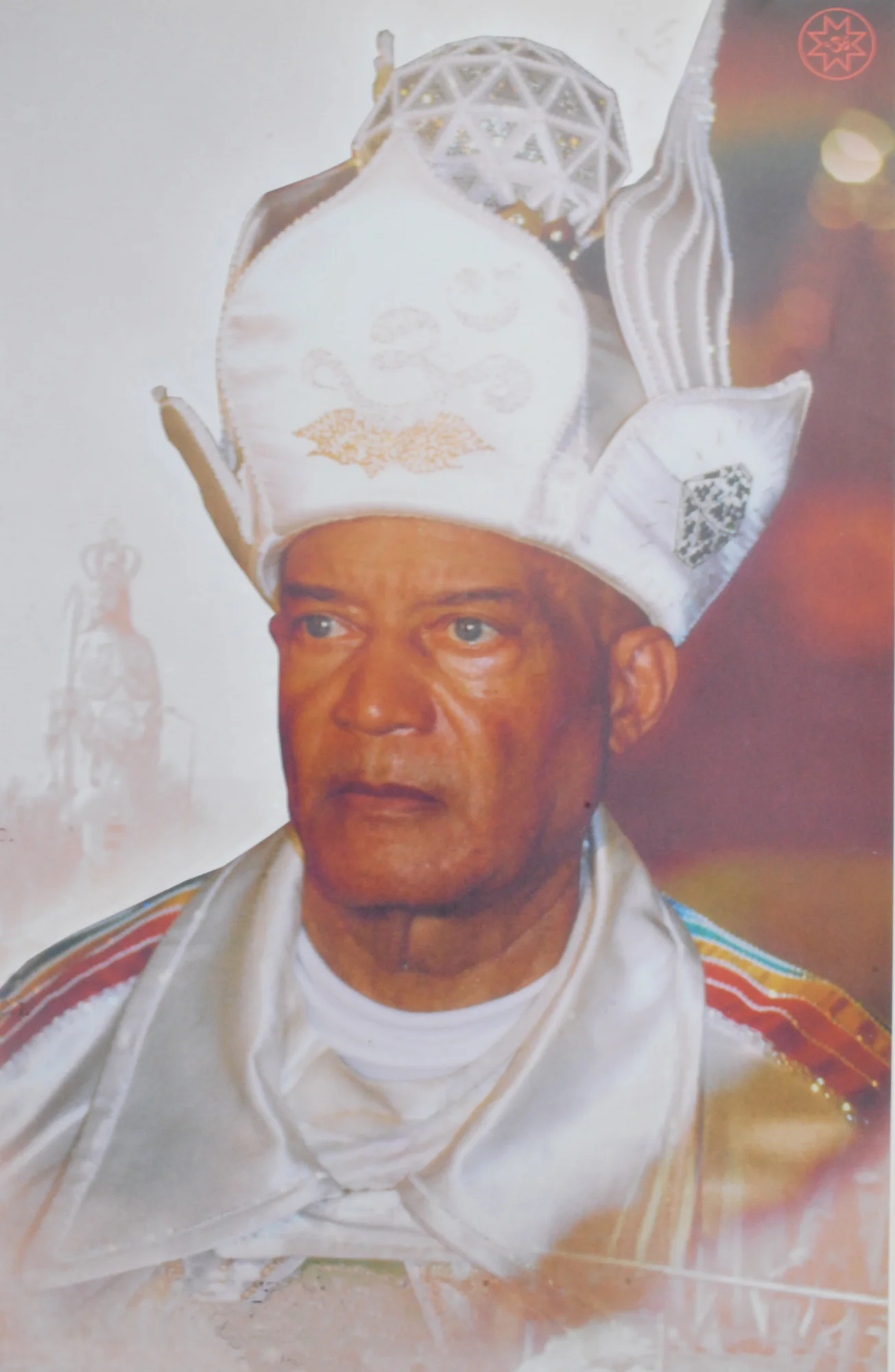
His Holiness Lord HAMSAH MANARAH tells us that selfishness is “the first climbing ivy to be uprooted from the depths of each person, so that the natural law of sharing riches, both material and spiritual, can be set in motion”.[1]
Selfishness drives people to seek only their personal interest. It leads to contempt for others and condones inequality. It goes hand in hand with sometimes ruthless competition, with the law of the strongest, which breeds violence: violence in those who crush others and want to keep their power, and violence in those who are crushed and want revenge and to reclaim their rights. The inequalities between North and South, but also within each continent with the “Fourth World”, have never been so glaring. Out of selfishness, individuals and nations see only their short-term interest, with no concern for future generations.
The Founder of Aumism came to restore Justice, which is essential to peace.
The time has come for the planet to reach a higher level of evolution, to replace the law of the strongest and the law of retaliation with the law of love, which presupposes justice:
“I will not build the Golden Age,” He says, “on a world of social and economic injustice, on an Earth where extreme wealth and extreme poverty live side by side. I will not build the Golden Age on an Earth subject to the God of money and the goddess of profit. I will not build the Golden Age on a planet broken up into a jigsaw puzzle that tears peoples apart and exacerbates local particularisms.”[2]
If nothing changes, division puts the Earth in mortal danger. This is why His Holiness Lord HAMSAH MANARAH gives us landmarks to guide our change and help us live in peace: He offers us new moral laws called the Laws of the Golden Age.
The 5th is the Law of Sharing, whose 1st principle is: “You shall share your know-how, your knowledge and your material and spiritual achievements with your neighbour.” And the second: “You shall never be like the miser sitting on his treasure chest while the world starves to death or souls take their own lives in despair.”[3]
Letting go of possessiveness
What prevents us from sharing is often the desire to keep for ourselves what is supposed to belong to us exclusively.
But “what then is yours, his, the other’s, mine, ours?” asks the Lord. “Nothing can belong to us lastingly. (…) What is true for the individual is even truer for a people or a nation. Border wars always arise from a feeling of having one day been robbed by history of part of one’s territory.”[4]
Peace will be firmly established when most human beings have made this maxim their own: “The Earth belongs to all and is the property of no one.”[5]
Developing a sense of the common good and of solidarity
Applying the Law of Sharing means thinking of the collective good and opening oneself to solidarity.
Lord HAMSAH MANARAH confronts each of us with the urgency: we cannot remain self-centred while the Earth is threatened with self-destruction.
“If each person sees only their own particular case, humanity is not about to regain its unity. But if we all come together around the collective case of our planet, which is slowly dying as a result of bad thoughts and actions, then each of us will find in the depths of ourselves the moral strength to tame the evil within, so as no longer to add to the collective burden of a planet at bay.”[6]
“True justice is what favours the protection of the collective interest.
True justice is what allows souls to become aware of their mistakes and to remedy them. (…)
True justice is synonymous with solidarity.”[7]
Beyond differences, “the Golden Age is above all the gesture of a hand held out to those who suffer”.[8]
The Lord helps us accelerate our inner change by confronting us with our personal duty.
Here are three questions to ask ourselves every day:
“What have I done today to help my neighbour?
What will I do tomorrow to relieve the suffering of the world?
Have I respected in every respect the law of sharing riches, both material and spiritual?”[9]
II. CULTIVATING THE SPIRIT OF JUSTICE TOWARDS NATURE
Human violence towards nature breeds conflict
In the Aumist religion, one cannot speak of justice towards human beings without mentioning the necessary justice towards nature: human consciousness is the fruit of a slow evolution through the mineral, plant, animal and human kingdoms. Before animating a human body, our consciousness dwelt in stones, plants and animals. This “chain of life” creates an interaction and a de facto solidarity between all living beings.
“Human souls come from the Evolutionary Ladder: before walking on the Earth, they were stones on the path that took on a plant body, then soared on the wings of the bird, before coming back to run on four legs on the earth and slowly straightening up to finally become human.”[10]
Having reached the top of the Pyramid, man is in a way the “chemosynthesis of all the kingdoms of nature”, “the summary of nature”. Because human consciousness has evolved through the different kingdoms from age to age, it stands at the top of the Evolutionary Pyramid, on the threshold of divinisation. This is why the kingdoms of nature follow the example of human beings, whether they move towards evolution and progress… or towards involution and the fall.
In the Age of wars and divisions that we are leaving (the Iron Age), man no longer takes on his responsibilities towards the kingdoms of nature from which he came:
- having become materialistic and too focused on the growing and immediate satisfaction of his material needs, he no longer respects God present within himself and in all that lives. He crushes, exploits and destroys nature. Through his prayers, he no longer helps the minerals, plants and animals evolving in his wake to progress;
- he sets a bad example of injustice. As a result, nature, which is alive, follows man down the slope of violence: it takes revenge for his lack of respect and for the suffering inflicted on it. This is the cause of many natural disasters and cataclysms.
Aumism insists on the consequences of the suffering inflicted on animals. In the light of the Law of Evolution, the animal kingdom must evolve towards the human kingdom: if they are mistreated, animals will keep a painful memory of the suffering inflicted on them and will become human beings filled with a desire for revenge. “Wars between men,” says Lord HAMSAH MANARAH, “begin with an open war between man the dictator and the sacrificed animal.”[11]
On the other hand, if they are loved and well cared for, if they become humanised by learning to communicate with us and to behave without violence, animals will become peaceful human beings capable of justice.
Man must restore peace with nature
Today it is essential to become aware of this interdependence between man and all the kingdoms of nature in order to regain planetary peace.
We human beings have been deeply unjust towards Nature: we have poisoned it, ravaged it, enslaved it and in places destroyed it, whereas it shelters us, warms us, feeds us and enables us to live. Hence the need to restore peace with Nature, which is the condition for peace between human beings: we must be just towards all the kingdoms.
This is where we can introduce the concept of sustainable development, all of whose key ideas are found in Aumism. Sustainable development meets present needs without destroying nature and without compromising the ability of future generations to meet their own. It aims to foster a state of harmony between the different kingdoms of nature.
In practical terms, it is imperative for humanity to weigh the long-term consequences of its actions:
- taking the future into account (the “precautionary principle”, for example…);
- taking the environment into account (protection of fauna and flora, CO2 emissions, energy consumption…).
Individually and collectively, we must avoid acts of violence towards the minerals, plants and animals that allow consciousnesses in the course of evolution to reach the next level. We owe them gratitude and concrete protection, as was discussed at the previous conference.
Moving beyond selfishness is fundamental: preserving nature means preserving the future of generations to come.
His Holiness Lord HAMSAH MANARAH shows us the direction to follow with the “Code of Honour of man towards the Kingdoms of Nature”, which I encourage you to read in L’Aumisme, la Doctrine de l’Âge d’Or, p. 206.
Here are the first 2 principles of the 11th Law of the Golden Age, the Law of the natural contract:
“Man who benefits from nature shall pray for the evolution of the lower spirits, in exchange for the blessings poured out each day.
Man shall refrain from upsetting the balance of nature, the climate, and the mineral, plant and animal species, on pain of seeing the earth tremble beneath his feet.”[12]
III. COMBINING PRAYER AND ACTION
The balance between prayer and action
“My positions are clear,” says His Holiness Lord HAMSAH MANARAH; “they urge each and every one to transcend selfishness and to help their neighbour through prayer, but also in concrete ways.”[13]
As we have seen, lasting peace must take concrete form in acts of solidarity towards nature and towards our human brothers and sisters. But combining prayer and action is a key idea of Aumism. Justice is restored through prayer and through action: humanity, like the whole Evolutionary Pyramid, is waiting for the sharing of prayers and for action in solidarity to relieve its suffering.
Prayer for our human brothers and sisters and for the other kingdoms of nature is an act of spiritual solidarity: “Each of us,” says His Holiness Lord HAMSAH MANARAH, “must be a redeemer for the kingdoms of nature and share the essence of our prayers of love with the spirits of minerals, plants, animals and other human beings.”[14]
The sense of selfless service
As we have seen, those who seek by every means to serve particular interests flout justice and solidarity. They fuel divisions and wars. To contribute to peace, we must therefore put our actions and our prayers at the service of the collective good, of the long-term general interest. Accompanying action and repeated selflessly, the prayer of OM fosters the evolution of all beings and spreads its blessings on all. OM represents “the ark of the covenant between man and nature”, the point of balance of the whole of creation. True peace depends on the right balance between the kingdoms, from mineral to human.
CONCLUSION
His Holiness Lord HAMSAH MANARAH urges us to become aware of the destructive role of injustice.
He urges us to restore true justice, a factor of peace, by showing us that, beyond the trials, the Golden Age is already on its way thanks to the descent of the Divine into matter: “The religious renewal under way,” He says, “will have ever greater repercussions, bringing about a new, non-static vision of the world. (…) The man of tomorrow will benefit both from technological progress and from a heightened awareness of his spiritual destiny. (…) A stable world environmental policy will take shape. With the reduction of the risks of war, new and updated data on the world economy will bring balance to the nations.”[15]
He advocates a world federalism that helps nations to live together in peace, while respecting differences, with, among other things, “the pooling of efforts to maintain social and economic balance, a distribution of wealth, and the safeguarding of the different parts that make up the heritage of humanity”.[16]
Beyond the errors, difficulties and violence that are still present, we see States seeking better cooperation at European and international level. Gradually, the longing for justice and peace is growing in the world.
And we will end with this wish of His Holiness Lord HAMSAH MANARAH for peace in the world:
“May the spirit of fairness and justice grow on this Earth!”[17]
*******
[1] La Révolution du monde des vivants et des morts, p. 441.
[2] L’Unité des Visages de Dieu, p. 370.
[3] La Loi d’Évolution des Âmes, p. 316.
[4] La Révolution du monde des vivants et des morts, p. 442.
[5] Ibid., p. 443.
[6] Ibid., p. 441.
[7] Vers un Âge d’Or d’Unité, p. 477.
[8] Une Loi pour détruire le Mal, p. 89.
[9] La Révolution du monde des vivants et des morts, p. 442.
[10] La Loi d’Évolution des Âmes, p. 273.
[11] L’Aumisme, la Doctrine de l’Âge d’Or, p. 196.
[12] La Loi d’Évolution des Âmes, p. 329.
[13] Une Loi pour détruire le Mal, p. 85.
[14] Vers un Âge d’Or d’Unité, p. 259.
[15] L’Aumisme, la Doctrine de l’Âge d’Or, p. 268.
[16] Ibid., p. 279.
[17] Ibid., p. 285.