SYMPOSIUMS
LECTURE
No. 1 – ENDING VIOLENCE, A PRIORITY
No. 1 – ENDING VIOLENCE, A PRIORITY
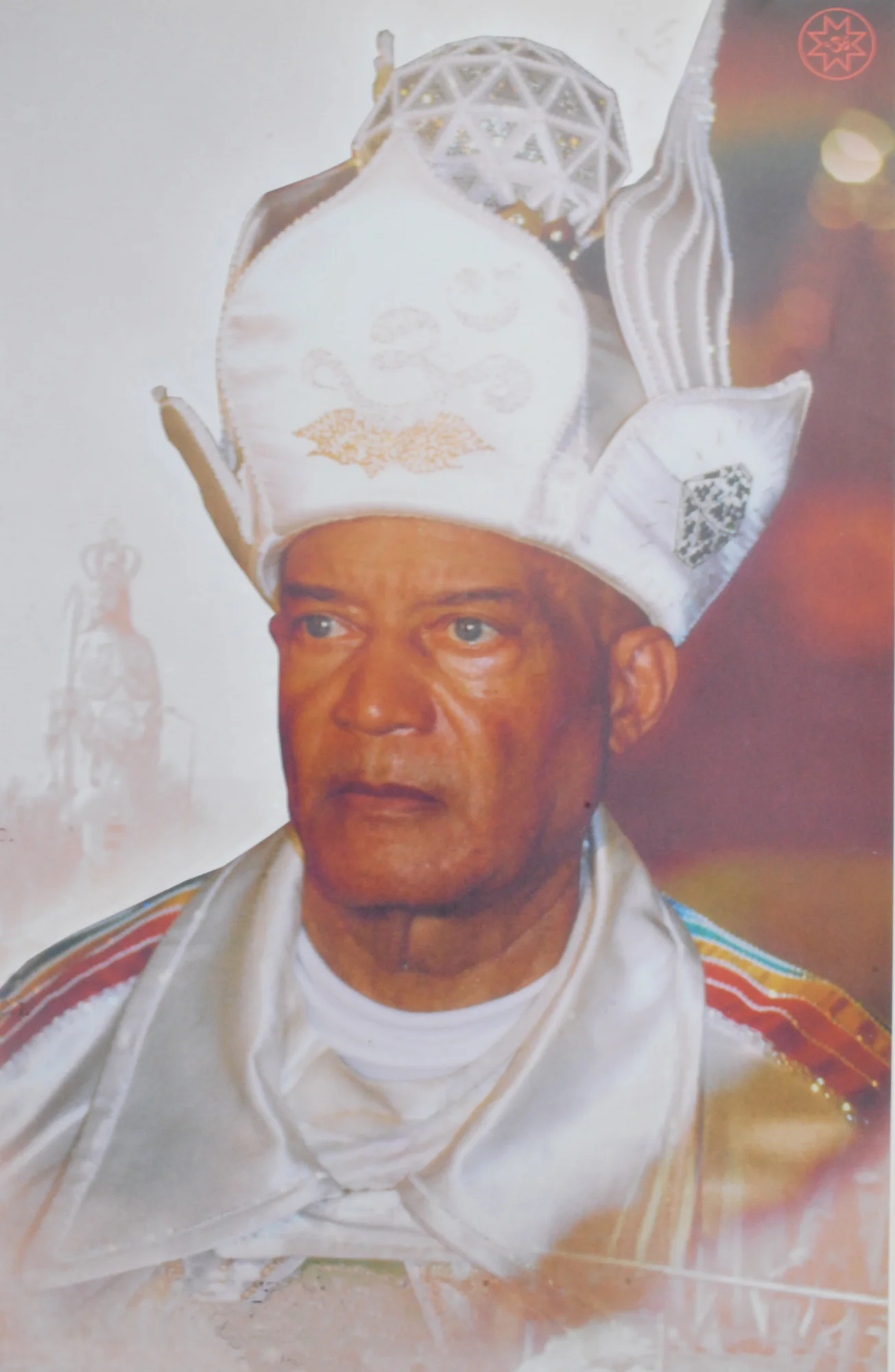
It is a great honour for me to open this 11th International Colloquium of Aumism, which welcomes all those who wish to help relieve humanity of the suffering caused by the many forms of violence. This colloquium, like the previous ones, owes its existence to His Holiness the Lord HAMSAH MANARAH, the Founder of Aumism, the religion of peace and brotherhood.
His Teaching and His example allow every person of goodwill, whatever their path, to take the helm of their life again in a concrete way, for their own good and for the common good. A hope for all those who wish to contribute to a positive change, which alone can lead to the happiness of living together better.
The wisdom of His Holiness the Lord HAMSAH MANARAH brings this new wine to help our humanity leave the Age of violence and suffering, called the Iron Age in Aumism, and build the New Era, the Golden Age, turned towards love of one’s neighbour, service, solidarity and sharing.
Ending violence is a priority, an urgent need in the face of the threats hanging over the life of our planet. Violence, visible or disguised, physical or symbolic, takes many forms: the armed violence of wars, and political, economic, social, communal and psychological violence. It is linked to a seizure of power and claims to resolve a conflict through the submission of the opposing side. Violence turns the other into an object.
In daily life, for example, it can affect every section of the population, locking certain individuals into a so-called inferiority (sexism, racism, etc.). Aggressive behaviour is found in every setting: sport, work, school… As Aeschylus wrote: “Violence, as it flourishes, produces an ear of misfortune that yields only a harvest of tears.”
The consequences are both physical and psychological: acute or chronic health problems, social isolation, depression, absenteeism at work, escape into alcohol, drugs or medication, dropping out of school, delinquency, etc. For children and adolescents there is also the risk of reproducing in adulthood the behaviour of victims or aggressors, as the case may be.
Moreover, the world constantly feeds on the ferment of violence present everywhere in video games: “How many did you kill today?” With the largest audience, television and its endlessly repeated stream of images saturate the collective unconscious. We can see it: all violence that weakens individuals weakens society and hinders the future on both the individual and the collective level. Ending violence is a crucial issue in everyone’s eyes. But it is often a long and chaotic process, with the methods traditionally used by men “whose only recognised law is that of force” (Gandhi).
Fortunately, there is progress, a growing awareness that makes people more sensitive to the harm caused by violence of every kind. Even if there is still much to do, respect for the rights of men, women, children and today of animals is more and more often invoked in the face of violence. Initiatives for dialogue, solidarity and reconciliation are making headway against all odds.
“We are currently,” says the Lord HAMSAH MANARAH, “in a pivotal period in which we are witnessing the last convulsions of the Iron Age and its violence, while the first glimmers of the dawning Golden Age are beginning to illuminate consciences.”[1]
That is why, at the beginning of the New Era, the rising aspiration to peace still coexists with the stubborn divisions of the past. So everyone must, with all their strength, take the side of love so that the world may escape the cycle of hatred. And this colloquium helps us consider solutions for reducing violence in the world through a true inner alchemy, as His Holiness the Lord HAMSAH MANARAH teaches.
It is no longer a matter of blaming God for our misfortunes, but of recognising, individually and collectively, that we are all more or less responsible for what happens in our society, and that we must change our mentality and our behaviour in order to reduce the world’s misery. This change is possible if we become aware that the whole of humanity is one and the same great family. Aumism reminds us of what many mystics and spiritual guides have taught for millennia: we are in the ONE through multiplicity, because the Divine is present in each person, whatever our differences.
“To feel different and separate,” says the Lord HAMSAH MANARAH, “is to create a gulf between oneself and humanity; it is to divide human beings into different classes, castes, countries, religions and races; it is to see appearances while forgetting that God is in each one; it is to give oneself the precious pretext of saying: ‘I am not the other, so I can do anything to him.’”[2]
But “if we feel that the other is a part of ourselves, how could we hate him lastingly, detest him, wish for his death? By attacking the other, we would therefore be attacking ourselves.”[3] Let us make clear that the non-violent attitude is not flight or cowardice; it requires strength.
In the footsteps of Gandhi, Martin Luther King and Nelson Mandela, some people today fight without weapons for respect for human rights. Among others, let us mention the struggles for greater justice and freedom of Medha Patkar, Irom Sharmila and the writer Arundhati Roy in India. Closer to home, those of the pastor Jean-Paul Nunez and the Franciscan father Alain Richard.
Mental resistance to violence is expressed in the reaction of the man who wrote, after losing his wife in Paris in the attack of 13 November 2015: “You will not have my hatred.”
His Holiness the Lord HAMSAH MANARAH teaches Love in Strength, the title of one of His works. The first act of courage is to stand alone before one’s conscience, agreeing to see within oneself the seeds of violence, in order to defuse the thoughts that each of us sends, consciously or unconsciously, into the collective reservoir of humanity. Identifying with the Supreme Self, with the Divine, which is Love, allows us to get out of the rut of revenge and to cultivate the Peace of the heart nourished by forgiveness, “the adornment of the soldier of Peace” according to Gandhi, and not a peace written in the ink of human blood.
“To put a definitive end to hatred in all its forms,” says the Lord HAMSAH MANARAH, “one must above all restore one’s Unity with the inner God present in oneself and in each one.
The ideal of Unity is therefore the royal road that allows us to free ourselves from the pressures of hatred, violence and intolerance.”[4]
And in rediscovering this feeling of unity, we rediscover the feeling of unity with all that lives, for the Divine is the Energy of Life present in the whole of Creation.
During this colloquium, points of the Aumist Teaching will be developed showing that it is possible to end violence in order to live together better, whether one is a believer or an atheist.
- The essential thing to begin with is to cultivate non-violence within oneself. Some think that violence exists only in others. Others are convinced that when external circumstances change, then and only then will they be able to transform themselves. Nothing could be further from reality. We will see in this lecture that cultivating non-violence and kindness towards oneself and others is nothing more nor less than the personal decision “to be the change we wish to see in the world”, in Gandhi’s words. The means of achieving this, each at their own pace, will be discussed, leading to the capacity to forgive and to develop more tolerance, in order to relieve our humanity of a heavy burden of wars and divisions still inscribed at the heart of our history.
- This brings us back to the problem of the religious oppositions at work in wars, and of the fanaticism expressed in acts of extreme violence such as terrorist attacks. The essential question, “how can we end religious intolerance?”, will therefore be the subject of the following lecture. It will look at Aumism’s contribution to helping religions rediscover the feeling of brotherhood, which alone can foster the peaceful coexistence of their differences. This reconciliation is essential, for putting an end to crimes committed in the name of God is the condition for planetary peace.
- Moreover, to live together better on the planet, another priority stands out: ending violence against nature. The consumerist way of life causes both inequality and the destruction of biodiversity. Every year, for example, 13 million hectares of forest are destroyed, although forests are indispensable to life. We are now becoming aware that human activity driven by short-term interests is threatening the planet. The deep understanding of the interdependence between human beings and the kingdoms of nature, which lies at the foundation of Aumist ecology, urges us to change the way we look at our environment and to mobilise in extremis to safeguard it.
This requires urging science to change its paradigm. If man wants to live in peace lastingly, of all the sciences he must learn, the main one is that of living while doing as little harm and as much good as possible. This will be dealt with in the lecture entitled “Reconciling science and conscience”, recalling Rabelais’s phrase: “Science without conscience is but the ruin of the soul.” Science must get out of its obsession with wanting to replace God (transhumanism is today a fine example of a creation that may escape its creator!). In Aumism, the science of the Golden Age is inseparable from a moral and spiritual ethic; it serves life on every level.
Lastly, we will address a theme that concerns us at every moment, “Thinking better to live together better”, with keys that everyone can use in daily life to get out of the currents of hatred, violence or fatalism that are accomplices of war. Thanks to knowledge of the mechanism of creative thought, we can more easily foster both our own happiness and that of others, and so contribute to peace.
Peace will be able to settle lastingly if human beings no longer let their minds take the helm of their existence, but at last take the helm of their minds. Our deepest wish is that each person may become a true inner alchemist, destroying the roots of ignorance in order to shed new light on our humanity through the marriage of Love and Knowledge. Let us stop being “double” agents, wanting Peace while continuing to plant time bombs in our everyday lives, for we are all responsible for what happens in the world. We cannot stand by with folded arms. This colloquium helps us consider solutions and above all share them as widely as possible, in order to foster the transmutation of hostility into Love.
To close, I will give the floor to His Holiness the Lord HAMSAH MANARAH:
“UNITY leads to LOVE of the whole world; hatred brings only divisions, wars, quarrels and crimes.”[5]
“May you change your outlook on the future and unite around this Ideal of Unity, reconciliation, forgiveness and international peace. Each person is responsible for the future.”[6]
May the desire for peace, love and light enlighten and guide each person in their choice.
*******
V. Bhima
[1] Le Yoga de l’Amour dans la Force, p. 208.
[2] Vers un Âge d’Or d’Unité, p. 192.
[3] Ibid., p. 186.
[4] Ibid., p. 186.
[5] Vers un Âge d’Or d’Unité, p. 188.
[6] Ibid.