SYMPOSIUMS
LECTURE
No. 2 – TOWARDS RELIGIOUS TOLERANCE
No. 2 – TOWARDS RELIGIOUS TOLERANCE
Since the dawn of time, humanity has been in search of the Creator, the Absolute, the Divine, sensing that a Higher Force presides over the perfect workings of nature and the cosmos.
Down the ages and on every continent, the message of inspired Envoys gave birth to the great religions and spiritual traditions, answering humanity’s aspiration to Transcendence.
With their practices, rites and dogmas, each brings its own particular light on the notion of the Divine, while advocating common values such as love, forgiveness and compassion.
Yet we must acknowledge that what should have united people around the sacred has often been a source of intolerance and division, leading to the wars of religion that have marked history.
Even today, we see that many conflicts have a religious dimension.
That is why, in this talk, we will address the importance of tolerance, defined as “respect, acceptance and appreciation of the rich diversity of our world’s cultures, our forms of expression and ways of being human”, and regarded as a universal requirement for peace and social harmony (UNESCO, Declaration of Principles on Tolerance, 16 November 1995).
To foster the conditions for lasting peace in a world in crisis, torn by so many divisions, it is becoming urgent to restore the primary function of all rightly understood spirituality: to connect human beings with God, and also with one another, in tolerance and mutual respect.
This talk therefore has three parts:
1) Religions in today’s conflicts,
2) The importance of interreligious dialogue for building bridges,
3) The Aumist experience of tolerance.
I – RELIGIONS AND TODAY’S CONFLICTS
In recent decades, many countries on every continent have been affected by violence with a religious dimension: for example Northern Ireland, the Middle East, India, Pakistan, China, Nigeria, Burma…
Today, the war in the Middle East illustrates the complexity of contemporary conflicts.
Behind the economic, energy and territorial stakes lie ancient religious fault lines, often stirred up by fundamentalism.
They show how religion, when it is exploited, can amplify international tensions.
Feeding the unbearable suffering of war, divisions, especially religious ones, challenge us deeply.
Behind the fighting, entire populations are suffering: broken families, forced exile, irreparable losses.
Moreover, in our globalised societies, no conflict remains isolated: its repercussions cross borders, affecting the global economic, social and human balance.
In the face of this reality, efforts towards peace can no longer be regarded as optional, but as an absolute necessity. It is a planetary emergency.
This effort for peace requires a collective commitment but also a personal one. It does not concern political or religious leaders alone, but each one of us.
It calls for a change of mentality which, overcoming the desire for revenge and power, puts first the will to move beyond hatred and to settle conflicts without sinking into inhumanity.
This means restoring to spirituality its universal dimension: the one that brings together rather than divides, the one that reminds us that, behind the diversity of beliefs, there is a common aspiration to love and peace.
Fortunately, for several years now, women and men of every tradition have been working to bring religions closer together by opening themselves to dialogue, tolerance and peace.
II – BRIDGES BETWEEN TRADITIONS: INTERRELIGIOUS DIALOGUE
Interreligious dialogue is one of the most powerful levers for understanding and tolerance between peoples.
It is not a new idea, but since the last century it has gradually taken hold in people’s minds, to the point of becoming essential.
Here are a few landmarks, by no means exhaustive:
– In 1893, in Chicago, the visionary address of Swami Vivekananda opened the first World’s Parliament of Religions and gave a tremendous boost to interreligious encounters.
He reminded his audience that, despite their differences, the spiritual traditions can unite their voices for tolerance, peace and justice, in the service of the planet.
– In 1964, Pope Paul VI set up the Secretariat for Non-Christians, which later became the Pontifical Council for Interreligious Dialogue.
– In 1986, in Assisi, in a historic gesture, John Paul II brought together the great religions for a World Day of Prayer for Peace.
– In 1995, UNESCO launched a Programme for Interreligious Dialogue, an integral part of intercultural dialogue, to promote encounters between religious and humanist traditions.
Today, interreligious dialogue takes various forms:
– Gatherings open to all traditions, such as the Parliament of the World’s Religions.
– Round tables between religious leaders, such as the Conference of Religious Leaders in France.
– Local initiatives run by associations in which believers of various religions come together for joint projects, solidarity work and shared prayer.
– Inter-convictional meetings, where believers and non-believers talk together in order to understand one another better.
Despite the divisions, these initiatives reflect a positive shift in mentalities towards greater tolerance. This is a genuine opening towards peace.
With this in mind, let us now turn to the Aumist experience of tolerance.
III – THE AUMIST EXPERIENCE OF TOLERANCE
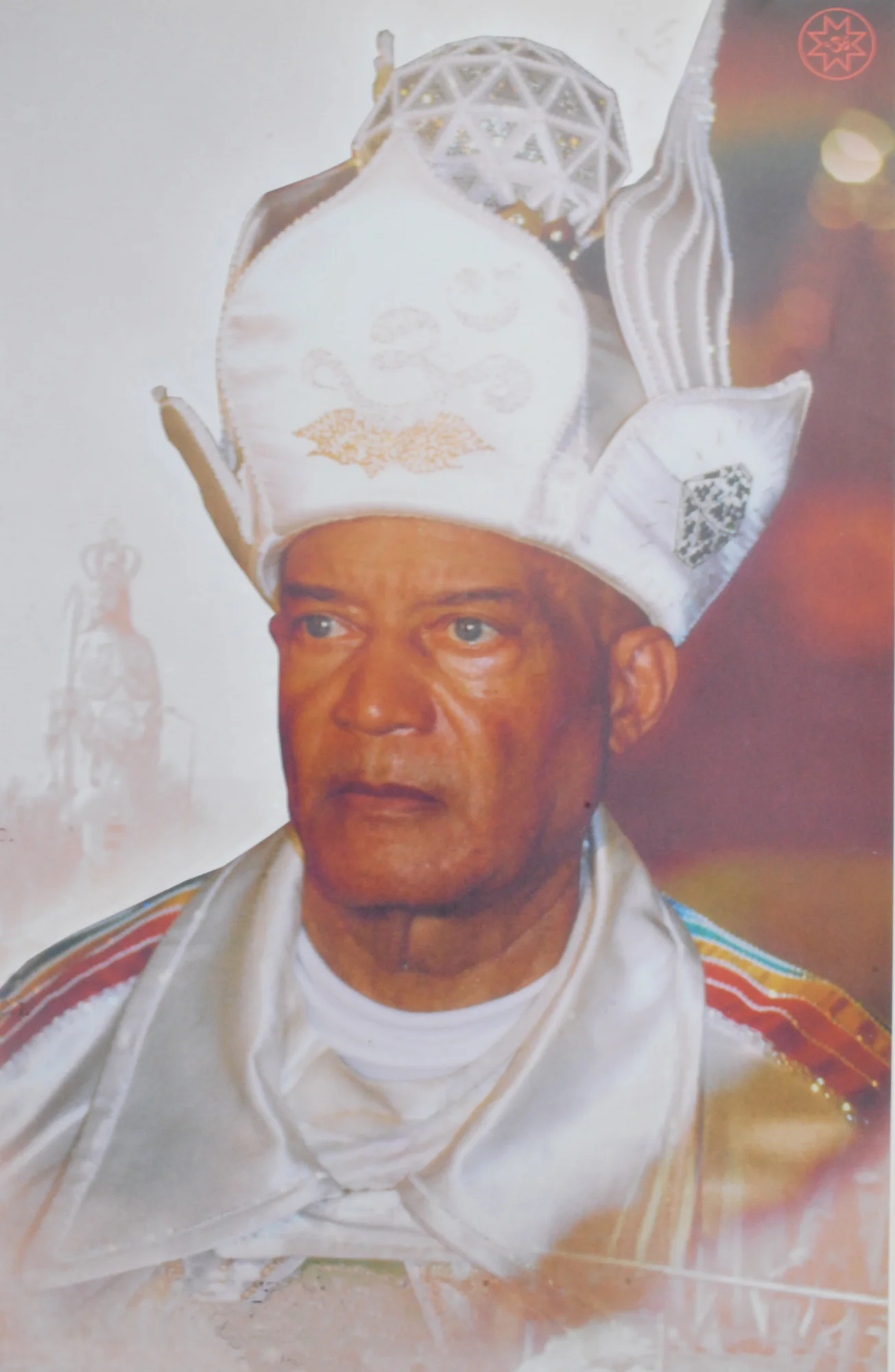
“Hatred of difference gives birth to intolerance,” says Lord HAMSAH MANARAH. [1]
In the face of the violence generated by intolerance, Aumism therefore offers a spiritual path founded on the acceptance of and respect for differences.
Unity in respect for the world’s religions
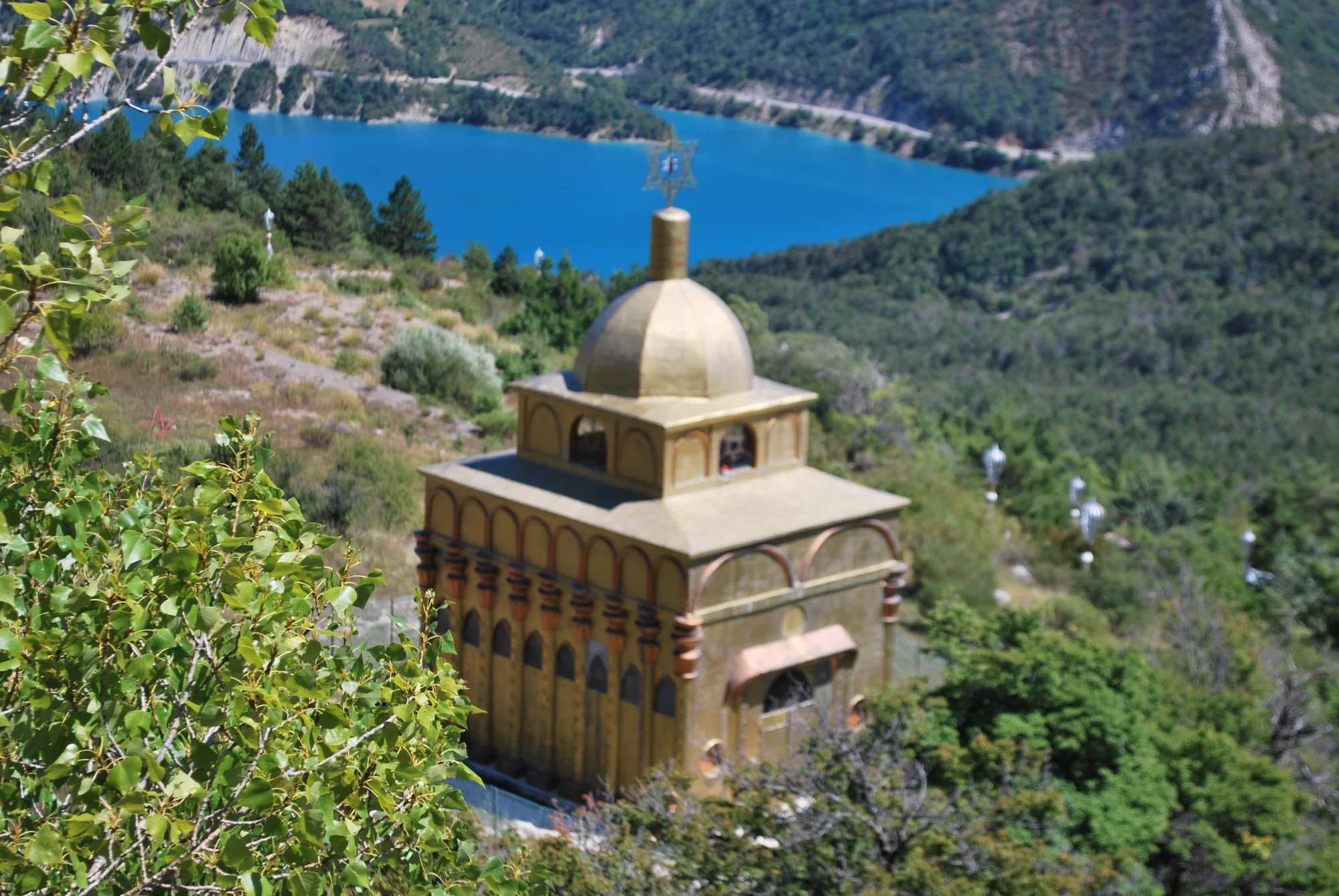
On His initiatory journey, Lord HAMSAH MANARAH experienced divine Unity at the heart of the traditions of West and East, where He met many Sages and received numerous initiations. This spiritual experience led Him to found, in the Alpes de Haute-Provence, the ecumenical monastery of the Mandarom, where temples and statues of the different traditions are brought together, symbolising, within one whole, respect for their specific character. You will be able to discover this monastery, unique in the world, during the screening of the film Sur les Pas du Messie (In the Footsteps of the Messiah).
Unity in respect for the different religions does not rest on erasing what is particular to each, but on recognising it with goodwill. Everyone is free to worship God according to their own understanding. “There are many paths leading to the fountain of eternal Bliss,” says Ramakrishna. “Each of the world’s religions is one of these paths.” There can be no competition: each religion is a spiritual quest offering its own practices to reach the common goal, fusion in God.
This freedom, however, goes hand in hand with the need to welcome fraternally the other messages of the Divine that spring from the same source of Light: it is logical to accept, respect and honour the diversity of the aspects of the Divine that have been revealed to humanity over time.
The only dogma of Aumism is that of the Unity of the Faces of GOD. It implies religious tolerance and can be summed up as follows: “God is One, whatever the Name by which He is called”; “It is human beings who divide Him.” [2]
Humanity must now leave behind the violence born of hatred of differences and strive towards a new Age called the Golden Age: “Society must be rebuilt around the values of Tolerance, Unity, Brotherhood and Solidarity.” [3]
It is a matter of serving this change of mentality, striving to contribute through one’s own effort to the awakening of a planetary consciousness that is ever more united and fraternal.
This new Era does not abolish existing religions; it invites them to recognise one another as different expressions of the same God.
In Aumism, this spiritual ideal is represented by the symbol of the Hexamide: a six-edged pyramid in the colours of the rainbow, symbolising the religious currents of the Earth, which in the Golden Age recover their unity by converging and merging in the white light of Synthesis of the OM.
In practice:
Being an Aumist does not require giving up one’s original faith: “All religions are worthy of respect, provided that they help people take charge of themselves and respect certain moral values.” [4]
Studying the sacred texts helps us understand our own religion better and highlights what it shares with others:
– The search for the Divine: they answer the spiritual aspiration of human beings.
– A common ethic and common values: love of one’s neighbour, kindness, forgiveness, sincerity, justice, humility, purity…
– The presence of the Divine in human beings: in Christianity, “The kingdom of God is within you”; in Hinduism, the Atman, the individual soul, is identical to Brahman; in Buddhism, “The Buddha nature lies dormant in every being”; in Sufism, “He who knows himself knows his Lord…”
– All of them offer the same goal: even if it is sometimes forgotten or veiled, beyond the dogmas the ultimate goal is Union with the Divine.
Religious tolerance in Aumism is expressed in its spiritual practices.
Lord HAMSAH MANARAH offers individual or collective meditations with evocative titles such as:
– The “Meditation on the Unity of the Faces of GOD”,
– The “Meditation on the Unity of Religions” [5],
– And the meditation “For the Unity of Nations” [6], shared during this symposium.
The Divine under its different Names is celebrated in unity with the believers of each tradition: for example at Christmas or Easter with Christians, at Wesak with Buddhists, and so on.
To close this symposium, you will also hear the sacred songs of the Aumist choir, inspired by many traditions. Each tradition can thus feel respected.
These practices develop the feeling of Unity and radiate an energy of tolerance and peace across the planet. They lead us to think sincerely: “I respect and love the pilgrims of all traditions, whatever their way of seeking God. May this feeling of Unity be shared by all the religious egregores, so that the ideal of bringing the religions of the Earth closer together may progress.” [7]
Respect for all human beings with their differences
“Accept others in their difference, for unity is not the crushing of those who do not think as you do, but the reconciliation of all those who think differently, while uniting their efforts for a better world.” (Une Loi pour détruire le Mal, p. 427)
In Aumism, as in other traditions, the Divine, also called the “Supreme Self”, is present in every human being, regardless of their culture, religion or history.
We are not separate from God. The “Supreme Self” within us is a luminous, eternal presence, beyond our conditioning.
This perspective changes our relationships. When we become aware of the Supreme Self within ourselves, we also begin to recognise it in others, even in those who at first seem different, distant or even opposed to us. Differences are then seen as so many riches that allow us to overcome the divides that separate us. We stop seeing others through the filters of origin, belief and educational or social conditioning. This helps us to move beyond discrimination, whether sexist prejudice (women as well as men take on responsibilities, lead prayers and officiate at sacraments) or racist prejudice (spiritual seekers are welcomed whatever their origin). Nor is there any prejudice against atheists, since God is present in every being, even when He is not recognised.
This acceptance of differences is necessary for the pacification of the world: “People will not know peace and harmony until they have developed greater respect for the human value in their neighbour,” Lord HAMSAH MANARAH constantly reminds us. “This respect must be expressed as tolerance.” [8]
OM, the prayer that unites
“It is through union in the OM that the return to Unity takes place. We must not forget that each religion, however imperfect, emanates from the Cosmic OM, which is from all eternity and which people call by various Names.” [9]
The term Aumism is derived from the primordial sound AUM, the sacred Word, creator of the Universe.
The Sound OM or AUM is found in Hinduism, Buddhism and Jainism… but also in other traditions through AMEN and AMIN.
Chanting the OM together means transcending cultural and religious barriers.
It means gaining access to a common sacred language, whatever each person’s beliefs.
The sound OM is the link between all traditions, a common divine vibration compatible with the prayers specific to each one.
The vibration of the OM, sent out with a pure intention, radiates beyond the person who utters it: it touches consciences, calms invisible tensions and supports suffering souls.
Prayer through the OM is not limited to a ritual act; it is a way of acting in Consciousness for Peace in the World.
It reminds us that Unity is not a concept, but an experience lived in the breath, in the heart, in the shared vibration.
IN SUMMARY
Along this journey, we have seen how religions, which should unite people around the sacred, have often been turned into sources of division.
Yet, beyond conflicts and oppositions, voices are being raised in every religious current for dialogue, for encounters between traditions, for peace.
Aumism, the Universal Religion, through its message of Unity, reminds us that behind every Name and every tradition there is one and the same Divine Presence. It is not a matter of replacing other religions with one religion, but of opening a common space where everyone can pray according to their own sensitivity, meet others without fear and walk with them in mutual tolerance.
In daily life, recognising the Divine in oneself and in others is also a way of working for tolerance, the kind that cannot be decreed but is felt in the way we look at others, in respect, compassion and shared prayer.
Religious tolerance is the hope of a humanity reconciled with itself and with the Divine, in which the primordial OM, through its sacred vibration that soothes, reconciles and raises the collective consciousness, resounds like a song of Peace, transcending the traditions without erasing them, and connecting souls.
“To eliminate the seeds of hatred and intolerance,” says Lord HAMSAH MANARAH,
“pour out a flood of seeds of Light of the Sound OM.
This work of invisible alchemy will touch human beings and the whole of nature,
and so you will take part in destroying the collective monster of hatred.” [10]
V. Vidhatri
*******
[1] Vers un Âge d’Or d’Unité, p. 552
[2] Le Flambeau d’Unité, pp. 418 and 421
[3] Vers un Âge d’Or d’Unité, p. 370
[4] Le Flambeau d’Unité, p. 65
[5] Le Flambeau d’Unité, pp. 417 and 420
[6] La Loi d’Évolution des Âmes, p. 488
[7] Le Flambeau d’Unité, p. 421
[8] Yoga et Sagesse, p. 257
[9] L’Aumisme, La Doctrine de l’Âge d’Or, p. 35
[10] Vers un Âge d’Or d’Unité, p. 185