SYMPOSIUMS
LECTURE
No. 3 – NON-VIOLENCE TOWARDS OTHERS – The importance of education
NON-VIOLENCE TOWARDS OTHERS: The importance of education
SUMMARY
“Non-violence towards others: the importance of education”. From the earliest age, the experience of love without laxity, the example of adults, dialogue and openness to the world prepare the child for good communication with others, for respect of the rules that make life in society easier, and for healthy reactions to conflict. Respect for the Divine in each person, which is first of all respect for each person’s human worth, serves as the foundation for the feeling of solidarity that will develop at the child’s own pace.
TALK
We cannot fail to note the scale of the problems of violence on every continent. Growing awareness has led many countries to set up think tanks to look for solutions to the various forms of violence that worry our contemporaries. In France, for example, town councils increasingly work with sociologists for this purpose. This work is of course indispensable, but it is not enough. It is from the earliest age, within the family and the immediate environment, that the child will absorb the violent or non-violent attitude he will later show as a teenager and an adult, fostering or disturbing social harmony.
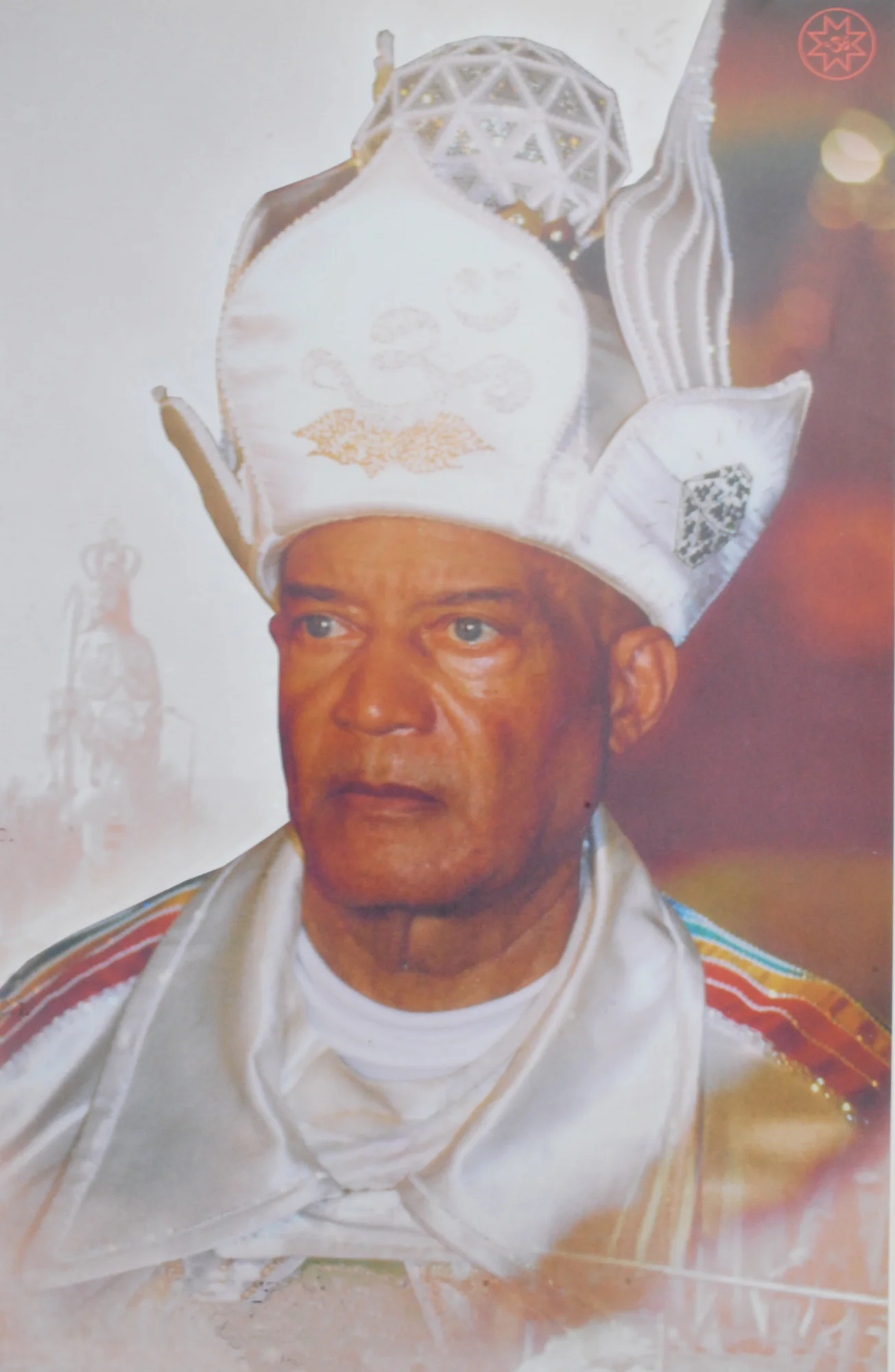
His Holiness Lord HAMSAH MANARAH, who came to make more Love reign on Earth, gives us precious help through His example and His Teaching. The Aumist Religion addresses this delicate problem of violence and offers effective answers for turning a child into a fully responsible adult who is a factor of peace.
In this talk we will look at:
I – THE NEED FOR A WELL-UNDERSTOOD NON-VIOLENCE TOWARDS CHILDREN
II – THE NEED FOR PARENTS’ EXAMPLE AND FOR DIALOGUE
III – THE NEED FOR OPENNESS TO OTHERS
I – THE NEED FOR A WELL-UNDERSTOOD NON-VIOLENCE TOWARDS CHILDREN
Being a parent is not easy; it is a job we do not learn at school. We become parents with our own history, which may include wounds, weaknesses and gaps. But whatever our past, we can work at becoming better in order to accompany our children as well as possible. Without waiting to be perfect, the point is to become aware of the behaviours that could harm our children and to set about correcting them. You do not need a vast fortune or a prestigious social rank to face up to your responsibilities as an educator. What matters is to create a climate of trust from the start, for the child’s experience will mark him for life.
In Le Yoga de la Vie Pratique, one of His first books, Lord HAMSAH MANARAH explains: “The child’s psyche is comparable both to photographic film and to the tape of a tape recorder. It records and stores everything it sees and hears. Every image, every thought, every idea impresses it, is recorded and leaves traces in its unconscious. Thus the first impressions form the foundation of the personality and condition the child’s future.” (p. 268)
A mistreated child lives from the outset in a hostile world, and if he accumulates feelings of anguish, injustice, revolt and resentment, he runs a greater risk than others of becoming violent.
“Parents,” says Lord HAMSAH MANARAH, “must respect their offspring and refrain from any act of cruelty or sadism towards them.” (Le Yoga de la Vie Pratique, p. 269)
By ensuring that the child has the healthiest possible life and a balanced timetable that respects his needs for food and sleep and the rhythms of his age for learning, parents show respect for the child. By accepting the child as he is, with his qualities to develop and his faults to overcome, his personal tastes and his originality, parents give him the emotional security and self-confidence that foster good relationships with others. Systematically belittling him, making him feel guilty or forcing him into a mould amounts to doing him violence, breaking his enthusiasm and provoking his aggressiveness. Let us also beware of possessiveness, which imprisons the child. “Children must evolve towards their own destiny,” says His Holiness Lord HAMSAH MANARAH. “We have allowed them to have a vehicle of flesh, but they are not our property.” (L’Aumisme, la Doctrine de l’Âge d’Or, p. 237)
Kahlil Gibran writes in The Prophet: “Your children are not your children. They are the sons and daughters of Life’s longing for itself.”
This non-violent education has nothing to do with the laxity that marks parents’ abdication. Clear-sighted love develops the child’s strength, courage, will and tenacity, which will help him face the trials of life. Let us note that it is often weakness that breeds aggressiveness.
Lord HAMSAH MANARAH insists: “Do not forget to point out to the child that he must demand a great deal of himself. Does not the wisdom of nations say, ‘Heaven helps those who help themselves’?” (Le Yoga de la Vie Pratique, p. 270) His Holiness Lord HAMSAH MANARAH highlights the harm done by laxity, which removes the rules and limits necessary for social life, by quoting with humour the advice given by the Seattle police in the USA under the title “How to make your children into good delinquents”. The text begins: “From infancy, give the child everything he wants. That way he will grow up thinking that the whole world owes him everything!” (Le Yoga de l’Amour dans la Force, p. 241)
Parents and educators have the difficult task of seeking, from the start, a balance between non-violence and firmness, to help the child build himself in confidence. But their role does not end there: they are their children’s first role models.
II – THE NEED FOR PARENTS’ EXAMPLE AND FOR DIALOGUE
1) Example
Lord HAMSAH MANARAH declares: “Example is the most persuasive form of eloquence.” (Le Yoga de l’Amour dans la Force, p. 243)
Indeed, adults who merely apply the method of “do as I say, not as I do” forget that above all the child imitates them. If their moralising words contradict their behaviour, sooner or later they will meet with the reproaches, even the contempt, of those to whom they thought they were teaching values without putting them into practice. Good example from adults at every level of society is sorely lacking today, and this partly explains the drift of young people who need guides worthy of esteem. Of course, setting an example takes more effort than making speeches. It requires a strong commitment from parents and educators, who have to transform themselves and progress. The techniques of work on oneself offered in the books of His Holiness Lord HAMSAH MANARAH, which allow us to see ourselves as we are, to cut ourselves off from the past and to master our emotions, can contribute to parents’ “self-education” and give them the chance of a fresh start. To maintain a peaceful climate within the family, parents will first strive to combat whatever may provoke violent reactions, whether physical, verbal or merely mental: impatience, intolerance, anger, jealousy, the desire for revenge, the taste for power, and a focus on the faults of others.
Lord HAMSAH MANARAH writes: “Hatred between parents rebounds on the children, who catch the virus of parental hatred and pass it on to future generations through a bad example from childhood.” (Vers un Âge d’Or d’Unité, p. 179)
It is important that adults know how to put into practice the values they wish to instil in the child:
– What is the use of preaching respect for animals if we chase away with a broom the dog that puts its muddy paws on the clean floor?
– What is the use of lecturing a little brawler if, a moment later, we are ready to come to blows with a driver who has grazed our bumper?
– What is the use of pontificating on Human Rights if we pull a face at the little immigrant friend our son brings home?
The best way to pass on to the child the values that counterbalance violence is to live them alongside him: for example, by never excluding, in word or deed, those who are different in culture, religion, sex, race, age, disability, lifestyle and so on.
Lord HAMSAH MANARAH tells us: “Having enough to clothe and feed oneself, to raise one’s children and ensure them a better future is a noble and healthy ambition. Educating them in tolerance, respect for each person, true love and mutual help is giving them the character that will make society better.” (Vers un Âge d’Or d’Unité, p. 143)
For example, Aumist children brought up in respect for the Divine present in each person are as mischievous as all children, but they are not racist and they respect all religions. This is simply due to their parents’ example, for there is no Aumist school or catechism.
2) Dialogue
If the child sees consistency between adults’ principles and their behaviour, he feels esteem and trust, and this encourages dialogue. It is important to give each child the opportunity to express his opinion and his feelings. Listening to him and letting him hear other points of view proves to him that we are interested in him and that he has his place. Conflicts that arise within the family and among siblings can thus be settled more easily.
Dialogue helps the child to face the violence that is everywhere in our society:
– family events (divorce, unsuspected abuse);
– social phenomena (exclusion, delinquency, assaults, crimes);
– violence on television, and so on.
Dialogue helps the child to face the physical and mental violence that affects him directly, whether he is its witness, its perpetrator or its victim, for example at school or in the street:
– if the child is the victim, the parents will teach him to forgive and to make peace, but also to know how to defend himself next time;
– if he is the aggressor, they will teach him to admit his wrongs, to face up to his own violence, to forgive himself, to ask for forgiveness, to make amends and not to do it again.
In all cases, educators can suggest that girls and boys take up a sport or a martial art to develop self-confidence and transmute aggressiveness.
Gradually, parents can also teach their child mental attitudes that are beneficial for him and those around him. Little by little, children will learn to cultivate positive thoughts and thoughts of love, and to respect the Divine in themselves and in others.
The relationship with a teenager is easier if the habit of dialogue with adults is formed very early. By keeping up listening and dialogue, parents help their children through crises. Even if no precise answers can be found to the problems encountered, and even if suffering is sometimes inevitable, the parents’ presence, open-mindedness and love protect against shocks that would be too violent.
III – THE NEED FOR OPENNESS TO OTHERS
Non-violence develops through our communication with others: children, colleagues, friends and neighbours.
Openness to others begins in the family, where the first learning takes place between brothers and sisters: learning to respect differences of sex, age, character and physical and intellectual abilities, and learning to accept the qualities and faults of others.
For example, if a child who does very well at school crushes his brother who has difficulties at school, he may provoke an aggressive reaction. If, on the contrary, he respects and helps him, he will provoke a reaction of love. It is also in the family that we learn the politeness of the heart, courtesy and tact, which express attention to others.
The Lord tells us (Le Yoga de la Vie Pratique, p. 178): “Politeness must not be confused with affectation and showing off; it requires naturalness, simplicity and modesty. It is a factor of success that should not be neglected.”
For example, a teenager who wants to take his brother’s or sister’s place at the family computer by pushing them away will certainly start a quarrel; if he asks politely, it will probably lead to a negotiation. The experience of mutual respect in the family fosters good relations with others in society. For let us not forget that the role of parents and educators is also to help the child to leave the family. Outside, school plays a special role in openness to others by bringing together children of all races, classes, religions, opinions and characters; that is why there is no Aumist school. Everything that brings the child into contact with different visions of the world is an indispensable enrichment that generates non-violence, whether:
– through varied reading,
– through films and documentaries,
– through certain television programmes.
Exchanges, encounters, contrasting points of view, learning languages and, when means allow, travel help to overcome the fears and misunderstandings that are a source of violence. The aim is to give the child the best possible baggage so that he becomes a factor of Peace.
In conclusion, I will read you this quotation from Lord HAMSAH MANARAH (Le Yoga de la Vie Pratique, p. 277):
“Prepare your children to become knights of Universal Peace. This requires the cultivation of non-violence, the absence of racism, sympathy for all nations, respect for all beliefs and religions, the greatest tolerance, and Universal Love.”
Bibliography (works in French):
– Works by His Holiness Lord HAMSAH MANARAH