SYMPOSIUMS
LECTURE
No. 3 – ON EARTH, ONE PRIORITY: RECONCILIATION
No. 3 – ON EARTH, ONE PRIORITY: RECONCILIATION
The flood of violence in today’s world shows how urgently a change of mentality is needed, for if violence answers violence and hatred answers hatred, the result is self-destruction for the planet.
In the Aumist religion, reconciliation between human beings, the return to unity, lies at the foundation of the change that must bring back peace. The example of the compassion of His Holiness the Lord HAMSAH MANARAH and His Teaching show us the way of Unity in respect for differences. He came to Earth to help us free ourselves from the suffering that we ourselves feed through our divisions. He came to give everyone the means to welcome and restore peace within and around themselves, whether or not they believe in the existence of God or of a life after life.
“Accept others in their difference,” He says, “for unity is not the crushing of those who do not think as you do, but indeed the reconciliation of all those who think differently, while uniting their efforts for a better world.”[1]
In this talk, this necessary reconciliation will be presented around three poles:
I – Reconciliation between believers and atheists.
II – Reconciliation between believers of the different religions.
III – Reconciliation on the interpersonal level.
I – RECONCILIATION BETWEEN BELIEVERS AND ATHEISTS
In a society that multiplies divisions, some tend to set atheists and believers against each other in a caricatured way.
But to take up the thought of the academician and philosopher Jean-Luc Marion:
“The notion of atheism is a relative notion. One is always an atheist with regard to a certain conception of God. Everyone is an atheist. One can say that believers are atheists with regard to the representations of GOD that do not suit them. Someone who calls himself an atheist can be considered an atheist on one condition: he is an atheist with regard to this or that representation of God, because he thinks that the representations of God are not correct. So he is provisionally an atheist. And believers are regionally atheists as well.”
Working for reconciliation means considering what brings human beings together, whoever they may be.
Seeking the meaning of life concerns all human beings
Individuals rarely question their beliefs, and not only their religious beliefs. Yet each of us could ask ourselves many questions: at what moment did I decide to believe what I believe? Should I judge a person by their beliefs or by their deeds? Human beings, in every latitude, show a fundamental need to think that things have a meaning. Discovering a meaning in one’s life is not a luxury, an accessory of modern man in the world; it is a fundamental existential need. All beings have spiritual concerns, insofar as they all try to understand the meaning of their life and to find their place in the world.
These fundamental questions concern the human condition:
“Who am I?
Did I exist before this life?
What will become of me after my death?
What have I come to do on this Earth?…”
For everyone, we find the unavoidable question of death and the afterlife. The answers differ, but whatever they may be, we can see ourselves as the fingers of a single hand, as the branches of the same trunk, directed towards the same Goal: lasting happiness, a world of Peace and Brotherhood, respectful of the planet and of those who live on it.
Developing more love concerns all human beings
Developing more love can reconcile men and women of goodwill from all sides. It is a duty for all the people of the Earth: “You have the right to deny the existence of God, but you have the duty to transform yourself, to improve yourself for the happiness of the world”,[2] the Lord HAMSAH MANARAH tells us.
This means wishing that all beings be happy and acting accordingly. Not out of moral constraint or duty, but through a right and real understanding that each person is inseparable from the other, whoever they may be. Neither the religious nor the secular are to be excluded. This love also means beginning by accepting oneself. Here again, even if the message has already been heard, when Jesus taught “Love your neighbour as yourself”, He was teaching something self-evident that is addressed to everyone. How can we love our neighbour if we hate ourselves? How can we project onto others what we do not feel within ourselves?
And then, this love does not concern only human beings, but all sentient beings, which includes the kingdoms of nature: our future is obviously linked to that of minerals, plants and animals, but also to that of the earth, water, sun and air. And this, whatever our beliefs. This very important point, reconciliation with nature, will be discussed tomorrow in another talk.
In Aumism, respect for the Divine present in each person implies respect for differences, the feeling of unity, and the need to pray and work for the reconciliation of peoples. But those who, without believing in God, believe in humanity and in humanist values also work towards mutual respect and brotherhood. Expressing together and with strength thoughts of love for all beings is a contribution to world peace within everyone’s reach, and no one has any monopoly on the following wish:
“May all sentient beings in the ten directions of space be free from enmity. May they be free from ill will, may they be rid of suffering. May they be happy: in the North, in the South, in the East, in the West, in the North-West, in the South-East, in the North-East, in the South-West, above and below.”[3]
II – RECONCILIATION BETWEEN BELIEVERS OF THE DIFFERENT RELIGIONS
Jean-Yves Leloup, writer, theologian and Orthodox priest, wrote a work entitled Deux maladies des yeux : athéisme et religion (“Two Diseases of the Eyes: Atheism and Religion”). He tells us: “Atheist literally means ‘without vision’, which is considered a disease. The atheist sees only the visible, but not the invisible. Daylight cannot be seen, yet it is what allows us to see all things. On the other hand, saying ‘God is this, God is that’ is also a disease of sight: it is idolatry.”
For Aumism, then, the task is to restore to religion its original vocation, which is to bind together. Its foundation is “the Unity of the Faces of God”, which reconciles all sincere believers.
The Principle of reconciliation: the Unity of the Faces of God
His Holiness the Lord HAMSAH MANARAH also tells us: “God is One; it is men who divide Him, peoples who split Him up, religions that wage war in His Name.”[4]
We read in the Bhagavad Gita: “Whatever the Name by which I am called, I remain the same.” Great Sages such as Ramakrishna and Vivekananda taught divine Unity. We need to think more in terms of One Energy, moved by a transcendent Consciousness, manifesting both through Form and beyond all form. And if God, in incarnating, takes on many Faces, it is to communicate to human beings, in different eras and different countries, His Message of Love and Wisdom. Religions emanate from the same source; they are different paths leading to the Absolute. Coming out of ignorance, studying their Teachings and engaging in dialogue help us discover their Unity. Everything must be done to eliminate sectarianism and fanaticism, the causes of so much violence, in order to reconcile the religions.
“How can a sincere religious person, whatever their doctrine, love God if, in their heart, they hate their Jewish brother, their Muslim or Hindu brother?”[5]
More than ever, Aumism’s call for the reconciliation of religions is relevant today. Its Founder writes: “Jews, Christians, Muslims, Hindus, Buddhists, yellow, white, black, love one another. Never kill your brothers in the name of God.”[6]
The symbol of Unity: the monastery of Mandarom
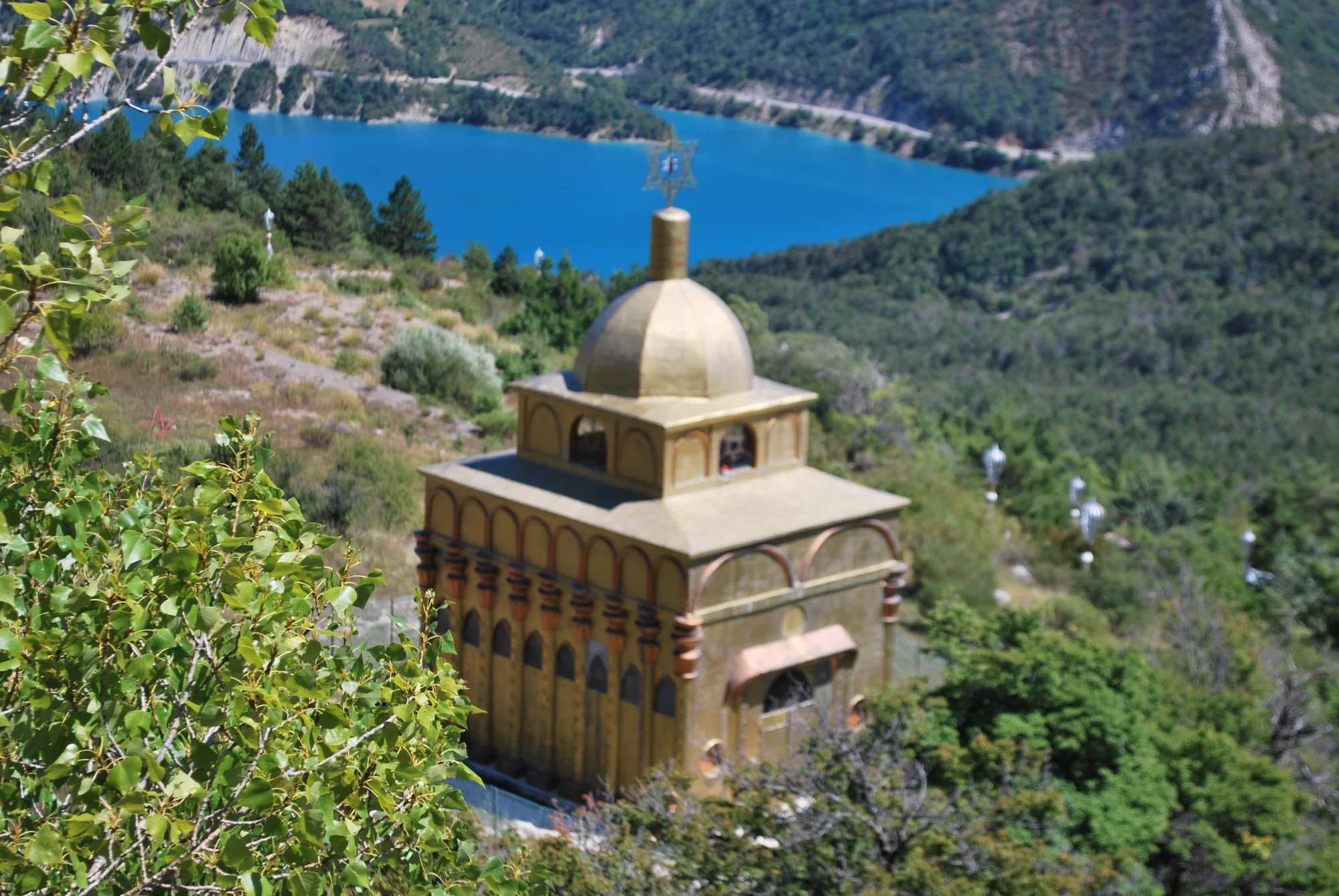
For this coming together of religions, peoples and nations, for the crystallisation of the Unity of the Faces of God on Earth, statues and temples related to the different religions have been built in the Holy City of Mandarom Shambhasalem.
“We wish,” says His Holiness the Lord HAMSAH MANARAH, “that everyone who comes to us may find, according to their deepest inclination, the revered aspect of the Absolute, the abstract symbol that speaks most to their heart.”[7]
In the Holy City one can see the Hexamid, symbol of the unity of religions. It is a pyramid with six edges in the colours of the rainbow, each representing a religious current. Each of these colours, each of these religions, merges into one and the same principle of Unity, in the white light of the OM, the creative Word, the first Name of God, which is the prayer of reconciliation and Unity.
And because human beings need symbols, because there had to be a symbol of the East known to the whole world and a symbol of the West known to all humanity, this reconciliation is crystallised at Mandarom by two statues facing each other: that of CHRIST and that of the BUDDHA. They mark the Union of East and West, of Love and Wisdom.
“The gaze of Christ merged with that of the Buddha is the symbol of tolerance and of the coming together of peoples,”[8] the Lord HAMSAH MANARAH tells us.
Finally, in accordance with His will, Aumists are working on an architectural and spiritual achievement of capital importance: the construction of the Temple Pyramid of the Unity of the Faces of GOD. As its name indicates, its architecture is characterised by a glass pyramid placed at the top of the building, in which all religions will be represented. All human beings wishing to meditate there will be welcomed, without discrimination of race or creed.
This Temple of Unity, a true talisman for the Planet, will be the guarantor of greater tolerance between peoples and religions, and will also symbolise the harmony restored between humanity and nature. This Temple Pyramid will give material form to the Ideal of Unity and Peace, and will express the noble ideal of a humanity reconciled around God present in all and in each. Every man or woman of goodwill can contribute to this achievement.
III – RECONCILIATION ON THE PERSONAL LEVEL
We often speak of the pollution of air, water and earth, but very little of the pollution of thoughts and of the mind. The illusions and limitations that still exist in our thoughts represent a real pollution that concerns each of us, believers or unbelievers. Our words and our deeds are the consequence of our conscious and unconscious thoughts, which is why it is important to maintain within ourselves a positive mental state of love, joy, forgiveness of offences, tolerance and kindness. Each of us here feels how difficult this goal is, and the Lord HAMSAH MANARAH invites us: “You must train yourselves to react positively, in order to undo, through a blessing, the poisoned arrow of the mental action of hatred.”[9]
A first step towards reconciliation: forgiving oneself
One of the fundamental keys that all religions speak of is forgiveness, even if few insist on forgiving oneself. “Serenity is won within oneself first, before wanting to see others already serene and filled with peace.”[10] Whatever our beliefs, nothing solid, lasting and fulfilling can be built on foundations of resentment and guilt. Quite simply because if we are not reconciled with ourselves, we remain closed to every manifestation of love and blind to every expression of wisdom. Forgiveness of oneself, regularly maintained, allows us to move forward, to dare to make mistakes, to start again, to try again, and to allow others to do the same.
The first step, the Lord tells us, is to forgive oneself in order to avoid self-punishment, without ever forgetting to evolve: “Do not ask GOD to have pity on you, but quite simply have pity on yourselves.”[11]
By lightening the conscience, forgiveness gives us the energy and the freedom, and therefore the duty, to transform ourselves and to set out again, while avoiding falling back into the same faults.
The second step towards reconciliation: forgiving others
Our capacity for evolution is directly linked to our capacity for forgiveness. Forgiveness grants us the joy of being freed from oppositions between people, from friend-enemy oppositions, from inner dualities, even if we do not believe in God. It avoids the cycle of revenge and hatred that blocks any possibility of change.
The second step is to turn towards those who have hurt us, who have hurt us the most, and say to them: “I forgive you all the harm done. May Light be in your mind, and Divine Love in your heart.”[12] Only this mental attitude of reconciliation matters, while paying attention to the effects it generates. And for those who seek God, forgiving oneself means being reconciled with one’s inner God. Forgiving others means recognising that God is in them.
The Lord Hamsah Manarah writes: “Love your neighbour as yourself, love the God who is in you, and you will pass from selfish love to Divine Love, for the happiness of your inner God.”[13] It is no longer a matter of trying to make amends for one’s own faults or to punish those of others while remaining turned towards the past. It is a matter of serving the divine plan. A plan that is at once the same for everyone, as a plan of love, and at the same time personal. It is a plan resolutely turned towards the future, a liberating plan because it is selfless. But like all plans, it requires will, continuity of will, perseverance, effort, patience and faith in its success.
Finally, because it is Love that makes forgiveness possible, Love that makes all reconciliations possible, and because Love can be trained, developed and brought to flower if it is nourished, let this prescription of His Holiness the Lord HAMSAH MANARAH for opening everyone’s heart be our conclusion:
“I am in unity with the LORD GOD ALL LOVE, present in me and in each one.
I love my parents as myself and wish them all the happiness in the world.
I love my enemies as myself and wish them all the happiness in the world.
I love all the men and women of the Earth as myself and wish each one all the happiness in the world.
I develop more and more the powerful force of Love for the whole world.
Today is the day of love, of sharing and of reconciliation with my neighbour.
I am in Unity with the LORD GOD ALL LOVE, bestowing His blessings on the whole Universe.”[14]
*******
[1] Une Loi pour détruire le Mal, p. 427.
[2] L’Unité des Visages de Dieu, p. 389.
[3] Le Yoga de l’Amour dans la Force, p. 59.
[4] La Loi d’Évolution des Âmes, p. 473.
[5] Le Flambeau d’Unité, p. 67.
[6] Yoga et Sagesse, p. 283.
[7] Mémoires d’un Yogi, p. 308.
[8] L’Unité des Visages de DIEU, p. 96.
[9] Vers un Âge d’Or d’Unité, p. 184.
[10] Une Loi pour détruire le Mal, p. 13.
[11] La Doctrine de l’Aumisme, p. 113.
[12] Vers un Âge d’Or d’Unité, pp. 177-178.
[13] Le Flambeau d’Unité, p. 344.
[14] Vers un Âge d’Or d’Unité, p. 153.