SYMPOSIUMS
LECTURE
No. 3 – PASSING ON A LOVE OF THE EARTH TO YOUNG PEOPLE
No. 3 – PASSING ON A LOVE OF THE EARTH TO YOUNG PEOPLE
Our planet Earth can only rejoice at the theme chosen for this 2020 Aumism conference: “Let us change to save the planet.” Why should the Earth rejoice? Quite simply because we are taking future generations into account, a long-term future. As Native American wisdom says, “We do not inherit the earth from our parents, we borrow it from our children.” It is a matter of leaving it to them in good condition, feeding them as well as possible, and ensuring their health and their existence.
We will speak here about agriculture, since it is my field of experience and I have been working the land for decades. Educating young people first requires setting them an example, so as to pass on our experience better. Yes, but how?
1. Change our state of mind
2. Change the way we farm
3. Teach young people to love the earth
Working for 20 years on old wheat varieties, we discovered a very great diversity: of height, of colour, bearded and beardless ears, resistance to downpours, cold, damp, drought and disease, diversity in the taste of the wheat grain, the smell of the flour, the smell and taste of the bread. This wealth of plant biodiversity, as a diversity of species, opened our minds to the biodiversity of the animal kingdom and that of the human kingdom. What a discovery! And, you see, it leads us to refocus on ourselves and become aware of our individual biodiversity, first through all the aspects of our personality, then of our humanity.
By simply loving ourselves as we are, without any complex, by accepting the polarity of our qualities and our faults, of positive and negative, joy and sadness, evolution and involution, light and shadow, life and death, knowing that everything is linked and inseparable, we can transmute the negative and develop the positive… This allows us to live serenely every day. And it allows us to blossom fully while respecting collective biodiversity, starting with the one we are experiencing right here during this conference, by accepting our different ways of thinking.
But how can we live this sense of well-being that accepting biodiversity gives us in an environment that is dying from lack of respect?
1 – CHANGE OUR STATE OF MIND
Intensive farming is still far more widespread than environmentally friendly agriculture. Plant biodiversity is not respected by the usual farming methods: for example, people want only wheat with very short straw and very long ears of the same colour for maximum yield. But global warming is challenging farmers: harvest dates are getting earlier and earlier, temperature differences from one day to the next are glaring, and all vegetation is suffering from this change.
Moreover, farmers still spread the residues of wars (nitrates and pesticides) on their land, and these end up in our tap water and in our food. For, you see, while the earth knows how to preserve the life forces of the seed, being the best granary (a place where grain is stored), it sends poisons back to those who poison it.
We are caught in a vicious circle:
– By using nitrates (explosive fertilisers), we boost the plants we sow but also the competing plants, so we use chemical weedkillers.
– Our crops, fed with chemical fertilisers, develop surface root systems and do not reach down deep to find the trace elements they need. Then fungus appears and attacks our crops, and we spread fungicides.
– With fertilisers, our crops ooze sap: aphids come to regulate the sap, and we use insecticide.
Since the 1960s, agriculture has been dependent on pesticides (active substances from war). Crops drugged to excess are forced to produce… but what food! The Earth, our nourishing mother, is polluted. Through run-off, the water is polluted. The polluted air we breathe overpowers the spring scents of nature. It is the source of very serious diseases among human beings.
We forget that the Earth is a living Being that responds to love as it does to violence. The “green revolution” that we were taught in my youth after the war of 1939-1945 made us into farm operators, there to exploit the land. While yields have soared, experience has shown that it has been at the expense of the quality of our food and of our physical and mental health. So together we are living through a constant involution, in contempt of nature. This division between man the predator and the land he exploits poses a serious threat to the planet. We must find our unity with the earth again.
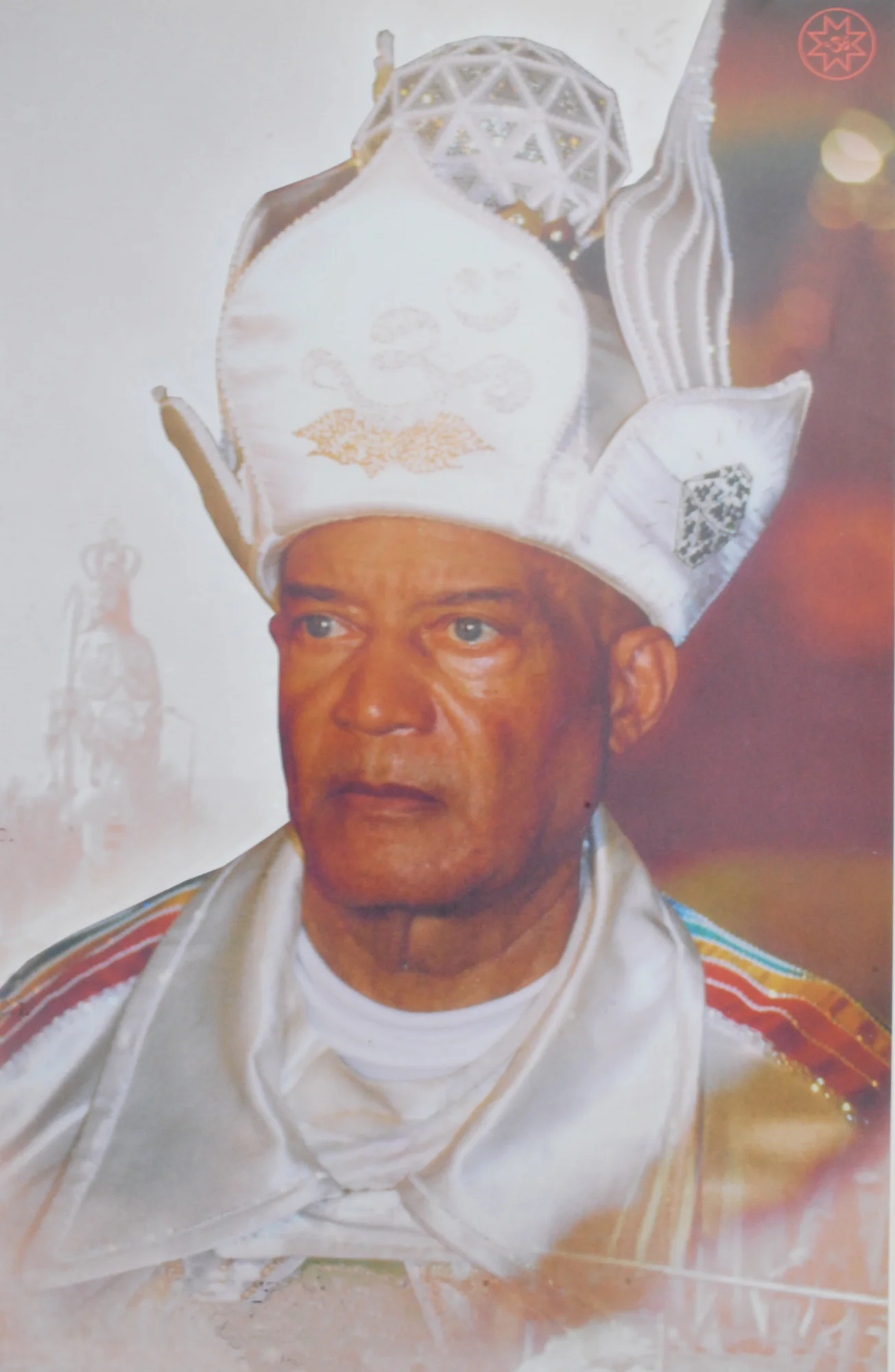
His Holiness Lord HAMSAH MANARAH came to Earth to establish a new era, the Golden Age of unity. Unity between farmers and nature means returning to the land in a spirit of exchange, sharing, positive thoughts and love, where work becomes a pleasure, a need, a prayer. Yes, but how can all this be put in place?
Everything begins with a new mental attitude
Let us not forget that “without plants, life would not be possible on earth”[1]. So let us consider agriculture in the light of Aumist Ecology: “Man has duties towards all the kingdoms”[2]. We must therefore take care of the living earth, protect it from harmful substances, take what we need without overexploiting it, in short, stop making it suffer. If we give the best to the earth, it gives us the best in return.
Producers and consumers can unite to preserve the planet through the supply of and demand for products grown without violence, respecting the seasons and biodiversity, without giving priority to profit at any cost. By choosing to cultivate the land with kindness, we develop our sense of responsibility towards future generations; we programme our success and theirs.
The benefits of prayer
By praying for plants in the countryside, on our balcony or in our garden, we help them grow, flourish and evolve.
Lord HAMSAH MANARAH teaches:
“Mother Nature expects everyone to respect the Law of sharing, which means that one does not pick a plant without first having prayed for its evolution.”[3] “The Sound OM must be the Ark of the Covenant between man and nature.”[4]
The Sound OM, the creative Word, can be repeated, whether one is a believer or an atheist, for the plant world as for the whole of creation.
According to Aumism, prayer goes hand in hand with action. Changing our state of mind, finding unity with the earth again and a sense of responsibility therefore leads us to abandon urgently the practices that poison the soils of our planet.
2 – CHANGE THE WAY WE FARM
It is essential to adopt practices that respect the earth. At present, farmers of goodwill are making an effort to reconcile both human health and the health of the land by developing organic farming. We are becoming familiar with the seeds of plants born of the earth. For example, wheat emerged from the earth in the Fertile Crescent watered by the Tigris and the Euphrates in Iraq, 12,000 to 15,000 years ago… We then understand that the tomato from our garden has nothing in common with the supermarket tomato, which often comes from seeds manipulated in laboratories, or with the tomato grown without soil.
A few examples of basic practices
These practices are both ancestral and forward-looking. Let us remember that the earth feeds and heals itself through plants.
– Let us leave a piece of land without working or sowing it: it will become covered with different grasses. Let us cut them and leave them on the ground: fungi come to break them down. Then earthworms eat and digest them and bring their castings up to the surface: we obtain new, perfectly balanced soil.
– Let us learn to sow plants that invigorate the soil, such as alfalfa, a taprooted plant that loosens the soil, captures atmospheric nitrogen and fixes it in its nodules so that it can be absorbed by the following crops: after two or three years, we have very well-aerated and fertile soil.
– Today, with global warming, gardeners have permaculture, with companion plants for our cultivated plants.
– In field crops, there is agroforestry, with rows of trees that are, here too, companions of the crops.
Those who work the land with love are sources of harmony, and the land repays them well by offering healthy, strengthening food with a high vibratory rate. They are examples for the new generations, who will have to spread responsible practices on a large scale to heal the planet. Furthermore, love of the nourishing earth does not concern farming professionals alone; it concerns all human beings, because it is quite simply love of life. And that is what we must teach children, whoever they may be.
3 – TEACH YOUNG PEOPLE TO LOVE THE EARTH
Getting back in touch with the earth
The rural exodus that we have experienced and are still experiencing, since there are fewer and fewer farmers, takes us away from the countryside and therefore from the land. Some children know only concrete. Yet it is extremely important to put our hands and feet in the earth, when we know that it also awakens our dormant forces of Life. The vibratory rate of the place increases, and with it that of everything that lives there, including the plants. We can teach all this to a child on the balcony of our flat with a large tub of soil, in a vegetable garden set up on the roof of a building, or of course in the countryside. Fortunately, efforts are being made in cities, with gardens made available to residents.
From an early age, children then learn to care for plants and to treat them as friends: “Their evolution, their blossoming and the length of their lives depend on the physical and psychic treatment to which they are subjected,” says Lord HAMSAH MANARAH. “Our affectionate care and our love are necessary to them.”[5] What children experience at a young age stays with them for life, and later they will find it natural to protect their environment.
Opening up to the values of the Golden Age
We must pass on to the new generations new kinds of “know-how” that rest on new ways of “being”.
“Prepare your children to become knights of universal peace,” teaches the founder of Aumism. “This means cultivating non-violence, the absence of racism, sympathy for all nations, respect for all beliefs and religions, the greatest tolerance, universal love.”[6]
Universal love is the love that embraces all human beings and also all the kingdoms of nature in their wonderful biodiversity. Educated in this way, young people feel they are citizens both of their country and of their planet. They learn to protect, through thought, prayer and action, the earth that belongs to all the people of the world. So, you see, let us prepare to accompany them, sharing with them our experience in the field. Is this not full of hope for the future, as a contribution to saving the planet? So let us wish one another: “Good luck!”
S. Ekatma
Honorary President of a plant protection association
*******
[1] L’Aumisme, la Doctrine de l’Âge d’Or, p. 194.
[2] Une loi pour détruire le mal, chapter I, p. 28.
[3] Vers un Âge d’Or d’Unité, p. 255.
[4] Ibid., p. 259.
[5] L’Aumisme, la Doctrine de l’Âge d’Or, p. 195.
[6] Le Yoga de la vie pratique, p. 277.