SYMPOSIUMS
LECTURE
No. 5 – PRAYER, A FACTOR OF PERSONAL AND PLANETARY BALANCE
PRAYER, A FACTOR OF PERSONAL AND PLANETARY BALANCE
Prayer, through which man connects with the Divine, takes various forms in the different Traditions: invocation, personal or altruistic request, the expression of gratitude, veneration, and so on.
Nowadays, the material takes precedence over the spiritual. Prayer often no longer has any place in people’s lives; some regard it solely as a way of asking God for solutions to everyday problems.
For Aumists, one must “hitch one’s plough to a star”, that is to say keep one’s feet on the ground while remaining connected to God. This means steadily developing the power of prayer.
In this talk, we will discuss prayer:
- first, as a factor of balance on the personal level;
- second, as a factor of balance on the planetary level.
I. PRAYER AND PERSONAL BALANCE
1) Prayer helps us regain our inner unity
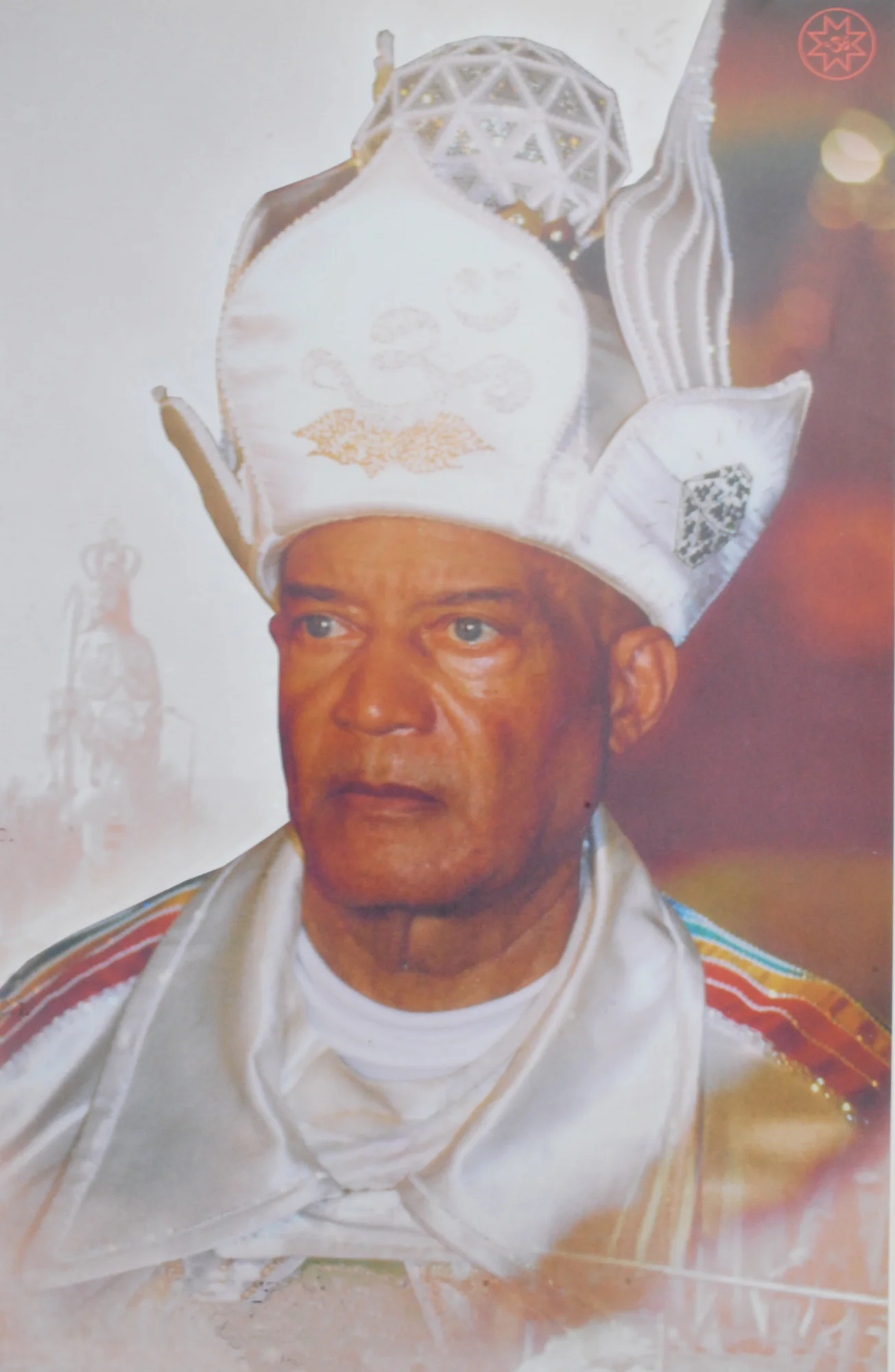
“Prayer,” says His Holiness Lord HAMSAH MANARAH, “is an impulse of the soul in which thought, word and gesture unite in an aspiration to obtain the grace of the Most High. Prayer is a force that not only heightens the creative possibilities of the being, but also allows us to benefit from the contribution of higher energies, external to ourselves.”[1]
Prayer calls on the whole being.
That is why, in Aumism, the regular practice of prayer involves fostering unity between body and mind and developing moral qualities.
The body is the “temple of the soul”, the receptacle of the Lord. At the monastery of the Mandarom, the practice of Hatha Yoga is strongly recommended for mastery of the body and the mind. Likewise, breath control makes it easier to concentrate one’s thoughts, which is essential for prayer.
As regards mastery of the mind, in Hinduism the Royal Yoga of Patanjali offers a graduated method of spiritual discipline. In Aumism, we speak of moral, mental and psychic hygiene: cultivating, in our daily lives, the qualities and values that oppose everything which pushes us towards the inertia and regression that veil the Divine present in each person.
The emphasis is on mastering one’s thoughts and creative imagination: what we think about during prayer steers our spiritual work in a more or less beneficial direction.
“If you want your prayer to be effective,” says Lord HAMSAH MANARAH, “not only must the cause be just and noble, but you must also maintain a favourable inner climate: banish hatred, resentment, jealousy and envy, detach yourself from yourself, do not be tense inside; moreover, forgive all your enemies, bless those who have helped you, and give thanks for all the blessings you receive every day from Providence.”[2]
Effectiveness also depends on regularity and perseverance.
Thus, connecting with God through prayer goes hand in hand with achieving one’s personal balance.
Moreover, prayer is in itself a force, a means of shedding what hinders our progress: it is the image of a “sponge that wipes away the past”.
It restores inner unity, unity with God present within oneself, which is the source of balance and serenity.
“Right prayer,” says the Lord, “is the substructure, the foundation of the Golden Age state of mind; it is the cornerstone of your inner Temple.”[3]
2) There is no break between prayer and action in daily life
A previous talk discussed the balance between prayer and action in secular life. Here, we will take examples from monastic life at the monastery of the Mandarom.
From the outside, one might imagine that a monastery is a place where people spend their time praying because there is nothing else to do. The Mandarom is the very opposite of such clichés: “We do not flee the world, we carry it with us.” Daily effort is required in community life, where each person is a mirror for the other. His Holiness would ask certain overly idealistic young people who aspired to live as residents to finish their studies and face the prosaic reality of the world before becoming monks!
Aumism is an authentic mysticism of prayer in action and of action in prayer.
The Lord set the example by fitting out a cave in the Vaucluse on His own in order to undertake the severe ascetic practices that led Him to Fusion in God. He restored a farm with His own hands to welcome those who asked for teaching. Forty years ago, helped by a few disciples, He began building the Mandarom, fuelled by constant prayer.
The balance between manual work and prayer can be found in the rules of monastic orders of various traditions, but the community of monks here has a particular feature: it is an Order of builders.
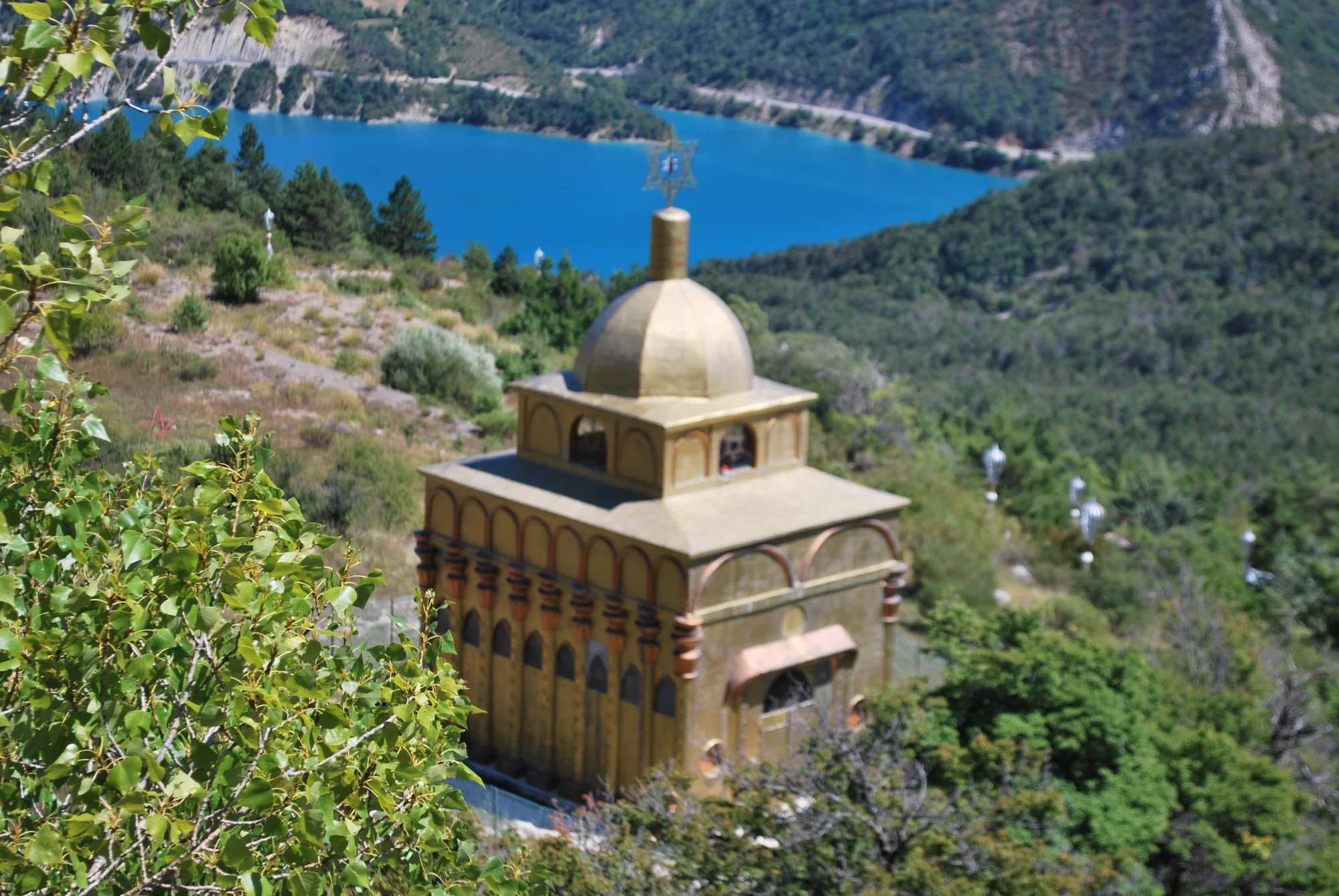
If you visit the Mandarom, you will see Temples and Statues of different Traditions side by side, symbolising the Unity of religions.
In particular, the Statues of the Buddha and of Christ, which face each other and bring together East and West, are a symbol of the return to the balance of the world, to the balance between Love and Wisdom.
Speaking of the building of the Statues of Christ (17 m high) and of the Buddha (22 m high), each constructed in three months, His Holiness explains: “For all those who contributed to this extraordinary achievement, it meant both building a sign of Love and Peace for the world and working on the architecture of their own perfection.”[4]
These religious monuments are the fruit of prayers and of labour in matter that led each person to train in the various building trades. This yoga of action is ongoing, meeting the material need to maintain the monuments. It is a Path of high spiritual value that helps, on the personal level, to purify and sublimate one’s energies.
The monks offer to God not only their work as builders but every task of daily life, including the most prosaic: when offered to God, actions are prayers. They alternate in a balanced way with the times devoted to prayer.
Alone or in groups, in the Temples or around the Statues, the hours of prayer set the rhythm of the days of the religious Community.
II. PRAYER, A FACTOR OF PLANETARY BALANCE
To bring real help, prayer must be selfless.
Praying for help in one’s personal undertakings is legitimate when they are well directed. But whoever prays selflessly expects nothing for themselves.
Free of the selfish interests that create imbalances in human societies, selfless prayer is at the service of humanity. It develops love and the feeling of unity with all beings and, what is more, it rebounds to the good of the one who prays.
Lord HAMSAH MANARAH has always set the example of selfless prayer. His only ambition: to serve humanity and the whole of Creation by spreading deep and true love, peace, happiness and light. These prayers are generous because they are offered without expectation of reward, with the sole joy of giving, comforting and uniting.
1) Selfless prayer fosters the return to peace
In our time, religious divisions and fanatical oppositions are throwing the planet off balance. The return to planetary balance requires us to seek what brings human beings together and can restore mutual understanding, tolerance and fraternity.
That is why Aumism has a single dogma, which implies tolerance and respect: that of the Unity of the Faces of God. “All the Divine Incarnations, whatever their Name, are aspects of God, who is One and indivisible: the dogma of the Unity of the Faces of God is the foundation of the Golden Age.”[5]
The principle of the Unity of the Faces of God is contained in OM, the first Name of God, which contains all the others.
Inscribed in a white sphere, it appears at the summit of the Hexamide, which symbolises the return to the Unity of religions.
On this six-edged pyramid, the different religions are represented by the colours of the rainbow which, after being divided, regain their original unity by merging at the summit into the white colour of OM, the synthesis of the colours of the rainbow.
Praying by repeating the Sound OM fosters the return to religious peace and to peace among all human beings.
2) Selfless prayer is an “invisible humanitarian action”
Aumists, and more particularly the members of the monastic Order at the Mandarom, pray to help souls on Earth and in the hereafter: their prayer is an “invisible humanitarian action”.
The Lord shows the Path of this essential solidarity:
“Pray each day for the whole of humanity,
Pray each day for suffering souls,
Pray each day that the Earth may be saved,
Pray each day to illuminate your future,
Pray each day to be the servant
Of the almighty God present in each one.”[6]
Among other prayers, the monks and nuns send out blessings several times a day to foster the return to planetary balance. The Lord stresses the creative power of thought. “Our thoughts,” He says, “certainly influence those around us. The nature and strength of our thoughts affect the very fate of the community. (…) That is why, in our oral Teaching and in our writings, we emphasise sending out thoughts of peace, love, happiness, harmony, health and spiritual progress for all.”[7]
Here are a few examples of blessings:
“Blessings on all the kingdoms of nature, on all minerals, plants, animals and humans.”
“May all sentient beings in the ten directions of space be free from enmity, free from ill will; may they be rid of suffering; may they be happy.”
“May Love, Peace, Happiness, Health, Prosperity, Light, Wisdom, Knowledge and infinite Bliss spread over all beings in all directions of space.”
Thus the monastery of the Mandarom, as His Holiness Lord HAMSAH MANARAH points out, is “a power station of spiritual Energy spreading its prayers over each and every one, beyond the divides of borders, races, peoples and religions”.[8]
3) Selfless prayer leads to Spiritual Liberation
Whoever prays for the world without expecting anything in return develops universal Love within. They can accelerate this inner transformation through the prayer of identification with the Divine. Moving towards spiritual Liberation is the true purpose of life. It is the opposite of selfishness: it means accepting hard work on oneself, which makes one capable of fully helping humanity.
According to Tradition, the Name and the Divinity are one. That is why the repetition of one of the Names of God is found in various religious currents, such as Hinduism, Sufism and the Hesychasm of the Desert Fathers. The repetition of the Sound OM, the first Name of God, fosters identification with the Divine, the expansion of individual consciousness into universal consciousness, Fusion in GOD.
But it is important not to rush thoughtlessly into ascetic practices. The Lord stresses the need to keep to the right measure and to follow a balanced progression. Let us emphasise that in all Traditions, sustained prayer work requires the guidance of an experienced Spiritual Master.
As a Spiritual Master, Lord HAMSAH MANARAH placed at the service of humanity His knowledge of the different Traditions, His practice of many ascetic disciplines, and His experience of the different degrees of mystical ecstasy up to total Fusion in GOD. Renowned religious figures from Jainism, Hinduism and Buddhism stayed at the Mandarom. They recognised in Him a Being of exceptional Realisation and conferred many titles on Him.
Thus, by following a balanced progression combined with various spiritual exercises and work on oneself, prayer allows the human being to reach the highest stage of evolution. They can attain Divinisation and become a pure channel of Divine Compassion. The power of their selfless prayer is multiplied, and they then work on all levels for the return and maintenance of planetary and cosmic balance. That is why, says the Lord, “one’s own Spiritual Liberation is the greatest service one can render to humanity”.[9]
III. CONCLUSION
We have just discussed various aspects of prayer as a factor of balance according to the Aumist religion.
Many religions also invite people, to varying degrees, to take part in building a world that is more harmonious and respectful of the laws that govern the universe. Each one attaches great importance to prayer, whatever its form.
We will therefore end this talk with this sentence from the Meditation on the Unity of the Faces of God[10]:
“May the religions reach out to one another and pray together
for the coming of the Golden Age of Unity, Truth and Love.”
*******
Further reading (works in French):
ELIADE Mircea, Histoire des croyances et des idées religieuses, Paris, Payot, 1980.
GOUILLARD Jean (translated and introduced by), Petite Philocalie de la prière du cœur, Paris, Seuil, 1979.
LALOY Jean (translated and introduced by), Récits d’un pèlerin russe, Paris, Seuil, 1978.
[1] H.H. HAMSAH MANARAH, L’Aumisme, la Doctrine de l’Âge d’Or, p. 317.
[2] H.H. HAMSAH MANARAH (H.H. HAMSANANDA), Mémoires d’un Yogi, p. 330.
[3] H.H. HAMSAH MANARAH, La Révolution du monde des vivants et des morts, p. 453.
[4] H.H. HAMSAH MANARAH, Les Combats du Messie attendu, p. 65.
[5] H.H. HAMSAH MANARAH, Le Flambeau d’Unité, p. 19.
[6] H.H. HAMSAH MANARAH, Le Flambeau d’Unité, p. 512.
[7] H.H. HAMSAH MANARAH, Yoga et Sagesse, pp. 111-112.
[8] H.H. HAMSAH MANARAH, Une loi pour détruire le Mal, p. 87.
[9] H.H. HAMSAH MANARAH, Yoga et Sagesse, p. 270.
[10] Ibid., p. 419.