SYMPOSIUMS
LECTURE
No. 5 – WORKING ON ONESELF: TOWARDS AN ENHANCED HUMANITY
No. 5 – WORKING ON ONESELF: TOWARDS AN ENHANCED HUMANITY
The dream of an enhanced Human…
In recent years, transhumanism has become prominent in public debate with its project of the enhanced Human: using scientific and technological advances and AI, the aim is “to improve the human being” (regarded as imperfect, even deficient), to amplify physical or cognitive performance, and even to create new capacities through genetic or biochemical modification, through the addition of prostheses such as exoskeletons, or through a human-machine hybridisation whose first signs we are beginning to see…
In the face of this vision of the human being, largely dictated by the craving for omnipotence of a high-tech minority and the egocentric fantasies of a few billionaires, Aumism offers that of a Human capable of enhancing himself or herself with more love and generosity, and of raising his or her consciousness too… through a process of inner transformation, a true “work” that allows us to realise the fullness of our being and to express the Divine essence present in each one of us, and so to become a better channel for “helping humanity”.
Here are a few aspects of this work on oneself…
LEARNING TO KNOW ONESELF
In keeping with the ancient adage “Know thyself”, work on oneself, a great “classic” of all religions and spiritual currents, often begins with a phase of introspection, though it cannot be reduced to that. Let us make clear from the outset that it is not the same as psychotherapy or psychoanalysis. In fact, long before Freud’s discoveries, the great Hindu and Buddhist spiritual masters, like the Christian Desert Fathers, were already working to shed light on that dark part of our psyche which escapes our control and which we call the unconscious.
HARMONISING THE CONSCIOUS AND THE UNCONSCIOUS
Once the fears, desires and other hidden springs that unknowingly make us repeat the same mistakes, causing suffering to those around us as well as to ourselves, have been brought to light, work on oneself does not consist merely in acknowledging them, but in truly embarking on a journey of transmutation.
This is, of course, so that we feel more harmonious, but also and above all so that we do not hurt others or cause negative repercussions for those close to us, and beyond them for the society, the country and the world in which we live…
HONESTY, SINCERITY, HUMILITY
Such an undertaking requires a minimum of sincerity and honesty:
first of all towards oneself, so as not to fall into the trap of guilt and incessant self-reproach; or, conversely, into self-satisfaction, a sense of superiority and a refusal to question oneself, always blaming others or society! In short, a right self-esteem: neither too much nor too little.
Sincerity, too, towards our brothers and sisters in humanity…
The two are linked: accepting, understanding and loving others presupposes accepting, understanding and loving oneself.
For work on oneself, beyond introspection and analysis, is not limited to seeking individual well-being; it aims at a beneficial, happy and altruistic transformation of our feelings, thoughts, behaviour and actions towards our “neighbour”, whoever that may be.
For anyone wishing to help Humanity today by taking this demanding Path, the first task will be to track down relentlessly hatred, rancour, jealousy, spiteful criticism and contempt… all those “sad passions” that stand in the way, within us, of the blossoming of what is called sometimes Charity, sometimes Compassion or Love, in their universal, limitless dimension, which characterises the “enhanced Human” in the sense we mean.
In this undertaking, considering one’s own faults is neither easy nor comfortable. It is downright uncomfortable when aspects of one’s personality that one would rather not have seen rise to the surface. Anandamayi Ma, a great saint of modern India, used to say: “It is when you scour a pond that it smells the worst”…
THE SPIRITUAL STRUGGLE
That is why all religions and traditions describe this “work”, which involves the whole of our being, as a true “struggle”, and associate it with the notion of effort:
- In Islam, it is the “greater jihad” waged within oneself, as opposed to the “lesser jihad”, waged outwardly. Note that the word “jihad” means precisely “effort”.
- In Judaism, it is the battle between the “divine soul” and the “animal soul” to transmute evil into good.
- In Christianity, one speaks of “purifying the passionate part of the soul”.
- In Hinduism, it is overcoming the “papa purusha”, the “man of sin” that each of us carries within…
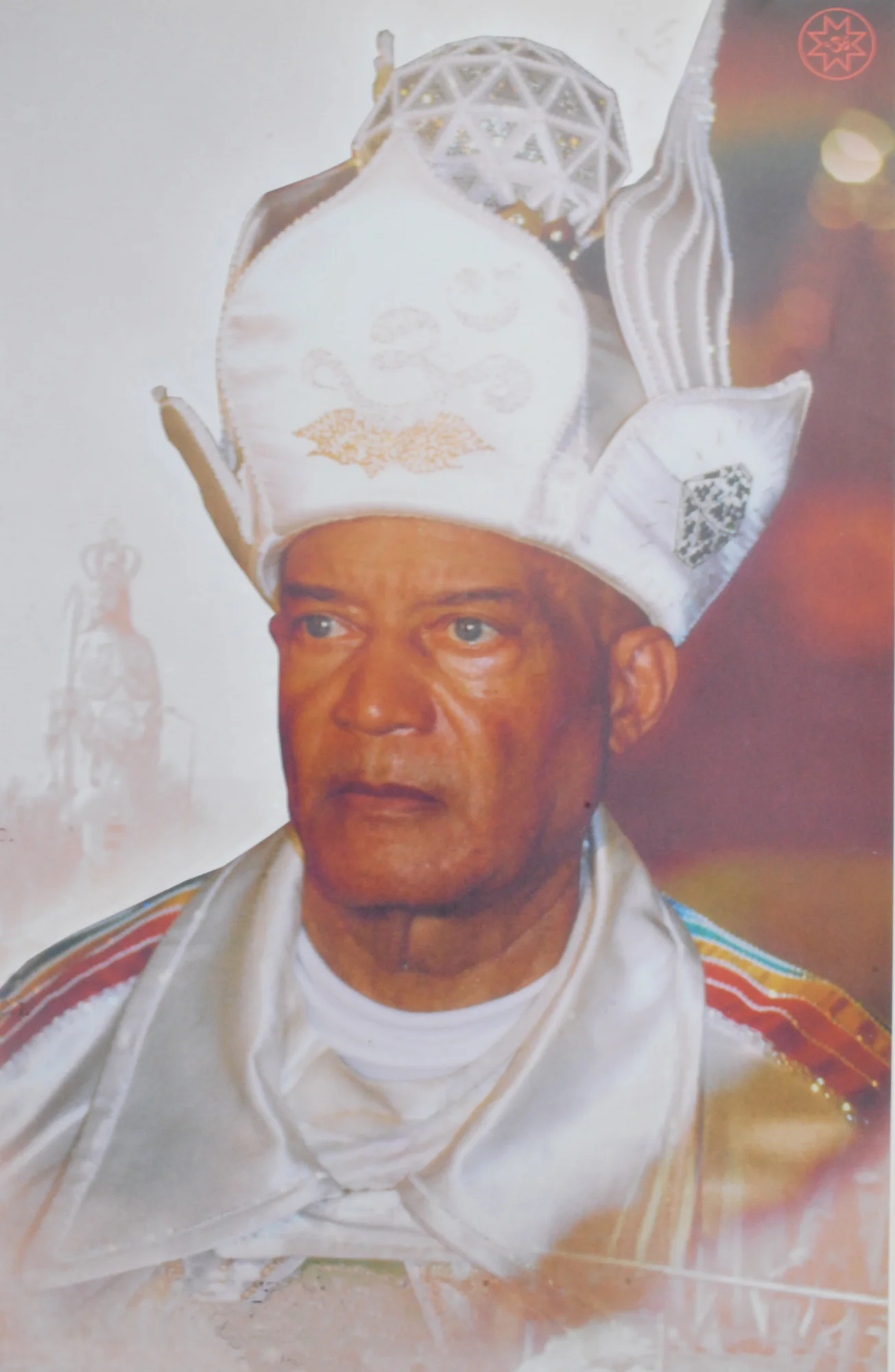
In Aumism, Lord HAMSAH MANARAH described this struggle in a poem, from which we give a few extracts here:
“I love war, my friends!
I love war! I love war on oneself.
I also love those who wage it;
But war without rifle or cannon,
Without bomb or machines of war
Bruising the flesh and shedding the blood of the innocent.
My own war, the one I prefer,
Is the silent war without projectiles;
It is war on selfishness, envy, jealousy,
It is war on separativeness, mediocrity, intolerance,
It is war in Love and not in indifference.
(…)
A war, however, without respite,
Reflecting on international Peace
And universal harmony.” [1]
This silent struggle must be pursued day after day without losing heart… A Muslim mystic said that it had taken him twelve years to undo his belt of pride, another twelve years to undo that of selfishness, and so on. An Orthodox nun, for her part, spoke of twenty years to overcome spiteful thoughts towards her sisters…
Hence the importance given to patience and perseverance in all religious currents. Here is what the Founder of Aumism writes on the subject, inviting us never to slacken our efforts:
“The fear of moving forward binds us to illusion; that is why we must not flee the effort to be made, for the Guide shows the way but cannot walk it in your place.” [2]
“GUARDING THE HEART” AND “POLICING THOUGHTS”
For Evagrius Ponticus, a Christian hermit of the 4th century, this spiritual struggle begins with guarding the heart: “Be the doorkeeper of your heart and let no thought enter without questioning it. (…) Say to it: Are you one of ours, or one of our adversaries?” [3]
When our Spiritual Master asks a disciple, “What are you thinking about?”, He invites a “freeze-frame” to become aware of the nature of our thought at that moment, to analyse how it came to us and what preceded it, in other words to trace back the chain of associations; and also to learn to distinguish the thoughts that come from ourselves from those that come from outside but find an echo in us…
According to the BUDDHA, right thought is part of the Eightfold Path leading to the cessation of suffering. In the context of Aumism, the emphasis is on the importance of our mental attitude during our various activities throughout the day, and above all during meditation, prayer and the repetition of mantras…
Indeed, the more our power of concentration increases through the practice of spiritual exercises, the more our responsibility towards others, Humanity and the Universe also increases. That is why the Lord insists that each person practise a true “policing of thoughts”, which consists not only in rejecting and cancelling the bad thought that passes through us, but also in replacing it with a kindly, luminous thought, a thought of blessing, so as not to add to the violence and suffering of the world. He writes:
“To think is to act, and the accumulation of thoughts of hatred, anger and destruction, however secret they may be, creates an invisible destructive ‘cloud’ which, sooner or later, will rain down revolutions, wars or disasters on a city, a region, a country or several continents (…) Conversely, generous thoughts of love, peace, harmony and spiritual progress spread happiness and invigorate those who receive them.”
“All human beings must be placed before the consequences of the choice of their thoughts. (…) If each of us makes sufficient effort to purify our heart, eliminate hostility and learn to love our neighbour… it is possible to contribute, with all people of good will, to creating the conditions for lasting Happiness.” [4]
CHOOSING WHAT FEEDS OUR MIND
This work goes hand in hand with choices that “feed” our mind and our emotions in an evolutionary direction, through reading, films or music, as well as company, that enrich and uplift us. Just as we avoid spoiled or toxic food, so we have the power, and the duty, to choose what feeds our thoughts, our emotions and our moods.
Take the example of the news: it is not a matter of cutting ourselves off from what is happening in the world, but of being able to resist the fascination of images on a loop, media frenzy and social-media “buzz”; of not becoming “hooked” on the news like a harmful soap opera in which each new episode delivers its share of cruelty, disaster and disenchantment. This is where the techniques taught by the Founder of Aumism come in, to avoid certain negative influences of the media…
Let us go one step further: through our positive thoughts and our prayers, we can even help those who govern to make good decisions, instead of nursing criticism and hostile feelings towards them, as we all too often tend to do.
TAMING THE IMAGINATION
“When thought is accompanied by a mental film, we say that the soul has just mounted the galloping horse of imagination.” [5]
Then unsatisfied desires grow sharper and invade the mind, whether we are fantasising about the latest fashionable connected gadget or about the neighbour’s wife, or coveting money, power or territory… It is this unruly imagination, which can lead to the worst excesses, that must be brought under control, not the creative faculty placed at the service of the Beautiful and the Good.
PURIFYING ONE’S “DOUBLE”
In His 22 Books, the Founder of Aumism gives a great many practical means of escaping the many determinisms that hinder our evolution… One of these keys deserves special attention: the purification of the double. What is it?
Throughout the ages, myths, tales, literature and religions have alluded more or less clearly to this enemy within that is called the double.
In Hinduism, knowledgeable initiates strive every day to transmute the “man of sin”, described as a dark homunculus within them.
In the Christian context, Racine puts it this way:
“My God, what a cruel war!
I find two men within me:
One wants my heart, full of love for you,
To be ever faithful to you;
The other, rebellious to your will,
Sets me in revolt against your law.
(…)
Alas! at war with myself,
Where shall I find peace?
I will, and never accomplish.
I will; but (O extreme misery!)
I do not do the good I love,
And I do the evil I hate.” [6]
Lord HAMSAH MANARAH makes the same observation:
“Men and women often wonder why they do the opposite of what they want. Often, everyone feels torn between the desire to move forward and the brakes imposed by a part of themselves.” [7]
What is specific to Aumism is that it sheds new light on this double, which is in reality linked to karma and which, if it is not fought, drives us to self-punishment and self-destruction, and can reactivate certain bad habits, or even perversions, that we had in our previous lives.
The techniques for purifying the karmic double are a powerful engine of transformation. Through regular practice, each person can free themselves from the past, reshape their future and emerge “from the suffering of being two in one and the same individuality”, for “it is better to be ONE with GOD than two, far from GOD.” [8]
Anyone engaged in work on themselves, whatever their Path, will benefit from these teachings, which give access to inner freedom by letting love of God, of others and of the world blossom.
FIGHTING DISCOURAGEMENT
In the process of working on oneself, the temptation of discouragement is frequent, notably because we are confronted with our “inner monsters”. The gap between the ideal self and the less flattering (even frightening) aspects of oneself is one of the major causes of discouragement on the spiritual path. Whether we call it sadness, defeatism or weariness, discouragement has only one aim: to halt our evolution and prevent the Goal from being reached.
“Everyone goes through periods of discouragement,” writes Lord HAMSAH MANARAH, “but these moments become rarer and rarer as we progress. They end up disappearing through the complete harmonisation of the personality and the full blossoming of the feeling of Unity.” [9]
Let us stress that discouragement never comes from God: the divine Word is always encouraging. So the best remedy when we are discouraged is to entrust ourselves to the Divine and always keep our trust in Him. Let us not hesitate, either, to ask for and accept help from others, for if discouragement is contagious, so is encouragement.
CULTIVATING KINDNESS AND THE STATE OF JOY
Often, other people’s faults irritate us so much that, instead of blessing them and praying for them as Aumism teaches us, we lock them into a negative view that may even turn into hostility. We therefore need to reflect on our own attitude (cf. the parable of the mote and the beam: “And why beholdest thou the mote that is in thy brother’s eye, but perceivest not the beam that is in thine own eye?” Luke 6:41).
If each person accepts three faults in others, considers their qualities first and remembers that God dwells in every being, it will be possible to live in harmony.
As for the state of Joy, it is the “signature” of our state of Unity with the Divine and with the World in which we live. It has beneficial repercussions not only on those immediately around us but on the whole of Humanity… If we put into practice the famous prayer of Saint Francis of Assisi, “where there is sadness, joy”, we will contribute to a better world and to the happiness of humankind.
“HITCHING ONE’S PLOUGH TO A STAR”
If work on oneself is a struggle, it takes two forms: fighting against (one’s faults, one’s bad thoughts, one’s double, etc.) and fighting for. In general terms, fighting to cultivate the qualities opposite to our faults, to forgive ourselves and others, to strengthen our will and patience, to develop more listening, empathy and sense of sharing, to broaden our capacity to love, and to develop the feeling of Unity with all living beings and with God.
It is important not to identify with the negative or limiting aspects of our personality but to centre ourselves on the Supreme Self, the immortal Soul, often affirming our Unity with the Divine Consciousness.
BY WAY OF CONCLUSION: TOWARDS AN ENHANCED HUMANITY?
Antonio Gramsci, the Italian philosopher and politician, already noted in the last century: “The old world is dying, the new world is slow to appear, and in this chiaroscuro monsters arise.” [10]
Confronted today with the many monsters whose names are wars, coups d’état, speeches of hatred and intolerance, the plundering of resources, the selfishness of States closing their borders, or of the super-rich in the face of poverty, the ideal of a Humanity capable of more love, solidarity and sharing may seem distant, even out of reach…
Yet let us not lose sight of everything that, even on a modest scale, is moving in the right direction, whether in the social or ecological sphere, the place of women, the evolution of thinking and laws on animals, the notion of “commons”, new forms of justice, peace initiatives, interreligious dialogue and so on. All over the planet, “watchers”, men and women of all ages, are shifting the lines and patiently, without media attention, welcoming, helping one another, repairing, inventing and preparing better tomorrows.
To the question “How can we help humanity today?”, the Founder of Aumism replies: “Serving humanity presupposes improving our own human and spiritual worth.” [11]
And we hear as an echo the words attributed to Mahatma Gandhi: “To change the world, we must begin by changing ourselves.”
In work on oneself, every small step counts and can make a significant difference. “Ye are the salt of the earth,” JESUS says to His disciples. Like leaven in the dough, the person who improves themselves improves the whole of Humanity. It is from the sum of individual awakenings, efforts and changes that a collective transformation can come about at this dawn of the Golden Age.
V. AKSHARA
Author, graduate in Oriental languages
*******
[1] Le Yoga de l’Amour dans la Force, p. 307
[2] L’Aumisme, La Doctrine de l’Âge d’Or, p. 69
[3] Antoine Guillaumont, Un philosophe au désert : Évagre le Pontique, Vrin, 2004
[4] L’Aumisme, La Doctrine de l’Âge d’Or, p. 310
[5] La Loi d’Évolution des Âmes, p. 397
[6] Jean Racine, extracts from « Plainte d’un chrétien… », Cantiques spirituels, 1694; Gallimard, 1999
[7] Le Flambeau d’Unité, p. 405
[8] Le Flambeau d’Unité, pp. 12 and 13
[9] Le Maître spirituel et le disciple, p. 288
[10] Antonio Gramsci, Cahiers de prison, Gallimard, 1996
[11] Le Yoga de l’Amour dans la Force, p. 292