SYMPOSIUMS
LECTURE
No. 6 – THINKING BETTER: THE CHANCE TO HELP HUMANITY BY HELPING OURSELVES
No. 6 – THINKING BETTER: THE CHANCE TO HELP HUMANITY BY HELPING OURSELVES
First of all, thank you all for all the fraternal thoughts that have converged on our planet during this conference.
To close this series of talks, we will discuss a form of solidarity that does not replace individual and collective action but is compatible with every form of solidarity: choosing the direction of our thoughts.
Let us start from the moral support our humanity needs in the face of the many-sided crisis we are going through.
According to a study published in The Lancet:
– the ecological threat is generating what is called “eco-anxiety”.
– the pandemic has increased cases of depression worldwide by more than a quarter.
– 75% of young people are worried about their future[1].
And the anxiety is of course greatly amplified by the current war.
We must recognise the reality of the risks, the distress caused by unprecedented situations, and human vulnerability in the face of these trials.
The future is worrying. No one can deny it.
But adding thoughts of fear, division and hatred to the difficulties multiplies them.
Protecting ourselves from this mental pollution is a duty, for not only does “man become what he thinks”, but “thought creates the state of the world”.
The founder of Aumism tells us: “Raising the moral level of humanity by saturating human minds with optimistic, fraternal, unifying and constructive thoughts has become an urgent necessity.”[2]
In this talk we will see that we can help humanity:
– by cultivating positive thoughts
– by cultivating kindly thoughts
– by passing them on to the new generations.
You may say:
How do my thoughts concern the whole of humanity?
First, we are not separate from one another.
– Interdependence is inherent in the human condition.
– For those (including Aumists) who believe that the soul evolves through several lives, we have already been, or perhaps will be, in the place of those we help or those we despise today.
– And in Aumism, as in other Traditions, the unity of humanity is founded on the presence of the Divine in each person.
Thus, “by harming my brother I harm myself” and I act against God, whereas “by loving others I love an aspect of myself” and I love God.
Furthermore, thought knows no limits.
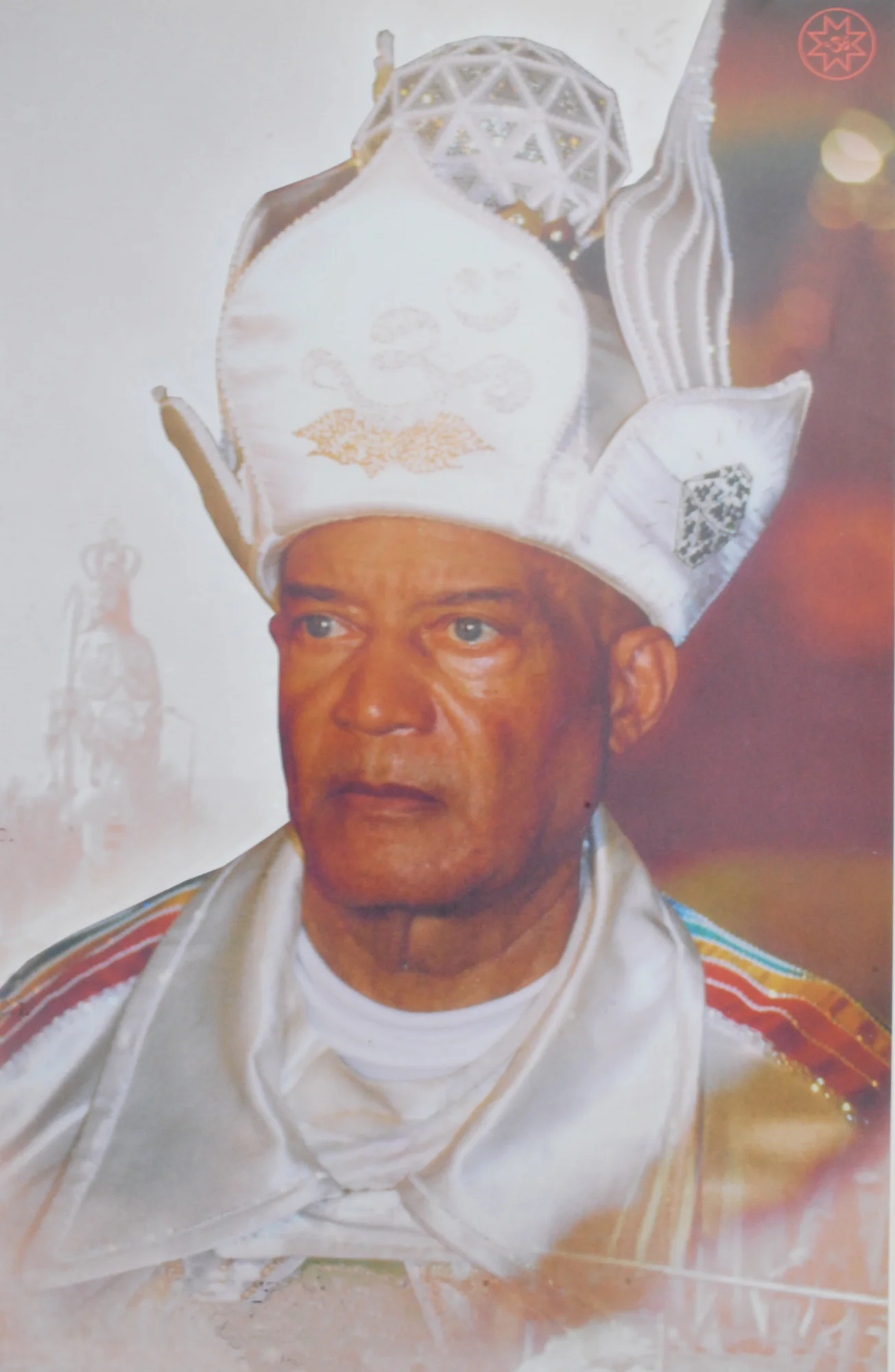
“It is vibration,” explains Lord HAMSAH MANARAH. “It radiates subtly, even if our ordinary senses do not detect its movements. Its power is real (as the phenomenon of telepathy shows). It affects those around us. It acts on the universe.”[3]
“The combination of thoughts of hatred and of bad deeds sooner or later brings about disasters harmful to the world.” Sadly, we can see this today.
But conversely, and this is a way out, “the meeting of good thoughts and good feelings attracts happy events for humanity”[4].
So, in the face of the prevailing gloom, which is understandable, we have a duty to cultivate positive and kindly thoughts.
I – MAKING OUR THOUGHTS MORE POSITIVE
To begin with, we can strengthen ourselves, motivate ourselves, and see life as a school.
Strengthening ourselves means seeking balance of body and mind so as not to be destabilised by our emotions and not to spread our own stress.
In the book Le Yoga de la vie pratique, for example, invigorating techniques help us get off to a good start.
– Prayer and meditation, in all traditions, help us put personal reactions into perspective.
– Identifying with the Divine present within us fosters stability. We can affirm:
“I am a centre of Strength, Light and consciousness.
I am in unity with the divine Consciousness,
I am divinely protected, inspired, enlightened, guided.”[5]
To motivate ourselves, we need only become aware of the harm done by pessimistic, defeatist thoughts.
They feed on rumours and on media commentary that fuels anxiety and spreads by word of mouth.
Focused on the worst, they lead to catastrophism and a feeling of powerlessness.
This can help neither ourselves nor others. That is obvious.
What helps is the desire, the hope and the will to contribute to an improvement.
Positive thoughts are not “head in the clouds”; they start from a lucid acknowledgement of the difficulties and inspire the efforts needed to overcome them.
All educational action, all humanitarian work, every rescue operation requires this state of mind. And today we have… our planet to save!
A well-understood optimism is therefore a pragmatic wisdom that leads us to “welcome events with the best hope” and to “make the most of the most unfavourable situations”.
Seeing life as a school helps us adopt this perspective.
Faced with an obstacle, we can let ourselves be defeated or mobilise our strength to overcome it.
Even if it is difficult, regarding existence as a school allows us to stay at the helm and to learn the lessons of experience so as to move forward against all odds.
In this way we rediscover the meaning of life, which is, says Lord HAMSAH MANARAH, “an act of love, a constant apprenticeship in solidarity, fraternity and mutual aid”[6].
II – CULTIVATING THOUGHTS OF LOVE
“It is because Love is absent from human relationships that humanity still persists in the darkness of war, intolerance and hatred.”[7]
All religions and Wisdoms encourage us to develop love, which is central to the Gospels and presented with unanswerable logic by the Buddha: “If hatred answers hatred, how will hatred ever end?”
Where should we begin in order to move towards greater love?
Breaking with negative judgements
– Moving beyond disparagement
Of course, no one is perfect, and discernment is necessary in human relationships. And fair, fraternal criticism is always useful.
But we must lose the habit of gossip, disparagement and stereotyped judgement, which fix others in their real or supposed faults. This fuels division and exclusion.
Recognising the qualities of others encourages them to develop them. It is an act of solidarity.
It is a way of recognising the Divine in each person, beyond the personality traits that may put us off.
– Moving beyond what we might call “psycho-emotional sectarianism”
When we say “it is impossible to love everyone”, we cut the world in two: those we like and those we dislike, often because of prejudice.
But we can move beyond knee-jerk reactions through mutual respect, laid down as a principle of cooperation.
When respect is accompanied by understanding, it leads to kindness, attention to the happiness of others.
When understanding becomes empathy, it opens us to the desire to ease suffering, to compassion.
Freed from sectarianism, solidarity has no borders. This path leads to a universal love that culminates in the totally selfless and unconditional love already mentioned in connection with the divine Envoys.
Of course, we do not change overnight. In each of us there is, to varying degrees, a tendency towards altruism and a tendency towards selfishness. They generate thoughts that sometimes help harmonise society and sometimes divide it.
That is why “the pacification of the world begins with our own pacification”[8]. This is a vigilance we can place at the service of humanity:
Neutralising our harmful thoughts
– To purify our mind, we can tell ourselves:
“I am not these thoughts, I am not these feelings, I am not these emotions of the mind. I erase all impure thoughts, all negative imprints, and settle into the inner Golden Age, peace, calm and serenity.”[9]
– To cancel our aggressive thoughts: “I cancel the thought of hatred sent out against this person and send them a thought of love, peace, harmony and unity. May their soul forgive me and be reconciled with my inner God.”[10]
– To break with resentment: the importance of forgiving oneself and others was discussed in a previous talk. In all religions, forgiveness frees us from the burden of hatred and allows us to move towards inner peace.
Spreading thoughts of love
This is “a direct participation in the silent service of the world”.
“Through our beneficial thoughts,” insists Lord HAMSAH MANARAH, “let us strive to generate a powerful current of fraternity and true love, strong enough to ward off violence. This is the essential condition for harmony between nations and for the creation of a psychological climate that fosters the evolution of the world. No one is too weak; no thought is lost.”[11]
Let us send out thoughts of solidarity, good wishes and prayers.
Let us not forget that the prayer of OM, offered to all, “saves souls in despair”.
In this way, all of us together, believers and atheists, can be ever more numerous in counterbalancing and transmuting the destructive thoughts that give rise to destructive acts.
Moreover, this selfless service rendered to humanity benefits us too, for “the more man improves, the more he learns to love deeply; and the more he loves, the more he improves”[12].
All along this path, the Lord encourages us: “Little by little, your example will spread, and at your own small personal level you will take part in destroying the octopus of hatred within society.”[13]
When adults make the effort to think better, it has an impact on children’s education. It is through them that a long-term change of mentality will take hold.
III – HELPING YOUNG PEOPLE TO THINK ACCORDING TO THE VALUES OF THE GOLDEN AGE
The future of humanity depends on this intergenerational solidarity.
Values guide each person’s thoughts and actions. It is therefore essential “to educate children in the spirit of tolerance, respect for each person, true love and mutual aid”.
It remains to inspire in them… a taste for the effort needed to put these values into practice!
We will emphasise example, the experience of happiness, and a new conception of citizenship.
Example
It is through imitation that a child begins to learn respect, mutual aid and justice… or their opposites. Every adult, whether a parent or educator or not, serves as a model, even unknowingly.
Children need reference points and rules; they must become aware of their responsibilities and know the satisfaction of a duty fulfilled.
But it is the example of caring adults that makes values attractive.
At the level of education, we find what Bergson calls open morality: the call of a model (a great figure of a Religion, a Wisdom, etc.) that inspires a morality of attraction, a source of enthusiasm and joy.
The experience of happiness
Giving young people the opportunity to experience solidarity in the family and outside opens them to kindness, without of course confusing goodness with weakness. It helps them flourish:
– making themselves useful helps them fit into the group.
– by developing their sensitivity and empathy, they think and act more effectively: their self-confidence grows.
– they learn to give and to receive, for those who give in all humility, without seeking personal gain, are enriched at other levels thanks to those who receive.
There is no relationship of domination.
Little by little, giving happiness will become part of their own happiness, which will not depend on external objects.
And they will pass on the values that make them happy.
A new notion of citizenship
At this dawn of the Golden Age, teaching children to “think universally” is essential.
“Every land is a domain of the immense human family, his own,” says Lord HAMSAH MANARAH. “He dwells on what brings people together rather than what divides them. He loves his country faithfully and strives to be a conscientious citizen, eager to increase his moral, intellectual and spiritual worth and his effectiveness. But he does not forget that he is a citizen of the world and of the universe.“[14]
The adventure of their life will be richer and more exciting.
They will more easily feel solidarity with all human beings, whatever their differences, and also with the kingdoms of Nature.
By helping young people to become, as the Lord wished, “men and women of heart, full of compassion, wishing to help themselves in order to help others better“[15], adults help to establish lastingly the Golden Age mental state that the Earth urgently needs.
In conclusion
“The level of evolution of humanity depends on the evolution of each being.”[16] That is why:
– choosing our thoughts,
– educating young people in this direction,
– encouraging everyone to think better,
are acts of solidarity that can succeed in “saving humanity from the consequences of its harmful thoughts”. For, let us not forget, all human behaviour originates in thought.
Moreover, thinking better means reconnecting with “the joy that must be born of the act of loving,” says Lord HAMSAH MANARAH, “of the act of serving, helping, rescuing, of the act of giving birth and then educating…”[17]
To finish, here is an affirmation from Le Yoga de la vie pratique. Whatever the situation, including in times of trial, it can help us hold to an attitude that, by helping others, helps ourselves:
“Deep Love grows within me for the world and the Universe.
I know that by opening myself to the service of others, to the service of humanity,
with all my heart, without expecting gratitude, I open the door to the fullness of all good.
I progress on the path of happiness and serenity.”[18]
OM
V. Mandaja
Doctor of Education Sciences
*******
[1] https://www.lemonde.fr/climat/article/2021/09/14/climat-les-trois-quarts-des-jeunes-jugent-le-futur-effrayant
[2] Le Yoga de l’Amour dans la Force, p. 302.
[3] Le Yoga de la vie pratique, p. 301.
[4] See Le Maître spirituel et le disciple, p. 285.
[5] Le Yoga de l’Amour dans la Force, p. 234.
[6] Le Flambeau d’Unité, p. 154.
[7] La Révolution du Monde des Vivants et des Morts, p. 344.
[8] La Voix de Lumière, p. 472.
[9] La Révolution du Monde des Vivants et des Morts, p. 266.
[10] L’Aumisme, la Doctrine de l’Âge d’Or, p. 151.
[11] L’Unité des Visages de Dieu, p. 390.
[12] Le Yoga de la vie pratique, p. 238.
[13] Vers un Âge d’Or d’Unité, p. 185.
[14] Le Yoga de la vie pratique, p. 279.
[15] Naturopathie et Yoga, p. 246.
[16] La Voix de Lumière, p. 473.
[17] Le Flambeau d’Unité, p. 358.
[18] Le Yoga de la vie pratique, p. 242.