SYMPOSIUMS
LECTURE
No. 7 – BUILDING THE GOLDEN AGE WITHIN ONESELF
BUILDING THE GOLDEN AGE WITHIN ONESELF
The future of the planet depends on the contribution of each person, and we are all concerned by the need to transform ourselves.
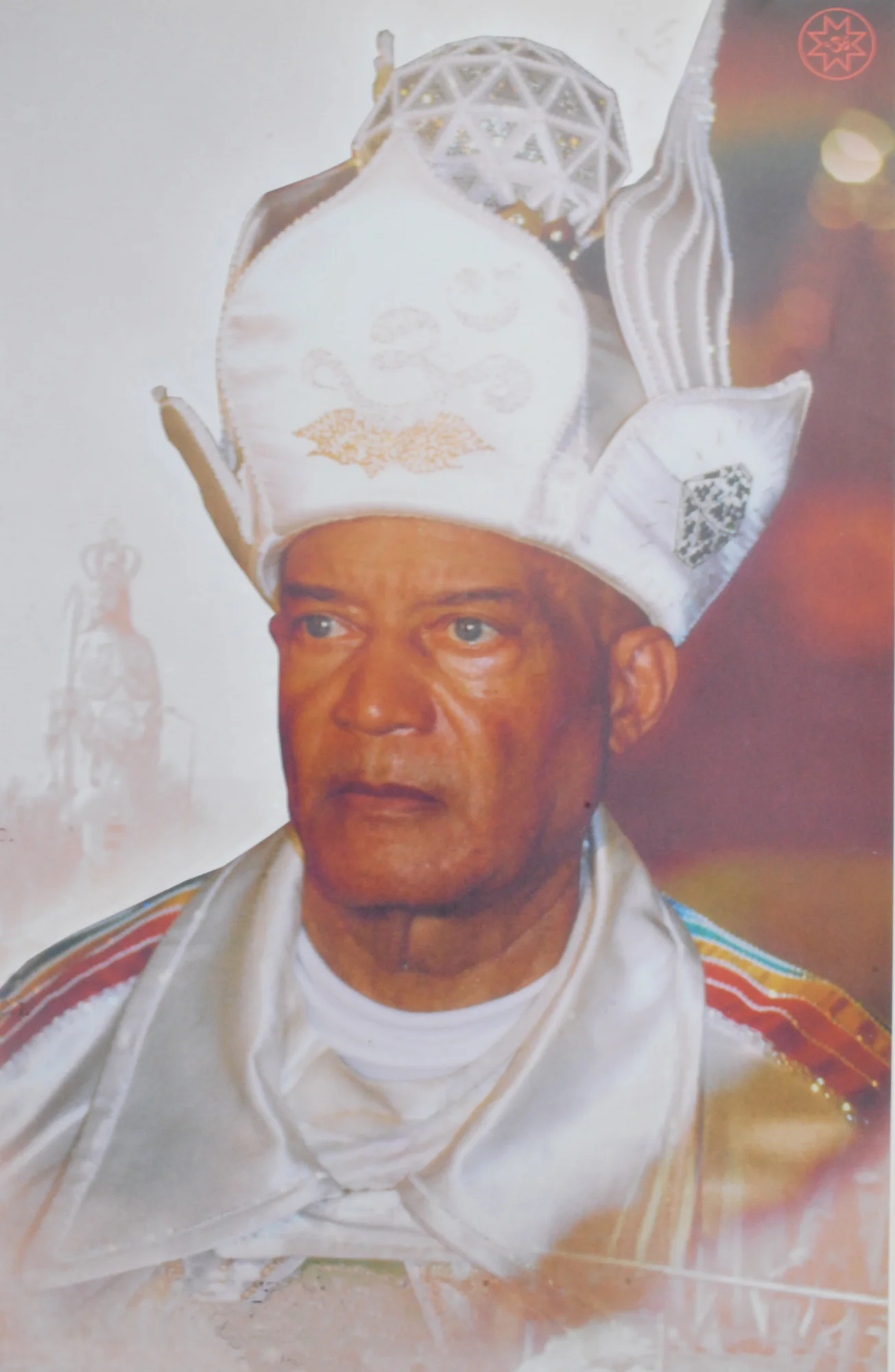
His Holiness the Lord HAMSAH MANARAH came to Earth to help us free ourselves from our sufferings and to give each person, believer or not, the means to enter the Golden Age, that is, to enter the new era, the Age of Peace, the Age of fraternity within oneself and around oneself.
He tells us: “The Golden Age is only a state of mind to be conquered, and it remains within everyone’s reach.”[1] “The Golden Age within oneself has infinite repercussions.”[2]
Building the Golden Age within oneself reminds me of the story of the three cathedral builders in the Middle Ages who were asked what they were doing. The first answered: “I am breaking stones…”, the second: “I am earning my living…” and the third: “I am building a cathedral…”. In other words, building the Golden Age within oneself is not a matter of some great feat, but depends first and foremost on a change of consciousness within everyone’s reach.
In this talk, we will therefore discuss the practical means proposed in the Aumist Teaching to build the Golden Age within ourselves. These means are grouped into three themes:
I – Taking care of one’s body
II – Improving one’s way of thinking
III – Spiritualising one’s daily life
I – TAKING CARE OF ONE’S BODY
In Aumism, the body is the Temple of the Soul. That is why it is essential to take care of it, in particular through the choice of one’s diet and through physical exercise.
Diet
Aumists favour a vegetarian diet, which helps maintain health while avoiding poisoning by the toxins brought by a diet too rich in meat.
The subject would deserve a lecture of its own. Let us simply stress three rules dictated by common sense and easy to remember:
– 1st rule: Favour a climate of calm, serenity and joy while eating. Refrain from eating under the influence of feelings that can harm digestion, such as anger, fear or sadness.
– 2nd rule: Frugality. To help us with this, chewing, besides its beneficial effects on the absorption of food, gives a feeling of satiety that avoids overloads harmful to the body.
– 3rd rule: The choice of healthy food that is as little processed as possible.
Physical exercise
Physical exercise is also very important because it makes it possible:
– to eliminate toxins and stress,
– to activate the metabolism in general as well as the various organs that are the seat of the emotions,
– to contribute to better mental and physical health by strengthening the muscles and bringing about a disconnection of the mind,
– to stimulate willpower and self-confidence,
– to establish a certain discipline and strengthen the will.
Among physical exercises, Hatha Yoga, at once a discipline, an art and a science, holds a royal place.
There are different Yogas: for example, Karma Yoga (the Yoga of selfless action and service), Bhakti Yoga (the Yoga of devotion) and Jnana Yoga (the Yoga of knowledge).
But Hatha Yoga is the best known in the West. It is based on mastery of the body and of the vital energies. It can therefore be practised whatever one’s religion of origin.
Hatha Yoga nourishes the body and the mind. Its work rests on the following aspects:
– The postures, called asanas
– Breathing
– Concentration
– The cultivation of inner letting go
– Relaxation
Breathing has a very important place in Hatha Yoga. It calms the mind and directs the energy absorbed towards the part or parts of the body on which the mind is concentrating.
This fundamental point therefore has great repercussions on spiritual exercises.
It is enough to visualise the inhaled air as a light circulating in the body in order to feel its happy effects. This control of energy by means of breathing and concentration is called “Pranayama”, a kind of “science of the breath”.
What is vital to remember is that where thought goes, energy goes.
Our words and our acts are also the consequence of our conscious and unconscious thought, which is why we will now turn to the 2nd point.
II – IMPROVING ONE’S WAY OF THINKING
The practice of autosuggestion
Psychoanalysis reveals the psychological process by which the world we live in is not only the projection of our unconscious but also the response given to our unconscious reactions. “Nothing can therefore be obtained unless one wants it both with the conscious and with the unconscious.”
It is therefore no surprise that there are so many techniques of positivation in Aumism. It is the positivation of the subconscious that will allow us to truly change our state of mind. There is indeed a part of us that wants to change and another that does not: the latter is called inertia, laziness, jealousy, pride, selfishness, fear, lack of self-confidence, attachment to the past, wrong beliefs… This part of our unconscious, which chains us to the past and influences our acts negatively and without our knowledge, is called the “double” in Aumism. It results from recent or distant events in our past.
His Holiness the Lord HAMSAH MANARAH tells us in the Doctrine of Aumism: “Practising autosuggestion gives access to the deepest layers of the being, in order better to govern one’s acts by making the subconscious a surer ally of one’s deliberate will.”[3] “The fundamental key to the highest evolution lies in the positivation of the subconscious.”[4]
Autosuggestion is therefore a powerful means of developing our qualities and our inner strength instead of remaining subjugated and imprisoned by our prejudices, our false beliefs and our errors of judgement. Autosuggestion supports us in our transformation, a transformation that itself goes in the direction of our evolutionary aspirations. The aim is to saturate our unconscious by cultivating positive thoughts, for these help to release energies within us that had been blocked until then. These positive thoughts can be repeated consciously and with conviction, by associating our imagination with these repetitions, by accepting them in the depths of ourselves, by visualising and feeling what we want to obtain: suggestion then becomes autosuggestion.
Example: “I am a centre of Strength, of Light and of Consciousness. I know that I am divinely inspired, enlightened, protected and guided.”
Positive affirmations can also be written down and displayed on clearly visible, attractive signs, choosing their location so that one’s gaze falls on them several times a day.
Examples: “I am more and more optimistic.” “I have confidence in myself.”
We can also record these affirmations and listen to them again several times during the day and/or the night.
Let us remember these words of Swami Sivananda: “An ounce of practice is worth more than tons of theory.”
Each person can thus learn to benefit from this technique of positivation while wishing happiness and prosperity for all, thereby fostering their own happiness. And these principles can be applied whatever one’s religion.
It is important to maintain within ourselves a positive state of mind, of love, of joy, of forgiveness of offences and of benevolence. Let us dwell on these last two essential points.
Forgiveness and benevolence
Nothing solid, lasting and fulfilling can be built on foundations of resentment and guilt.
Forgiveness of others and of oneself, regularly maintained, allows us to move forward, to dare to make mistakes and to start again, to try once more, and to allow others to do the same.
By lightening the conscience, forgiveness gives us the energy and the freedom, and therefore the duty, to transform ourselves and to set out again, avoiding falling back into the same failings.
Our capacity for evolution is directly linked to our capacity for forgiveness.
“The first step,” the Lord tells us, “is Forgiveness of oneself, to avoid self-punishment. The second step is to turn towards those who have harmed us, who have harmed us the most, and say to them: ‘I forgive you all the harm you have done. May there be Light in your mind and Divine Love in your heart.’”[5]
This sentence, too, can be spoken mentally as many times as necessary to impregnate the subconscious thoroughly, even without the presence of the person to whom it is addressed. Only the mental attitude of reconciliation matters, while remaining attentive to the effects it generates…
As for benevolence, we can exercise our vigilance and gradually decide, for one, two or three days, not to attack anyone in deed, word or thought, until this attitude becomes part of our life.
Let us affirm at the start of the day:
“May Love, Peace, Harmony, Wisdom, Knowledge, Prosperity, Felicity and Beatitude be for all beings in all the directions of space: to the North, to the East, to the South, to the West, at the Zenith and at the Nadir.
May all sentient beings in the ten directions of space be free from enmity. May they be free from ill will, may they be delivered from suffering. May they be happy: to the North, to the South, to the East, to the West, to the North-West, to the South-East, to the North-East, to the South-West, above and below.”[6]
Our nervous balance depends on our vigilance in the cultivation of the mind and psyche: our serene tranquillity, our success, our well-being, our happiness, as well as good relations with others.
Thus, whatever our social position and our family obligations, seeking our spiritual liberation will give a new meaning, a noble and permanent meaning, to our life and to our daily existence. This brings us to the last point.
III – SPIRITUALISING ONE’S DAILY LIFE
Recognising the Divine in oneself and in others
Man becomes what he thinks; as we have already said, where thought goes, energy goes. One of the most limiting beliefs consists in identifying with one’s personality, that more or less stubborn veneer, instead of identifying with the divine consciousness or the universal consciousness, the Kingdom of God within us of which Jesus speaks. Recognising in oneself and in everyone the Divine Essence, the absolute Consciousness, helps us develop an invisible Strength within ourselves and fosters the growth of the feeling of Unity with the Source of all good. It is within everyone’s reach to change their state of mind by getting into the habit of repeating: “I am not this body, I am not this personality, I am in Unity with the Divine Consciousness.”
Let us finally consider that recognising and nourishing the Divine in oneself leads to recognising it in others. Man is a universe in miniature; thus, working on oneself to become a luminous consciousness is the surest way to improve the world around us.
As we heard during this morning’s lecture, repeating the sacred syllable AUM aloud, softly or mentally, at varied rhythms, with benevolence and true love, will allow us to bring calm back within ourselves, to harmonise the atmosphere, to meditate, and to free ourselves from the “double” mentioned earlier by purifying ourselves.
The aim is to replace everything that is involutive within ourselves with this luminous consciousness present in everyone.
Offering one’s actions (even the most ordinary) to the Divine
Many of us are convinced that, to follow a true spiritual path, one must be free of all family and social obligations, or else be a superman. This is not so, for, like the stonecutter who defines himself as a cathedral builder, each of us can at every moment dedicate the most prosaic tasks and offer all our actions, even the humblest, to the Divine Consciousness.
“Each time,” the Lord HAMSAH MANARAH tells us, “that you have to carry out a material task that displeases you, costs you an effort or even pleases you, offer it to the Divine.”[7]
You don’t like doing the dishes? Take the opportunity to imagine that you are cleaning your unconscious, and remove the residual impurities.
You like walking? With each step, mentally repeat key ideas that will impregnate your whole being: “Love, Joy, Will, Strength, Power of concentration, Unity, Humility, Health…”
You spend time commuting? Consciously bless the people you pass or overtake, wish each one all the happiness in the world, and feel the happiness this brings you.
You are preparing your meal? Bless all the kingdoms of Nature: minerals, plants, animals and human beings. Give thanks and wish prosperity to each one.
Let us finally consider the happiness that comes from feeling that we are contributing to the collective Golden Age and to the well-being of those around us, through our luminous transformation, which has repercussions on the whole planet.
But it would be untrue to claim that this will happen without effort. The Golden Age can be considered the age of effort. Everything we know, we have learned through repetition. We learned to write, to drive, to walk and to speak through repetition.
Acting, putting into practice with will, courage and tenacity: that is what leads to success.
And to conclude, I will quote His Holiness the Lord HAMSAH MANARAH:
“You have the right to deny the existence of God, but you have the duty to transform yourselves, to improve yourselves for the happiness of the world.”[8]
“My Message is a message of hope. I insist that every man should know that his destiny depends on the nature of the thoughts maintained in the field of his consciousness.”
“Sow a thought, reap an act.
Sow an act, reap a habit.
Sow a habit, reap a character.
Sow a character, reap a destiny.”[9]
*******
[1] Périple d’un Yogi et Initié d’Occident, p. 145.
[2] Je suis l’Avatar Lumineux de Synthèse, voici pourquoi, p. 291.
[3] La Doctrine de l’Aumisme, p. 544.
[4] La Voix de lumière, p. 102.
[5] Vers un Âge d’Or d’Unité, pp. 177-178.
[6] Le Yoga de l’Amour dans la Force, p. 59.
[7] La Réintégration divine par le yoga, p. 203.
[8] Yoga et Sagesse, p. 283.
[9] La Doctrine de l’Aumisme, p. 601.