SYMPOSIUMS
LECTURE
No. 8 – BUILDING PEACE IN ONE’S DAILY LIFE
BUILDING PEACE IN ONE’S DAILY LIFE
The world is suffering from its own violence; it must learn peace. The urgency is such that we can no longer simply say: “Things have to change!” It is up to each of us to make a direct contribution to peace. These words of Gandhi are entirely topical: “You must be the change you wish to see in the world.”
Let us say straight away that there is no question of denying the importance of the collective decisions and actions needed for global change at the level of structures. But we must clearly understand that each of us must contribute individually to collective evolution, without systematically shifting the responsibility onto others. The Constitution of UNESCO states: “Since wars begin in the minds of men, it is in the minds of men that the defences of peace must be constructed.” And it is at every moment that we must begin to construct the defences of peace in our minds.
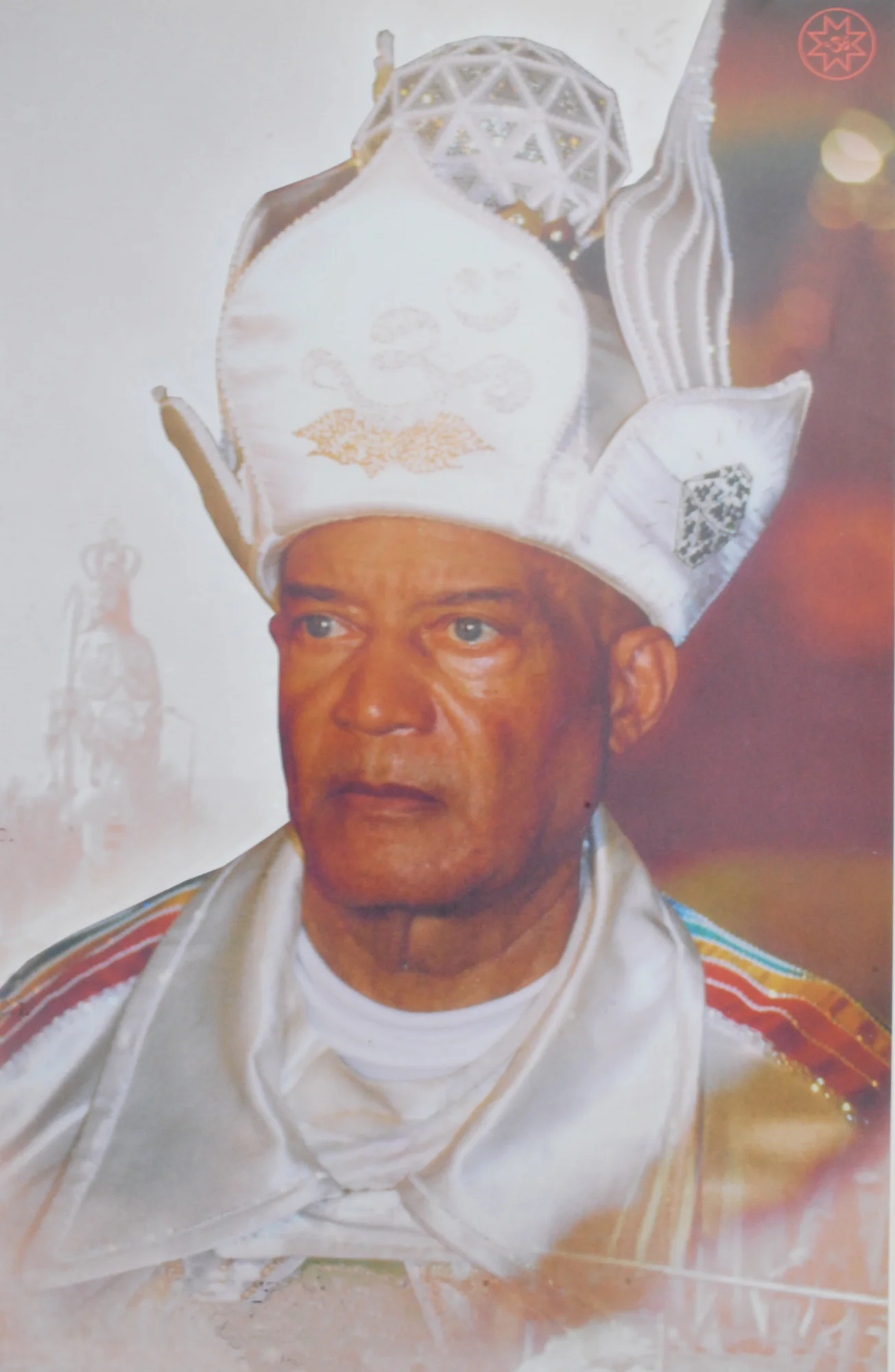
In this 3rd millennium, Lord HAMSAH MANARAH founded the Aumist religion, which offers answers to the questions of a changing world and helps everyone to be a builder of peace in their daily life, whatever their personal path. The Teaching of His Holiness Lord HAMSAH MANARAH does not segregate believers and atheists, or men and women of any race, for the Divine is present in everyone: “You have the right to deny the existence of God, but you have the duty to transform yourselves, to improve yourselves for the happiness of the world.”[1]
It is for the whole of humanity that the MESSIAH incarnated and worked in the visible and the invisible, so that from now on everyone is free to choose the path of Unity, the source of true happiness. He guides us towards autonomy: “I show you the way but cannot take it in your place. Do not refuse the effort to be made.”[2]
It is therefore up to each person to take charge of themselves and seize their chance to enter the Era of peace, faced with the choice that arises in every circumstance of daily life:
- for or against hatred and contempt;
- for or against kindness and respect for differences.
In the present situation, we are becoming aware that we are all sailors on the same ship, and that if one part of humanity is in difficulty, the others suffer the consequences. We are responsible not only for our own future but also for that of the planet. It is together that we must right the helm.
To close this conference, we will therefore address in this talk three points that we can all put into practice every day:
- 1. We can create a climate of peace around us.
- 2. We can educate the new generations for peace.
- 3. And we can help humanity through our thoughts of peace.
I. HOW TO CREATE A CLIMATE OF PEACE AROUND ONESELF
“If you think wrongly,” says His Holiness Lord HAMSAH MANARAH, “you will act wrongly; if you act wrongly, you will perpetuate wars; if wars are perpetuated, you will increase the misfortune of your planet.”[3] To contribute to peace, we have seen during this conference the need to take action in the direction of solidarity, justice and reconciliation towards people and nature. All this goes hand in hand with a positive way of thinking. This is not naive optimism. It is the ability to see the forces of life at work beyond daily difficulties and each person’s imperfections.
Choosing our thoughts
What happens if we do not look at ourselves positively, that is, with confidence in our ability to progress?
- We see nothing but our failings. We end up rejecting certain aspects of ourselves.
- This conflict deprives us of inner peace and damages our relationships, because we project onto others what we reject in ourselves.
What happens if we lock people around us into a negative view?
- We weigh down our mind with bad thoughts.
- If the evil we see is real, focusing our thoughts on it keeps it alive.
- If it is our imagination that projects evil onto the other person, it leads that person to react with resentment, or sometimes to conform to the idea we have of them.
In the end, we hold back both our own evolution and that of others, we make ourselves unhappy, and we feed the collective river of discord. To be at peace with oneself and with others, we must therefore cultivate a positive attitude towards ourselves and those around us. We must accept, then transform, what needs to be improved. And above all, we must remain centred on our qualities, on our noblest aspirations, on the Divine present in ourselves as in everyone. This is not easy, for there are obstacles within us that are sometimes deeply rooted… But if we persevere, this constructive attitude develops self-esteem and the confidence that allows us to cultivate kindness, which the Lord calls a “social duty”.
It then becomes possible to live in peace with those around us:
- to distance ourselves from the opinions of others, attaching no importance to malicious criticism while being able to recognise what can help us progress;
- to develop tolerance: to strive to tolerate at least 3 faults in those around us!
- to learn to forgive, which was developed in the talk on reconciliation.
Of course, we do not change our way of thinking completely overnight! It is the fruit of daily training, during which the Lord helps us with patience and love. Do malicious thoughts escape us? He gives us the means to neutralise them: “Restore the balance by building better thoughts and spreading them to infinity.”[4]
Do we sometimes relapse and lose heart? He restores our confidence: “God never abandons you; God does not count your falls, provided that you get up again.”[5]
He also urges us to raise our thoughts on the Path of Compassion, giving us the sublime example of the Realised Being, fused in God: “The man of Compassion fears the effects of evil more for those who do it than for himself.”[6] This is because hatred causes the misfortune of the one who cultivates it, just as love creates the conditions for happiness.
The prayer of OM
His Holiness Lord HAMSAH MANARAH offers us an extraordinary tool: OM, the prayer of peace. It is the first Name of God, the Word of Unity.
“The Sound OM is the Divine Name; it is the most powerful Sound; it is the symbol of the supreme reality. This is why chanting OM is an immense privilege.”[7] The benefits of OM are offered to all: “Even if you do not believe in God at first,” says the Lord, “test its miraculous effects…”[8] But for everyone there is one essential condition: the Sound OM must be repeated only with benevolent intentions.
- Repeating OM means pouring out a deluge of seeds of Light. It means taking part in the destruction of the “collective monster of hatred”. Let us remember that whoever prays for peace and for the happiness of others builds their own inner peace and happiness.
- Moreover, for those who wish to accelerate their inner transformation, the Sound OM makes it possible to cleanse the negative energies accumulated from life to life by each individual, which prevent them from evolving: “In every being there exist: negativity; apprehension and fear; pessimism; the ‘tamasic’ spirit that rejects all effort; feelings of guilt, self-punishment and self-destruction; attachment to the past and to memories; attachment to suffering and to karma, etc.”[9] This crystallisation of harmful energies lies beneath our feet (the “double of the depths”) and above our heads (the “aerial double”, which contains the memories of the soul since its creation). Sending the white light of OM into these shadowy areas purifies them. Our inner obstacles grow lighter and we can walk more and more freely on the path of peace.
These efforts by adults to move towards peace give children an example to follow and a favourable environment. “Children, who will be the adults and therefore the leaders of tomorrow, will, if they do not enjoy a harmonious and serene climate, be sometimes hateful and sometimes aggressive, and the whole of society will tremble on its foundations before the harvest of hatred reaped from the rising generations.”[10] With this in mind, they must also receive an education that opens them to respect and love.
II. SOME BASIC PRINCIPLES FOR EDUCATING CHILDREN FOR PEACE ACCORDING TO AUMISM
Education concerns all adults. Whether or not they are parents, they bear a responsibility towards young people through the example, advice and experience they can offer. We will take particular care not to lock young people in the prison of prejudice.
“Prepare your children to become Knights of universal Peace. This requires: the culture of non-violence, the absence of racism, sympathy for all nations, respect for all beliefs and religions, the greatest tolerance, universal Love.”[11]
Respect for the Divine present in every being
Aumism proposes a change of mentality that is necessarily lasting, because it rests on respect for the Divine present in every being. In a society that is losing its sense of meaning, too many young people have no bearings and no goal and are searching for an identity. They commit violence against themselves (we know the consequences of drugs, dangerous games and extreme, sometimes suicidal, challenges) and against others (we see minors committing various assaults, some of them deadly).
- Children will therefore benefit from learning from the outset that the Divine is present within them and that the meaning of life is to blossom by expressing It, that is, by developing the best of oneself. “Become the God that you are,” says the Founder of Aumism, inviting us to set out to win true happiness.
- With the idea that the Divine is in everyone, children will escape the contempt and violence that permeate racism and sexism. They will cultivate mutual respect and respect for differences.
Indeed, according to Aumism, through reincarnation each person has various experiences in bodies of different sexes, races and cultures, the goal being to move towards greater love. To reject someone who is different is to reject oneself, for we may already have been in their place in a previous life, or may be in a future one! - Knowing that God is the same for all, according to the principle of the Unity of the Faces of God, which can be summed up as “God is One, whatever the Name by which He is called”, young people will be able to escape fanaticism, sectarianism and wars of religion. They will show tolerance.
- Knowing that the Divine is in the whole of creation, which evolves within the Evolutionary Pyramid, they will learn to respect and protect all the kingdoms of nature.
Non-violence rightly understood
Non-violence is a fundamental value. However, non-violence must not be confused with a weakness that would submit to hatred!
His Holiness Lord HAMSAH MANARAH does not preach softness, for “goodness in weakness is not true goodness.”[12] Weakness breeds fear, and fear distorts human relationships: it makes people suspicious and aggressive and draws suspicion and aggressiveness from others; neither openness, nor trust, nor a positive outlook is possible. On the contrary, “strength imposes a true love that fear of the other does not come to profane.”[13] By practising the positive training of the mind (effective techniques are given in Le Yoga de la vie pratique), and by practising hatha yoga and the martial arts, children learn to master themselves and not to attack others, but they gain the strength to defend themselves if need be and to protect others.
In a text entitled the “Code of the young Knights of peace”, which you can find in L’Aumisme, la Doctrine de l’Âge d’Or, p. 248, the Lord gives young people landmarks for building a better future. Children thus acquire a sense of universality: “They dwell on what brings people together rather than on what divides them. They love their country faithfully but do not forget that they are citizens of the world and of the universe.” Let us add that some humanists do not believe in God but believe in man: they advocate educational values founded on respect, and we join hands with them to build peace.
As you can see, turning our mind into a power station that generates positive and benevolent thoughts gives a new dimension to our daily life:
- here and now, we can live in peace with ourselves and with those around us;
- we can go beyond the limits of time and prepare future peace through an education that gives young people the strength to establish and maintain peace;
- and we can also go beyond the limits of space and help human beings on every continent, which brings us to our 3rd point.
III. WE CAN HELP HUMANITY THROUGH OUR THOUGHTS OF PEACE
Prayers and benevolent thoughts lead to right action. Moreover, they are also in themselves a help for all. They feed a river of love. Whether we are at work, in a supermarket, at the cinema, at a stadium or at home, doing the housework or in front of the television, we can send thoughts of love to the other side of the planet to support those who suffer and to counterbalance thoughts of hatred.
“Through your beneficial thoughts, generate a powerful current of peace, fraternity and true love, strong enough to ward off war and social conflict.”[14]
His Holiness Lord HAMSAH MANARAH urges us to take charge of the future of the planet: “Raising the moral level of humanity by saturating human minds with optimistic, fraternal, unifying and constructive thoughts has become an urgent necessity. All human beings, believers and non-believers, should be invited to direct benevolent thoughts towards heads of state, peoples and nations, in order to prepare a future of social harmony and peace.”[15]
Thus all people of good will can contribute to peace by saying this short prayer:
“May Love, Harmony and Peace reign among all men, all peoples, all nations.
May the Golden Age crystallise on Earth.”[16]
CONCLUSION
In conclusion, if you will, let us think together of the men, women and children of our planet, which is today undergoing profound change:
- That all those who, in one way or another, are living in fear and trial may be helped… OM
- That positive thoughts of respect and tolerance may generate more and more just and caring behaviour, and triumph over violence in the daily life of every human being… OM
- That, through the awareness growing today, the change of mentality leading to peace may grow and accelerate among all the peoples of the world… OM
*******
[1] L’Unité des Visages de Dieu, p. 389.
[2] Ibid., p. 378.
[3] L’Aumisme, la Doctrine de l’Âge d’Or, p. 163.
[4] Ibid., p. 151.
[5] Une Loi pour détruire le Mal, p. 422.
[6] Le Maître spirituel et le disciple, p. 60.
[7] L’Aumisme, la Doctrine de l’Âge d’Or, p. 27.
[8] Vers un Âge d’Or d’Unité, p. 111.
[9] L’Aumisme, la Doctrine de l’Âge d’Or, p. 157.
[10] Ibid., p. 179.
[11] Le Yoga de la vie pratique, p. 277.
[12] Le Maître spirituel et le disciple, p. 102.
[13] Vers un Âge d’Or d’Unité, p. 446.
[14] L’Unité des Visages de Dieu, p. 390.
[15] Le Yoga de l’Amour dans la Force, p. 302.
[16] L’Aumisme, la Doctrine de l’Âge d’Or, p. 313.