SYMPOSIUMS
LECTURE
No. 8 – THE MONASTIC PATH IN AUMISM
THE MONASTIC PATH IN AUMISM
SUMMARY
In Aumism, everyone, wherever they are, can move towards Spiritual Liberation. But the short path of the Monastic Way is offered to those who wish it. Monks and nuns follow in the footsteps of His Holiness Lord HAMSAH MANARAH, initiated in 1961 by Swami Sivananda, who experienced Fusion in God and founded the Monastery of Mandarom Shambhasalem. Their ideal is “To love, to forgive, to serve, to meditate, to realise the Divine within oneself.” The symbols, temples and statues of different Traditions constantly remind them that “God is One, whatever the Name by which He is called”.
These exceptional conditions, which foster high-level spiritual work, do not exempt anyone from personal effort and the inner struggle that requires will and perseverance.
Service within the Community and in welcoming people from outside (external members, monks’ families, visitors), freely chosen monastic Discipline, and practices that develop Love and Knowledge connect the monk to the Divine in daily life. Prayers and meditations punctuate the days and are offered for the evolution of the Earth and of Creation. Inner happiness is born, moreover, of service rendered for the good of all beings.
TALK
Just as Aumism unites the main religious currents, the Aumist monastic path, inspired by its Founder His Holiness Lord HAMSAH MANARAH, embodies the ideal, authenticity and dynamism that presided over the flourishing of the monastic orders of all religious traditions.
The Aumist monastic path brings together men and women whose vocation is to devote themselves to prayer so as to radiate the energies of love, peace and brotherhood over the earth and the universes, in respect for the Unity of the Faces of God. “God remains the same, whatever the Name by which He is called”, is written in a sacred text of India, the Bhagavad Gita.
The Aumist monastic path is also the short path, taught in a spirit suited to our modern times, for the perfect expression of Buddhahood, of the Divine present in each person.
In this talk we will discuss:
- Part 1: THE FOUNDER OF THE MONASTIC ORDER, HIS HOLINESS LORD HAMSAH MANARAH
- Part 2: THE COMMUNITY OF MONKS AND NUNS
- Part 3: PRAYER AND SERVICE
I. THE FOUNDER OF THE MONASTIC ORDER: HIS HOLINESS LORD HAMSAH MANARAH
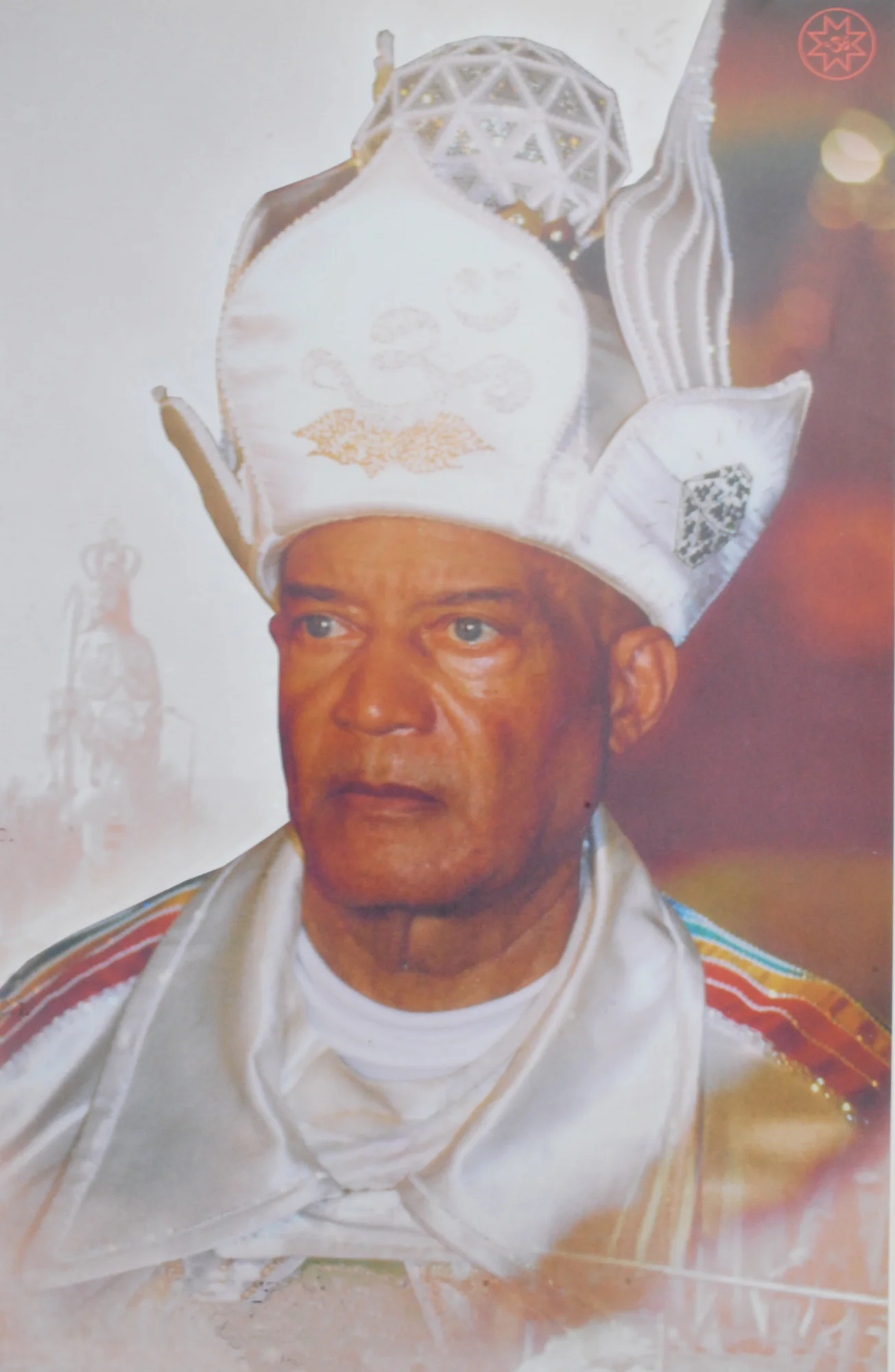
His Holiness Lord HAMSAH MANARAH is an Initiate of the highest rank. He was initiated into the main Western and Eastern traditions, in particular into Sannyasa for Hinduism by Swami Sivananda on 13 February 1961, and into the Lineage of the Lotus Masters for Tibetan Buddhism by His Holiness the 16th Karmapa in 1977. Like the great mystics of the past, His Holiness’s sole ambition was the life of a hermit in poverty and anonymity. It was the request of souls drawn by His radiance and His natural devotion to others that compelled Him to found several ashrams and then the monastery of Mandarom Shambhasalem. He says: “I had no pretension to teach… Circumstances arranged themselves so that, in spite of Myself and against My will, I had to instruct seekers on the path.” (Mémoires d’un Yogi, p. 29)
His Holiness Lord HAMSAH MANARAH experienced “samadhis”, or mystical ecstasies, and then renounced them in order to remain available and train His disciples. He thus combines perfect Knowledge with experience of the spiritual techniques that allow persevering disciples to reach the high planes of consciousness and Fusion in God, not for themselves but to help beings evolve. For all those who have had the privilege of approaching Him, He remains the Example of self-giving, simplicity, courtesy and fidelity to the principles of Love, Forgiveness and selfless Service. He writes:
“I know the conditions of existence,
The way that leads to the goal;
I followed it laboriously
To set the example.
I have completely destroyed the principles of Evil.
My actions, My words and thoughts proceed from Knowledge.
The degrees of ecstasy, known in theory, have been explored in practice.
I have become the elephant of men,
The Ferryman across the planes of consciousness.” (L’Unité des Visages de Dieu, p. 347)
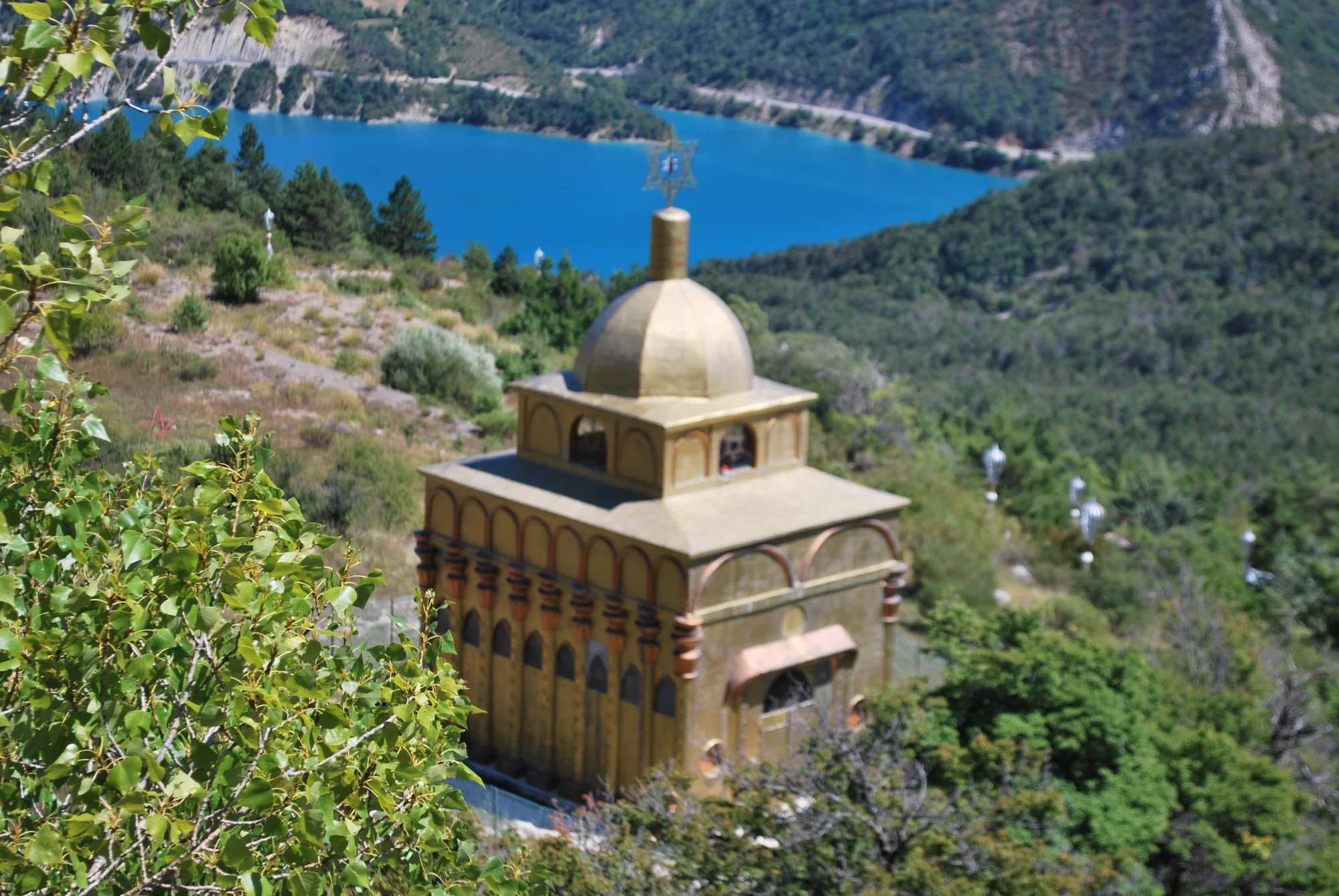
The monastery of Mandarom Shambhasalem is a privileged geographical site because of the quality of its setting. Its Temples and statues bear witness to the exceptional spiritual experience of Lord HAMSAH MANARAH shared with the disciples. These symbols are the crystallisation of billions of prayers and sacred sounds, which act as so many catalysts of positive energy for the region, for France, for the Earth, for all the universes, and so on. Each Temple and each statue is a reminder of the essence of the Divine message as found in the great religions, for the advent of the Golden Age. For example: Love with Christ and Maria Cosmica; Wisdom full of compassion with the Buddha; the Divine Fire with Kalki; the Great Forgiveness with the Golden Temple; Divine Unity with the Mosque; Spiritual Liberation with the Lotus Temple; and the Unity of the Faces of God with the statue of the Cosmo-Planetary Messiah.
The Holy City of Mandarom Shambhasalem is therefore a sacred space where the different religions live harmoniously side by side in all their symbolic and architectural diversity. It is the material proof of the coexistence and reconciliation of religions which appear very different but whose teachings help beings of all origins to go back to the same source. “The Monastery of Mandarom is a Power Station of Spiritual Energy, indispensable to maintaining the balance of the Cosmos and to safeguarding it” (Périple d’un Yogi et Initié d’Occident, p. 14).
II. THE COMMUNITY OF MONKS AND NUNS
1. Regarding aspirants:
The Monastic Way is open to external members who have been members for a minimum length of time, to make adaptation easier. One must have reached the legal age of majority and be free of family and social obligations, because no couples or children live permanently in the Centre. The Monastery is neither a holiday village nor a refuge for the socially maladjusted. The probationary period may last several years in order to test the aspirant’s will. Yet surprises do happen, even if they are rare: once a brother crossed the ocean with his girlfriend and his dog, asked for a double room and applied to become a monk! With a little diplomacy and a few explanations, misunderstandings are cleared up and everything quickly returns to normal.
2. Community life:
It allows one to take better stock of one’s degree of evolution. It acts like a chain in which each link plays its part in tempering characters, maintaining vigilance and overcoming inertia through renewed efforts. The personalities in the monastery reflect the colourful civilisations of our planet: “The school you are going through is irreplaceable,” says the Lord. “In the Community, you are like so many stones thrown against one another in the same torrent until they become polished and perfect, like the pebbles found in the Verdon… It is up to you to know what you want…” (La Voix de Lumière, p. 392)
“The essential conflict that divides the soul is not diminished but intensified by the monastic vocation” (Périple d’un Yogi et Initié d’Occident, p. 22).
3. One does not flee the world; one carries it with oneself, whether in a cave or in a monastery. The aridity and grandeur of the landscape and the simplicity of the living cells naturally help one to break free from the many solicitations that drain the senses and the mind of our humanity. This renunciation and detachment foster introspection and increase one’s strength, so that one can better devote oneself to the service of the world through prayer and purification.
4. The Spiritual Master and the Disciple:
The High Teaching given by the Spiritual Master during Initiations and ascetic practices requires of the disciple unfailing determination and unshakeable trust in order to progress on the path and thwart its many pitfalls. We accept that an athlete submits to the authority of his coach in order to apply the methods that will make him a champion. We understand that if the bonds uniting the disciple to his Spiritual Director are close enough, the disciple, by redoubling his ardour, has a better chance of success on the path of Spiritual Liberation. In practice, the Spiritual Director intervenes to clarify the Teaching according to the disciple’s progress, the qualities the disciple must acquire or develop, and the problems he may encounter during his ascetic practice.
5. Monastic Discipline:
“The word disciple means one who follows a discipline; how then can one be a disciple without being disciplined?” (Le Maître Spirituel et le disciple). As in the various religious traditions, respect for freely accepted Discipline is a duty for the monk; it is a salutary help for perfecting oneself in one’s ideal. It is accepted without constraint, and even with joy. The life of the Great Instructors is a discipline followed unceasingly, for perfection has no limit, and whoever does not advance falls back.
His Holiness Lord HAMSAH MANARAH writes:
“Discipline, O Initiate, is the cornerstone of every Initiatic Order. Discipline is indispensable for the Ideal of the Golden Age to advance. It presupposes:
Mastery of the body.
Cleanliness of the body.
Mastery of gestures.
Mastery of passions, instincts and emotions.
Discipline of the mind.
Discipline of the imagination.
Discipline of speech.
Community discipline.” (L’Unité des Visages de Dieu, p. 335)
Respect for these principles makes relations between members of the Community easier. The Rule of the Monastery is simple and accessible. For the monks and nuns of the Holy City of Mandarom Shambhasalem, observing it is one of the ways of becoming one with the Spiritual Father.
His Holiness Lord HAMSAH MANARAH wishes that there should reign in an Aumist monastery:
“Humility, Compassion, Tolerance.
The true spirit of renunciation and poverty.
Deep love in true brotherhood.
The will to serve in self-forgetfulness.
The cultivation of silence.
Self-mastery.
Exercise and training in endurance.
Austerity that does not exclude a state of joy.
A climate of research and study.
The cultivation of the highest virtues, including non-violence in thought, word and deed.
A taste for effort and struggle.
The courage to face difficulties in the hope of better times.
The strength to accept oneself while fighting the little monsters that slumber within.
Freely accepted discipline, indispensable to harmonious community life.
Forgetfulness of the little self in order to reach inner mastery with a view to Spiritual Liberation.”
(L’Unité des Visages de Dieu, p. 350)
For the internal organisation and openness to the outside world, service in daily tasks is also important. In addition to maintenance, accommodation and catering, the climate of prayer and the vibratory quality of the monastery allow brothers and sisters from outside to recharge. They then share in a fraternal spirit the many community activities with the permanent residents. Interested people visit the Temples of the Holy City every weekend and during the holidays: a guide explains the symbols and the Aumist religion to them, and they can also attend a service, share a meal or listen to religious chants. When they wish, the families of monks and nuns are received at the Monastery. In general, these contacts are enriching and the surprises pleasant.
III. SERVICE AND PRAYER
His Holiness Lord HAMSAH MANARAH defines prayer as “an impulse of the soul in which thought, word and gesture unite in an aspiration to obtain the grace of the Most High. Prayer is a force which not only exalts the creative possibilities of the being but allows us to benefit from the contribution of higher energies outside ourselves” (L’Aumisme, la Doctrine de l’Age d’Or, p. 317).
a) The seven hours of collective prayer are at the centre of the monastery’s activities. The day begins at 6 a.m. with the first collective prayer, and the last prayer ends at 9 p.m. Another form of prayer is actions performed with detachment, without hope of reward: they are an offering, a gift of oneself to GOD. In small tasks as in great ones, the monk strives to be a channel, an instrument of the Divine. It is a privilege, a grace, to work in the thousandfold blessed Monastery of MANDAROM SHAMBHASALEM.
“A monastery,” says Lord HAMSAH MANARAH, “is a power station of Spiritual Energy spreading its prayers over each and every one, beyond divisions, borders, races, peoples and religions” (Une Loi pour détruire le Mal, p. 87).
The monks pray for all the kingdoms of nature and for the visible and invisible worlds.
b) Developing a sense of the general interest and increasing one’s individual strengths and abilities in the balance of body and mind are the key factors of achievement and success.
The regular practice of Hatha yoga and controlled breathing is recommended to tone the body, the main instrument for surpassing oneself. All these exercises stabilise the activity of the mind, allow the transmutation of vital energies and self-mastery, and develop the psychic faculties. They ensure better preparation for meditation and a saving of energy in the various activities.
c) Another essential focus of the work is the opening of the heart to universal Love, together with Knowledge. Lord HAMSAH MANARAH explains: “Much love and little intellectual openness widen the gap in discernment in extreme situations. A keen intelligence reigning over a dry heart feeds a pride that leads to excess. Love and Knowledge are the two pillars of True Wisdom” (Le Yoga de l’Amour dans la Force, p. 152).
Love stripped of all sentimentality and all petty feelings is a powerful bond between members of the same spiritual family. The monk’s sincere devotion to His Holiness Lord HAMSAH MANARAH is the simplest and most precious expression of his gratitude for what he receives each day in order to accomplish his individual and collective mission. This devotion to the Spiritual Master is the Royal Road for sublimating limited human love, leading to Transcendent and Universal Divine Love. It is the conviction that beyond time and space there is this omnipresent, omnipotent and omniscient Principle that is always there when a being works in Unity or sincerely seeks the Light.
For Aumists, GOD incarnates through the lineage of the HIEROKARANTINES, bearing witness to the Unity of the Faces of GOD, in particular through the rebuilding of the Pyramid Temple. “The Pyramid Temple is the guarantee of a better future, of a lasting Golden Age, of a reconciled humanity that has rediscovered its unity with God the Father, Creator of all things” (Une Loi pour détruire le Mal, p. 297).
CONCLUSION
“Spiritual Liberation consists in freeing oneself from the barrier of the mind, from the illusion of believing oneself separate from GOD. The purpose of life in the Golden Age:
- is to offer human beings the means to take advantage of the trials of existence to develop their qualities and transform them into high virtues…
- is to offer human beings the opportunity to raise their level of consciousness, so as to reach true happiness and bliss.” (La Doctrine de l’Aumisme, p. 149).
In fulfilling their vocation, monks and nuns do not seek happiness for themselves. By carrying out their service of prayer and purification, which benefits everyone, they experience a state of fullness and joy despite the obstacles coming from themselves or from outside, despite the ups and downs of every human journey. The mere pursuit of their Ideal and the mere practice of the Teaching fulfil them. In it they find the strength to persevere in the inner struggle, the forward movement in full Knowledge of the laws of the Golden Age and of the Consciousness that governs them.
“May the Divine and Cosmic blessing spread over the Monastery of MANDAROM SHAMBHASALEM so that it may always be a Haven of Peace, Love, Light, Harmony, Wisdom and Happiness for all.”
OM TAT SAT OM
Bibliography:
The 22 Books of His Holiness Lord HAMSAH MANARAH, Éditions du MANDAROM
- Règles monastiques d’Occident, IVe-VIe siècle, d’Augustin à Ferréol
- J. Lacarrière, Les hommes ivres de Dieu
- L. Lekai, Les moines blancs. Histoire de l’Ordre cistercien
- Règles des moines: Pacôme, Augustin, Benoît
- Dom C.J. Nesmy, Saint Benoît et la vie monastique
- H. von Campenhausen, Les Pères latins
- The Bhagavad Gita
- Brahmananda, Disciplines monastiques
- P. Carus, L’Évangile du Bouddha
- Lama Govinda, Le chemin des nuages blancs
- La vie de Milarepa
- Books by A. David-Néel