SYMPOSIUMS
LECTURE
No. 8 – AT THE HEART OF THE AUMIST RELIGION: LEARNING RESPECT
AT THE HEART OF THE AUMIST RELIGION: LEARNING RESPECT
In the Age of division called the Iron Age, contempt generates the worst violence on both the individual and the collective level.
Entering the new era means beginning by restoring respect at every level. To respect is to “take into consideration”, to “pay attention to”. This quality of attention alone can renew the bonds between man, his fellow human beings and his environment.
Of course, the Aumist religion is not alone in working to restore respect. And fortunately so, because all goodwill is needed, regardless of religious or political affiliation. At present, for example, with alarm bells ringing almost everywhere, human beings are beginning to understand that it is in their interest to respect the environment. This reaction to the threats of the moment is certainly already useful: it is changing some behaviour.
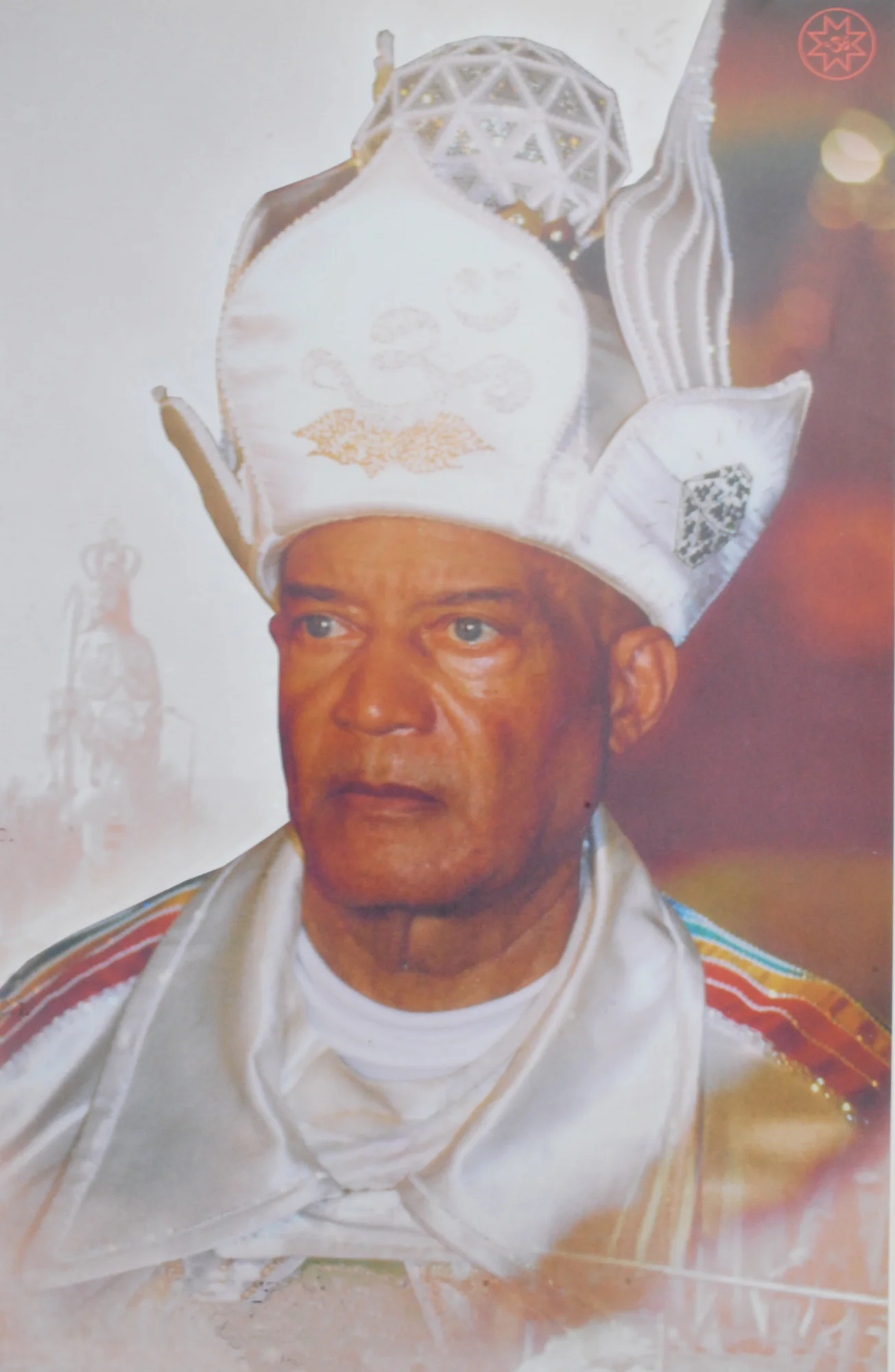
However, to bring about a real change in mentalities and regenerate the planet in depth, awareness must go further. The Aumist religion therefore teaches the deep meaning of respect: its Founder, His Holiness Lord HAMSAH MANARAH, brings both Knowledge, since ignorance breeds contempt and violence, and the Example that serves as a guide. Both are necessary for any learning.
In the first part, we will therefore recall the three main lines of the Teaching that have been discussed during this symposium.
In the second part, we will discuss the example of respect given by its Founder, His Holiness Lord HAMSAH MANARAH.
I. IN THE AUMIST RELIGION, KNOWLEDGE FOSTERS LEARNING RESPECT FOR THE ENVIRONMENT, FOR OTHERS AND FOR ONESELF
Respect is a moral value indispensable to social harmony. This value, which can bring atheists and believers together at the bedside of the planet, is therefore of great importance for Aumism, which is at the service of social and planetary peace.
But in the Teaching of His Holiness Lord HAMSAH MANARAH, respect also has a spiritual dimension: to respect living beings is to respect the Divine present in each one. This is what guarantees a truly lasting responsibility for the individual and collective future.
1. Becoming aware of the presence of the Divine in all the kingdoms means respecting Nature: this is the foundation of Aumist ecology.
According to Aumism, since human consciousness is the fruit of a slow evolution through the various kingdoms, man has the inescapable duty to respect nature by acting to protect it and by praying for its evolution within the Evolutionary Pyramid of the kingdoms of nature.
2. Becoming aware of the presence of the Divine in every human being means respecting others.
According to Aumism, this is the foundation of social and planetary peace.
“The society of the Golden Age,” Lord HAMSAH MANARAH affirms, “will not be built on anarchy, disorder and the lack of values that divide families, peoples, nations and religions. The ideal of Unity presupposes a value of tolerance and mutual respect that must be shared by all.”[1]
He attaches great importance to mutual respect, which is learned first within the family and fosters true solidarity between generations.
Moreover, respect for human value, emphasised by the Declaration of Human Rights, means seeing in differences the richness of complementarity and not sources of division. Thus:
- men and women must learn to respect each other;
- human beings of different cultures and different races must learn to respect each other;
- and “whoever retains within themselves even the slightest prejudice regarding race, class or ideology is unfit for the Kingdom of God”,[2] warns His Holiness Lord HAMSAH MANARAH.
Indispensable respect for freedom of conscience and freedom of thought, so important in Aumism, which respects both atheism and other religions, prevents the hatred born of intolerance, sectarianism and fanaticism, which are the sources of wars and persecutions.
The balanced position for an Aumist is therefore to transcend all social prejudices, to respect the laws and institutions of the country in which they live, but to remain in their heart a citizen of the universe.[3]
Respect for the environment and respect for others are familiar notions. But it is also important to look within oneself.
3. Becoming aware that the Divine is present in oneself, as in each person, means respecting it by developing one’s spiritual dimension.
“How can one achieve reintegration into the Divine Consciousness if one makes the mistake of debasing the soul?” asks His Holiness Lord HAMSAH MANARAH.[4]
We can therefore understand the meaning of this sentence by Ramakrishna: “A true man is one who has self-respect.”
Ultimately, the key to respect is not to forget that “the sound OM beats in every mineral, every plant, every animal and every human being…”[5]
That is why the OM prayer, the Creative Word that fosters the evolution of all, goes hand in hand with action that brings concrete help in matter.
In the Aumist religion, as in every authentic religion, the Founder fosters awareness and human progress by bringing not only Knowledge but also the Example. He thus serves as a Guide. Here, then, is the second part of this talk.
II. THE FOUNDER OF AUMISM SETS THE EXAMPLE OF RESPECT
For the purposes of this talk, I will present a few aspects of the example of respect given by the Founder of Aumism, but of course they are closely intertwined. They express the inner Unity of the Realised Being who has merged with the Divine, thus showing human beings how far respect for the Divine within oneself can lead, and showing that all obstacles can be overcome to reach the goal of life: fusion in God, which opens onto infinite Compassion.
The Compassion of Lord HAMSAH MANARAH is expressed in the smallest details of daily life through the attention He pays to all beings.
One example: as He was making a round of the monastery, the disciples surrounded Him without noticing that a couple had just arrived laden with luggage. Without a word, the Lord went over to them and took the lady’s suitcase to carry it to her lodging.
He has always shown consideration for stones, plants and animals, blessing them along His way. In the monastery, in particular, there was a little dog that was receptive to this respect and love, and that managed to repeat the sound OM with Him by modulating its bark!
1. As a Spiritual Master, Lord HAMSAH MANARAH respects the journey of His disciples
Respect for each person’s religious origin: He welcomes disciples of various backgrounds without obliging them to leave their religion.
Respect for each person’s pace
“Each aspirant,” He says, “is a case distinct from all the others, to which the methods of a single instructor adapt. Each disciple has a pace suited to their aptitudes and their plan of evolution.”[6]
We can indeed see that the books of His Holiness Lord HAMSAH MANARAH accompany us through life according to our own evolution: even after reading the same book several times, there are always aspects of the Knowledge that had escaped us until then and that now penetrate heart and mind.
Respect for individual freedom
Religious faith is inseparable from freedom. It is the opposite of conditioning. It is a personal choice that no one can impose on another.
“Every being has the right to withdraw from a group or to leave an instructor if they feel unable to follow him and are not in harmony with his teaching,” says Lord HAMSAH MANARAH. “Nothing, however, prevents one from doing so with elegance, dignity and nobility.”[7]
One day, a monk asked to go back to his family for two months, and the Lord replied: “I advise you to stay outside for four months instead. That way, if you come back, you will have taken the time to make your choice.”
Respect for autonomy
“The aim of the true Master,” says Lord HAMSAH MANARAH, “must above all be to bring the disciple to their own spiritual majority. He takes care not to encourage an overly childish tendency towards dependence. It is his duty to prepare the aspirant to do without him through the awakening of the inner Master.”[8]
And if some came to ask for help with everyday problems before trying to solve them, the Lord would send them back to themselves, to their ability to take charge of themselves: “You have all the Keys to find the solution.” He liked to use this image: the spiritual Master prepares a good meal, but he cannot eat it in the disciple’s place!
2. Lord HAMSAH MANARAH sets the example of respect as the Founder of a religion
Respect for the different Traditions
As you have heard during the symposium, the single dogma of Aumism, the Unity of the Faces of God, implies respect for the different Traditions:
“God, through His many Emanations, delivers to each civilisation and each humanity the same message of Love, Peace and Fraternity. That is why all religious beliefs are worthy of respect, provided they were founded by one of the Envoys of God whom the Divine sends from Age to Age to save humanity better.”[9]
The Lord Himself has set an example visible to all. The love and respect that His Holiness Lord HAMSAH MANARAH has shown towards all Traditions have not escaped the great Sages and Dignitaries of these Traditions of East and West: in return, they conferred on Him titles and the highest initiations as tokens of spiritual esteem, thereby recognising the qualities of a realised soul.
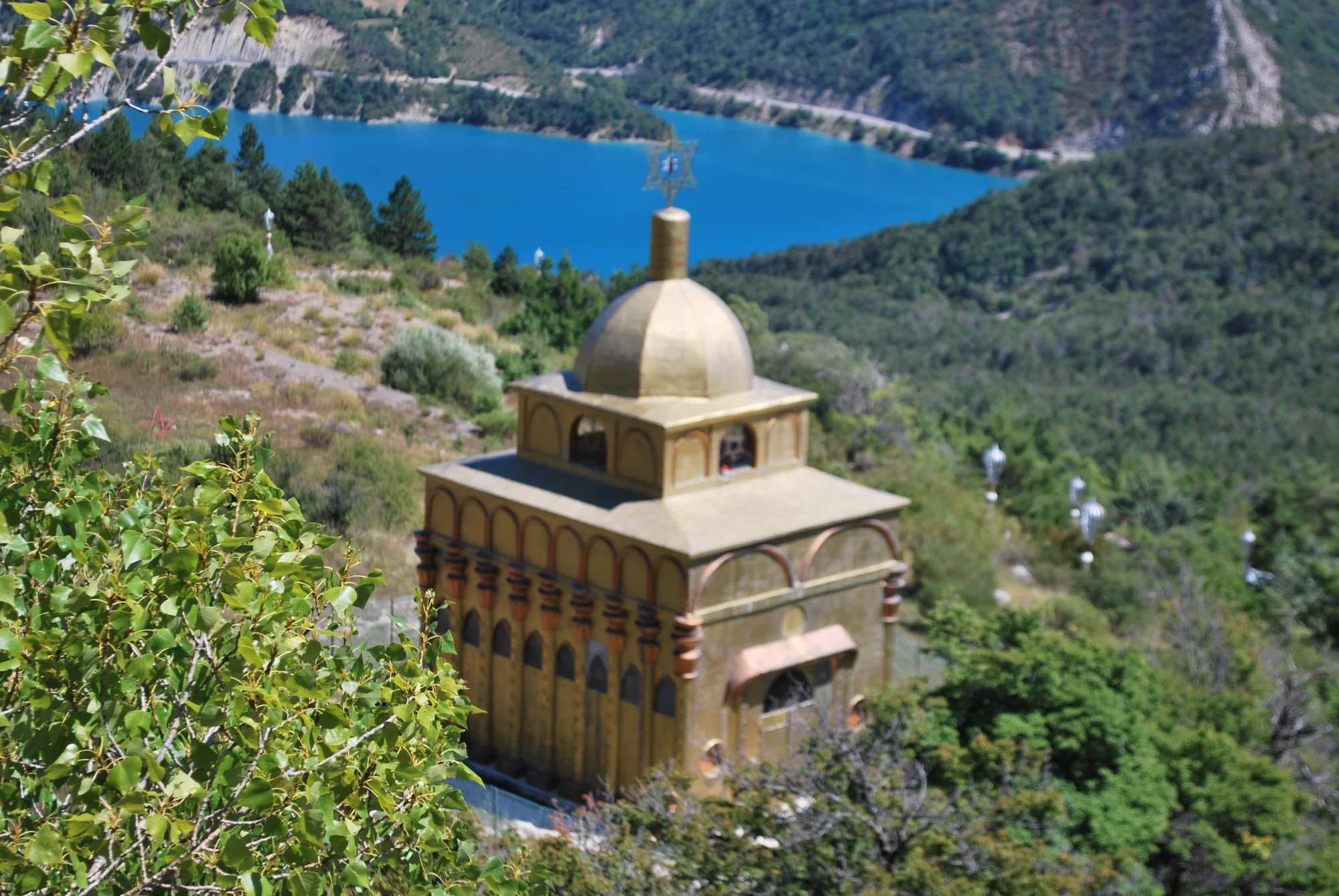
“I do not preach in theory, but have entered into the heart of each religion and have loved and venerated all the Prophets and all the Messiahs of the past… I put my Body into resonance with each Sacred place and then built the ideal of Unity in the Holy City of Mandarom Shambhasalem, clinging to the side of a mountain in Haute Provence.”[10] You visited this Holy City yesterday: you saw that building temples and statues of different Traditions in the same place is a symbol of respect and love for believers of diverse backgrounds. The Lord’s wish is that each person should find there what speaks most to their heart.
The building of the Pyramid Temple of Unity is also to be a symbol of Unity in respect for differences. It will include architectural elements from different traditions. Not because ingredients would be taken from here and there, but because the return to peace is a return to the original unity of religions.
It will welcome men and women of goodwill from all Traditions.
3. Respect is an aspect of the divine Compassion of the MESSIAH
The Mission of the Founder of Aumism as MESSIAH is to intervene to help save the planet when it is suffocated by destructive thoughts and acts. The MESSIAH intervenes in many ways in the visible and the invisible. But if human beings only had to let God smooth out their difficulties, they would change nothing in their harmful ways of thinking and behaving, and they would not know how to safeguard peace. The MESSIAH comes to help our humanity learn a lasting fraternity, which begins with learning respect.
He comes to heal humanity of contempt. To do so:
The MESSIAH Himself expresses His respect for the Divine in each being
He pays homage to the Supreme Self in each disciple He welcomes:
“When we affirm this great truth, ‘Homage to the Almighty God present in each one’,” He says, “it means that we bow down before this Pearl of Light that the Spirit of Unity has placed in every soul, in every human body, in every animal, plant and mineral of the Evolutionary Pyramid.”[11]
The MESSIAH teaches the lesson of respect even towards the intolerant
By accepting the Mission of helping human beings change their mentality and regain their saving unity, the Divine Envoy exposes Himself to the aggressiveness of those who do not want to improve. Yet Lord HAMSAH MANARAH writes: “We are respectful of the police, the justice system, political parties, religions and the rights of all categories.”[12] The religion He founded is at the service of social and planetary peace. And He Himself responds to intolerance by setting the example of respect and non-violence, thus expressing His divine Compassion.
“I, Sir, respect you!” He replied to an intolerant man who was particularly insulting towards Him.
The Lord teaches us that the key to this inner calm, which has to be won, is to see God in the other person even if they behave unacceptably. He teaches us that Compassion is expressed by praying for the evolution of those who let themselves be caught in the infernal trap of contempt and violence.
And finally:
The ultimate respect for human freedom is expressed in the Judgement of the End of Time
Having come to help human beings take charge of the future of their planet, the MESSIAH demystifies what is called the Judgement of the End of Time. It is not a punishment for past mistakes. The MESSIAH came to grant His great Forgiveness to all, so that each person might be freed from a heavy past and be able to make their choice freely. The Judgement is a choice offered here and now, “For or against the Golden Age”, that is to say for or against the change of mentality that allows us to break out of the cycle of violence in all its forms and to rediscover the taste for true happiness and the capacity to be in harmony with all that lives.
The Messiah says to each person: “The future belongs to you; the decisive choice for your destiny is in your hands.”[13] He warns us of the terrible consequences for our planet if we refuse to change individually and collectively. But He gives us the choice, respecting each person’s freedom, because the lasting change that will save the planet is the fruit of a free and responsible commitment, of a voluntary effort.
IN CONCLUSION
To conclude both this talk and this symposium on the importance of respect, let us recall that learning respect characterises the Teaching of the Aumist religion, whose aim is that of an authentic religion, whose mission is to bind together (from the Latin religare).
Respect restores the bond:
- between human beings and God present in each one;
- between human beings and their fellows;
- between human beings and nature, which is alive.
That is why Aumism is the religion of Unity in respect for differences:
“Unity is above all union in respect for differences, not their disappearance,” says His Holiness Lord HAMSAH MANARAH.[14]
*******
[1] Vers un Âge d’Or d’Unité, p. 141.
[2] Une Loi pour détruire le Mal, p. 418.
[3] See L’Aumisme, la Doctrine de l’Âge d’Or, p. 332.
[4] La Réintégration divine par le Yoga, p. 75.
[5] La Révolution du monde des vivants et des morts, p. 198.
[6] La Réintégration divine par le Yoga, p. 149.
[7] Le Maître spirituel et le disciple, p. 226.
[8] Le Maître spirituel et le disciple, p. 125.
[9] Le Flambeau d’Unité, p. 64.
[10] Vers un Âge d’Or d’Unité, p. 518.
[11] Vers un Âge d’Or d’Unité, p. 552.
[12] Périple d’un Yogi et Initié d’Occident, p. 88.
[13] Vers un Âge d’Or d’Unité, p. 545.
[14] La Révolution du monde des vivants et des morts, p. 85.