SYMPOSIUMS
LECTURE
No. 5 – AUMISM AND RESPECT FOR THE HUMAN PERSON
AUMISM AND RESPECT FOR THE HUMAN PERSON
From Human Rights to Divine Laws: from Respect to Compassion
This talk on respect for the human person has three parts:
- respect for freedom of thought and conscience;
- respect for the person regardless of race, class or sex;
- respect for the Divine Laws: from respect to compassion.
In the last part, we will dwell on respect for the Divine Laws revealed by His Holiness Lord HAMSAH MANARAH to guide Humanity along the path of evolution that leads from Respect to Compassion.
I. Respect for freedom of thought and conscience
Respect is one of the themes of Aumism in that it flows from other qualities or feelings such as Love, the feeling of unity with all that lives, self-knowledge, and humility too. Respect has several levels. As a moral value it concerns everyone and is necessary for social peace, independently of the feeling of unity. Moreover, it reaches its highest degree, which is spiritual, with the feeling of unity. We cannot respect others if we do not respect ourselves, if we do not respect the Divine spark that is within us and within each one of us. We cannot respect others if we do not respect our own body, which is the Temple of God and infinitely precious.
How can we respect others as long as we have not realised that we are all countless cells of the body of God, totally interdependent and indispensable to one another? An Indian sage said: “I am not going to pull out my teeth because they bit my tongue!”
The feeling of unity with all human beings, all animals, all plants and all minerals inevitably leads to respect for others at every moment of our lives. If we do not respect others in their way of living, believing and praying, it is because we believe them to be different from us, strangers to us, but that is an illusion. Beyond our apparent differences, we are all made of the same atoms, the same molecules and the same organic components; our hearts beat, the same blood flows in our veins, and it is the same colour for all.
We all have a mind and a soul; we are all born in the same way and we will all die one day. Between these two points there is an infinite variety of forms, appearances, faces, bodies, landscapes, life paths and experiences through which we grow and evolve.
Aumism is the religion of the Unity of the Faces of God. Indeed, as the Bhagavad Gita says, “Whatever name is given to Him, God remains the same.” Aumism is therefore based on this notion of respect for the opinion of others, respect for the other’s representation of God. Christ, the Buddha, Allah, Jehovah and Krishna are only different Faces that God has shown to human beings, each Face being adapted to a culture, a civilisation and an era, but the Divine Energy is the same. That is why studying the various religions and traditions of the earth shows how similar they are in essence and how the same notions are found in their teachings. Hence the fact that 60% of the conflicts on the planet are religious in nature, that blood flows every day in the name of GOD and that religions oppose one another becomes absurd in the eyes of anyone who has studied them. Far from being opposed, religions are complementary through their apparent differences.
So how can Christians, Jews, Muslims, Buddhists or Hindus fail to respect one another, when they have the same goal and, through different doctrines, prayers, rites and dress, are brothers?
That is why Aumism respects, studies, understands and loves all religions, which are steps for rising back towards God, towards the Divinity present in every human being.
Respect therefore comes naturally from knowledge, which leads to the feeling of unity, which in turn leads to sharing with the other, since he is my fellow, part of my family, my human family, my family of living beings. I therefore respect others naturally, even if their prayers are in another language, even if their skin is a different colour, even if their houses do not have the same architecture as mine.
And we see this clearly during a disaster, a hurricane, an earthquake or a tsunami: whether it happens on our shores or at the other end of the world, we suffer with the victims, we identify with them, we feel compassion (etymologically, compassion means “to suffer with”), and this gives rise to solidarity. We want to help them, send them aid, give them food and drink; they are like us, and if it happened to us, we would want others to do the same for us!
“Do not do to others what you would not want done to you” and “Do to others what you would want done to you”: is this not the basis of respect, present in the Golden Rule found in all religions, which has passed into popular wisdom yet has great practical significance?
Instead, people want power over others, they want to profit from the work of others, they want others to have the same ideas as they do and the same Face of God as they do, they want to enslave their fellow human beings, and they are ready to kill without hesitation those who do not look like them.
What ignorance of the laws of the universe, when we know that our thoughts, words and actions come back to us as surely as a ripe apple comes away from its branch and falls to the ground. Whoever lives by the sword will perish by the sword, but if we strive to respect others, they will respect us too.
At this dawn of the Golden Age, at the beginning of this new cycle for humanity, moments of awareness will multiply and lead human beings to greater love for their human brothers and sisters and for all that lives and is part of the cycle of nature, and to greater knowledge of themselves and therefore of others.
On the pediment of the Temple of Delphi was written “Know thyself and thou shalt know the gods, men and the universe”, and a little later Socrates said:
“Is it not obvious, dear Xenophon, that men are never happier than when they know themselves, nor more unhappy than when they are mistaken about themselves?”
Indeed, those who know themselves are aware of what suits them and can tell what they are and are not capable of. They limit themselves to speaking of what they know, seek to acquire what they lack and humbly refrain from what is beyond their abilities; in this way they avoid mistakes and faults. Those who do not know themselves and are mistaken about themselves are in the same ignorance with regard to other people and human affairs in general.
Self-knowledge therefore seems to be the first science.
More than ever, man needs to know himself so that civilisation may evolve towards greater love and respect for others. More than ever, man must realise that he is capable of the best but also of the worst.
He achieves the best by respecting the Divine Laws taught by religions, sacred texts, philosophies, morality and very often the popular common sense that springs from age-old wisdom.
He achieves the worst by scorning these same Laws, in ignorance of what he is and of what all human beings are. He achieves the worst through frenzied selfishness and the feeling of individuality and separateness, which lead straight to the misuse of power, to dictatorship, despotism and enslavement, and therefore to disrespect for others, or even to their outright negation.
For a dictator, the other does not exist; he is only an obstacle to the dictator’s thirst for power over his people, which at last gives him the impression of existing. To this end he can kill without any respect for human life. The human body, that sublime divine creation that breathes, moves, thinks, speaks, sings and can create marvels: he has no respect for it. One may well wonder what respect such a bloodthirsty despot can have for himself! He generally ends up riddled with bullets or tortured to death, reaping what he has sown according to the law of cause and effect.
The intolerant, whether religious, racist, political or intellectual, do the same with the human mind and conscience: they want to govern, manipulate and enslave them so that others cannot think any differently from themselves. For them there is only one way of thinking, theirs; only one ideology, theirs; only one Face of God, theirs; and they want nothing of the rest and do not respect it.
Anything else would call into question their power, their fortune and their supremacy; they would risk losing everything. But being limited, because focused on themselves or on their caste alone, they do not want to acquire self-knowledge, even though it would bring them more peace, serenity and tranquillity, and above all a better future. Is it not ignorance and fear of the unknown that make them so intolerant and aggressive?
At his best, man has enacted laws so that people respect and tolerate one another, if they cannot love one another.
The United States Declaration of Independence of 4 July 1776 states: “We hold these truths to be self-evident, that all men are created equal, that they are endowed by their Creator with certain unalienable Rights, that among these are Life, Liberty and the pursuit of Happiness. That to secure these rights, Governments are instituted among Men, deriving their just powers from the consent of the governed, That whenever any Form of Government becomes destructive of these ends, it is the Right of the People to alter or to abolish it, and to institute new Government…”
The Declaration of the Rights of Man and of the Citizen, adopted in August 1789, is part of the French constitution and governs French law. It is often summed up by its first article, “Men are born and remain free and equal in rights”, but it also guarantees individual liberty, the rights to property, security and resistance to oppression, freedom of the press, and freedom of opinion and conscience, including freedom of religion and worship.
At his worst, man does not respect these laws, twists them and tries to go back to intolerance, enslavement, despotism and disregard for the freedoms, thoughts and beliefs of others.
The European Court of Human Rights was created in 1959 to ensure respect for the Convention for the Protection of Human Rights and Fundamental Freedoms, usually called the European Convention on Human Rights. This convention was adopted by the Council of Europe in 1950 and came into force in 1953, after being ratified by ten States.
The purpose of this international legal text is to protect human rights and fundamental freedoms by allowing judicial review of respect for these individual rights. It refers to the Universal Declaration of Human Rights, proclaimed by the General Assembly of the United Nations on 10 December 1948, whose first article reads: “All human beings are born free and equal in dignity and rights. They are endowed with reason and conscience and should act towards one another in a spirit of brotherhood.” The declaration contains 30 articles, and on reading it one realises that very few are respected.
As an example, I will quote only Article 18, which concerns us particularly, since we have suffered persecution for more than 15 years because of our beliefs and of the Aumist religion that we chose in accordance with our conscience.
Article 18
“Everyone has the right to freedom of thought, conscience and religion; this right includes freedom to change his religion or belief, and freedom, either alone or in community with others and in public or private, to manifest his religion or belief in teaching, practice, worship and observance.”
We have been fighting for more than 20 years for the right to exist, and we are living proof that this article is particularly difficult to enforce in France. But to exist is to persist, and since the end of 2009 we have obtained the status of a religious association, and the European Court of Human Rights has agreed to examine 2 of the 12 applications we submitted. We may have every hope of justice!
Professor James Richardson of the University of Nevada, Reno, who has studied our case, will speak to you about it in detail shortly.
To conclude this part, we will quote these words of Martin Luther King:
“We must learn to live together as brothers or perish together as fools.”
II. Respect for the person regardless of race, class, culture, age or sex
In Aumism, respect for the person is advocated without any distinction of race, class, culture, age or sex. Rich or poor, young or older, of Eastern or Western culture, man or woman, each person has their place, a real place, in the Aumist religion.
A saying goes: “Every being is superior to me in something; that is why I learn from all.”
Such is the thinking of Aumists, who see their human brothers and sisters as unique beings, deserving the greatest respect for what they are, and from whom they learn a little more every day. On the spiritual path, for example, there is no superiority between souls of opposite sexes. The religion of Aumism gives men and women the same place, in total mutual respect. Whether one is male or female matters little: all that counts is openness of heart, prayers and the efforts made to reach the expression of one’s divinity. Women are the equals of men and have the same responsibilities.
In his book L’Aumisme, la Doctrine de l’Âge d’Or, Lord HAMSAH MANARAH writes:
“You are in turn woman, man, man, woman, man.
We know very well that there are masculine women
And, in the stronger sex, effeminate men.
There are also women who are more often logical
Than men, forming in this the exception.
Some men astonish us by their sensitivity,
While some women frighten us by their hardness!
So why fight over a hypothetical superiority?”
On pages 228 and 229 of the same book, L’Aumisme, la Doctrine de l’Âge d’Or, we read:
“The notion of the superiority of man over woman belongs entirely to the Iron Age.
In the Golden Age, woman is essentially an energising force that must balance the world, according to a pattern that is perhaps less in man’s favour but more in the direction of complementarity between the two polarities.
Each woman is a manifestation of the Divine Energy, the shakti reflecting the creative power of eternal reality. Mistreating a woman is a crime against the Universal Mother.”
Respect for women is therefore an important element of the religion of Aumism, women being called within this religion to the same functions and responsibilities as men: prayers, meditations, sacraments, access to the priesthood (there are also women Bishops), and so on. It is also through this deep respect between men and women that a fraternal world of tolerance and peace will be built.
In La Révolution du monde des vivants et des morts, in chapter 6, entitled “Towards a true unity of peoples”, Lord Hamsah Manarah writes:
“The earth belongs to everyone and is the property of no one. No more borders, no more barriers of language, culture, civilisation, religion, race or ideology… Human beings, beyond their differences, must know how to unite at the bedside of their environment, which is sick from being overexploited and polluted. (…) And let us not forget that true unity is not the crushing of opposites but their reconciliation in respect for the cultural specificity of each.”
In the same way, children have a special place in the Aumist religion, in the sense that they often teach us about ourselves. The reincarnationist position of Aumism leads us to respect a child, even a very young one, who may well be an “old soul” in a young body. Through the multitude of lives and experiences lived, one sometimes discerns in a child a quite particular wisdom, extraordinary in the literal sense of the word, which commands respect and gives indications of the evolution of the soul that inhabits this child’s body. That is why respecting children and paying attention to their words, actions, journey and emotions is an integral part of the notion of respect that is omnipresent in the religion of Aumism. This does not mean letting a capricious child get away with everything or treating every child as a “child king”, but rather regarding each child as a person in their own right, a soul in the process of evolution, whose wisdom, sometimes greater than an adult’s, obliges us to look at them and approach them with the greatest respect, while giving them the best possible education.
Thus, in Aumism, respect is applied to all regardless of race, class, culture, religion, age or sex.
III. Respect for the Divine Laws: from Respect to Compassion
In the previous parts we discussed respect for freedom of thought and conscience and respect for the person regardless of sex and race. In this part we will dwell on the Divine Laws, which go beyond Human Rights and lead humanity from Respect to Compassion. We will present two laws that are essential for humanity’s evolution towards the Golden Age: the law of sharing and the law of the natural contract.
Respect allows social cohesion and harmonises life in communities; however, respect does not necessarily lead to the changes needed for humanity’s evolution. On the contrary, respect is often accompanied by conservatism. Today the Teaching of His Holiness Lord HAMSAH MANARAH offers human beings a new spiritual path: that of prayer in action, of understanding and of the will to help others, of compassion for all beings.
Respect is very often linked to social status: we tend to respect an elder more than a child, someone successful more than a homeless person, someone from our own circle more than a foreigner. It is therefore essential to develop compassion, the guarantee of fair justice: the compassion that leads us to love all beings whatever their class, race or age. It is also necessary to understand others in order to help them effectively, for all too often we want to help others by imposing our own ideas.
For example, in the world system, the opinion of an expert from the North is respected more than that of an expert from the South; experts from the North are thought to know more than those from the South, and they are more respected. And so the countries of the South have been pushed to follow the frantic development of the North, bringing the planet to the brink of suffocation.
To respect, in the strict dictionary sense, means “to have regard for someone”:
- regard is necessary but not sufficient to stop poverty; sharing is essential;
- regard is useful, but knowledge of planetary imbalances is indispensable for making the right decisions and acting;
- having regard for exploited children is good, but more is needed: all acts that degrade children must be prevented.
Only a revolution in consciousness can bring a salutary and lasting solution. This revolution was set in motion by His Holiness Lord HAMSAH MANARAH. Current events show that it is under way. We are increasingly being led to change our mentalities by the events our planet is undergoing. As this evolution proceeds, charters of rights are multiplying: after human rights come the rights of women and children, animal rights, the rights of the Planet, and so on.
The Divine Laws do not lay down rights; they set out the efforts that each person must make to reach perfection, and it is because each person makes these efforts that the Rights of all will be respected. For the harmonious development of the planet and the establishment of the Golden Age on earth, His Holiness Lord HAMSAH MANARAH has enacted Divine Laws that human beings who wish to evolve and to see their environment evolve must respect. In particular, to fight poverty, there is the Law of sharing. In Le Monde of 27 February 2010 we can read this text:
“We are building a world of 9 billion inhabitants; we must make it liveable and harmonious. This is the concern of all human communities, as strong as each individual’s concern for their family,” concludes Jean-Michel Severino, director general of the French Development Agency (AFD). “The time of charity is over. Now is the time of profitable solidarity. That is the price of building a common future.”
Sharing is the path of exchange in solidarity, allowing each person to keep their dignity. There is not one who gives and one who receives, but two people who exchange.
The 5th law is the law of SHARING, from La Loi d’Évolution des Âmes, page 316:
“First principle:
You shall share your learning, your knowledge and your material and spiritual gains with your neighbour.
Second principle:
You shall never be like the miser, sitting on his treasure chest while the world starves to death or souls take their own lives in despair.
Third principle:
You shall think of your neighbour more than of yourself and help him to evolve, even to surpass you if he can.
Such is the law of sharing, which excludes all selfishness at whatever level.
Sharing what one has acquired by the sweat of one’s brow is indispensable, for treasures piled up in the depths of caves, with no appointed custodian, will very soon be sterile for humanity.”
More and more innovative initiatives are developing. It is not enough to give money; it is better to live together, share experiences and create a different world together, without of course disdaining international aid or new technologies, but above all by letting the people concerned make the choices that suit their way of life.
Some countries have adopted taxes on airline tickets or on currency transactions. These taxes generate sums that are used for development, but the most important thing is to organise projects that involve partners from the North and the South at decision-making level and that allow the countries of the South to gain their autonomy.
Before concluding, we would like to present another Divine Law, on the role of human beings as a model for the lower kingdoms. To rebalance the planet, man must pray for the lower kingdoms and set them an example; this is expressed by the Law of the Natural Contract.
11th Law of the Golden Age (La Loi d’Évolution des Âmes, page 328):
“First principle:
Man, who benefits from nature, shall pray for the evolution of the lower spirits, in exchange for the blessings poured out each day.
Second principle:
Man shall refrain from throwing nature, the climate and the mineral, plant and animal species off balance, lest he see the earth tremble beneath his feet.
Third principle:
Man shall regard himself as the Guide of the lower beings that envy his position as an intelligent two-legged animal.
He shall set a good example and never despise, disown, insult or scorn them, even in thought.
Thus, O pilgrim, respect for this Natural Contract between man and nature will allow this great reconciliation to come about and bring peace back to Earth and to the Universe.”
At present, many species are threatened with extinction because human beings have no notion of their duty towards nature; they think only of their right to make profits. And what is distressing is that an international commission has just granted them the right to go on destroying endangered species. On 12 January this year, the earthquake in Haiti caused the deaths of more than 300,000 people. Everyone felt concerned for a month, and aid poured in from all over the world; now, three months later, only the humanitarian organisations are still mobilised on the ground. Do we need disasters for all of us to feel concerned by the suffering of others? Is there not another way?
We must think in terms of duties rather than rights, uplift our soul so that it evolves towards perfection, and stop always thinking about what we can have, and think instead about what we can give and what we can share.
In this talk we have successively discussed:
- respect for freedom of thought and conscience;
- respect for the person regardless of race, class, age or sex;
- respect for the Divine Laws, which light the way from Respect to Compassion.
Respect is the first step in the Revolution of consciousness stimulated by the Revelation of the Cosmoplanetary Messiah twenty years ago.
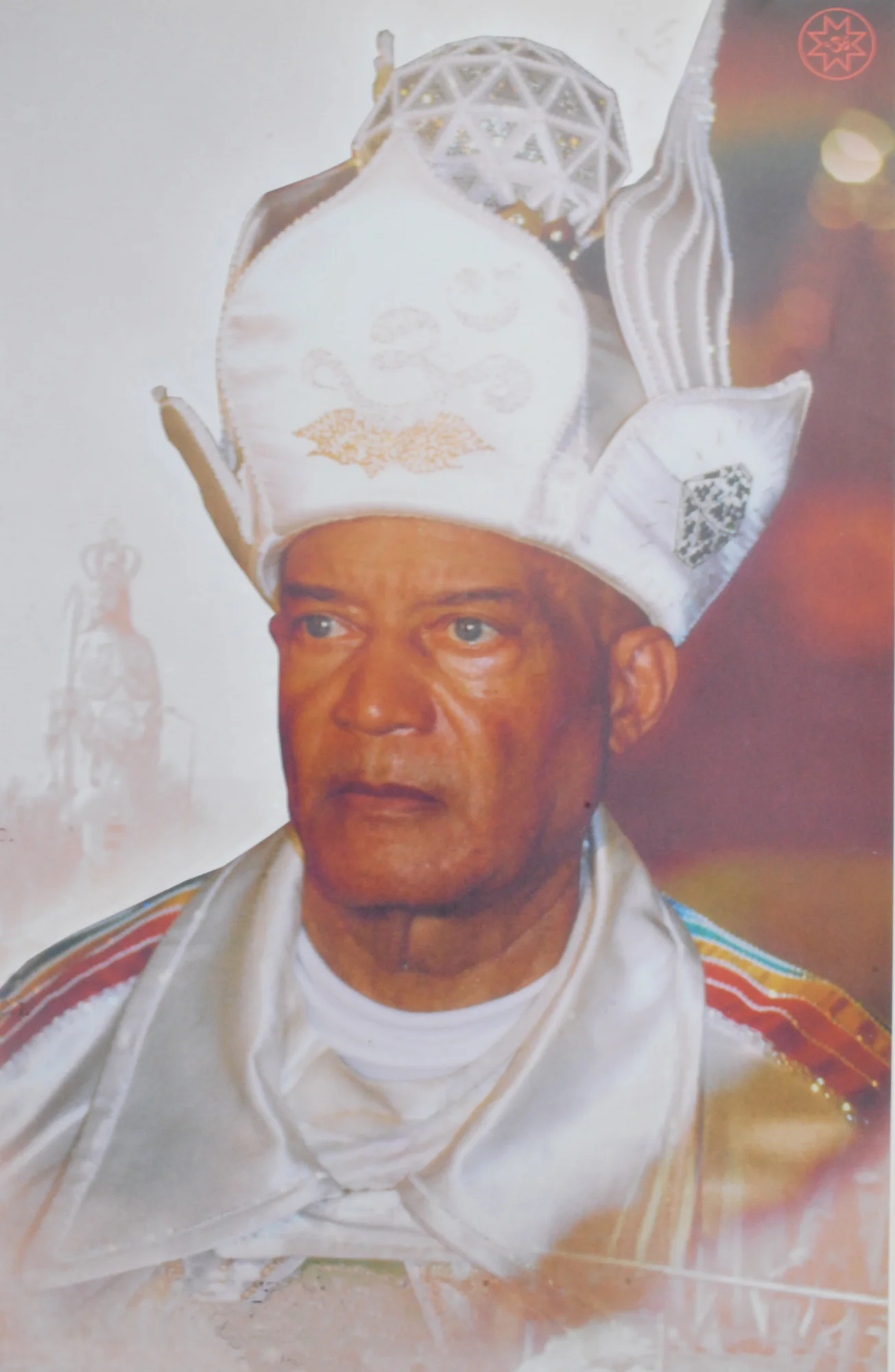
As disciples of His Holiness Lord HAMSAH MANARAH, we wish to express our immense gratitude and love for this Being of Light who guides us on the path of evolution through the fabulously rich written teaching He has bequeathed to all the human beings on earth.
*******