SYMPOSIUMS
LECTURE
No. 5 – ACTING FOR THE PLANET
No. 5 – ACTING FOR THE PLANET
This talk covers four themes:
- The interdependence of all that lives on the planet, and therefore the need for a systemic approach
- Climate change and the work of scientists in this field
- The results of a successful international project based on ethical rules and the sharing of knowledge
- The answers of Aumism: consciousness and solidarity
1. Interdependence: a systemic approach is needed
Aumism, like other religious doctrines, includes reincarnation, with the principle that consciousness is present in the mineral, the plant, the animal and the human. A human being acquires an individual soul after transmigrating through the different kingdoms. Consciousness evolves through the different kingdoms within group souls, which bring together all the beings of the same species. An individualised consciousness exists only in human beings. The consciousness of all the beings making up all the kingdoms is organised in an evolutionary pyramid. This unitive approach links human beings in consciousness to the whole of nature. The human being, placed at the top of the evolutionary pyramid, has as goal to reach the Divine and as duty to protect all the lower kingdoms.
Today many associations are working to protect Nature. We will draw on the website www.worldwildlife.org, which gives advice in this area.
The mineral kingdom is overexploited, and regions of the planet have been and can be destroyed because of our actions (see the regions of our planet to be saved on the website www.worldwildlife.org). Here we will mention only the recent development of energy based on the extraction of shale gas, which damages the soil. Our society, which needs more and more energy, is undermining the survival of our planet. Let us note here that the use of fossil fuels causes global warming.
Like the mineral kingdom, the plant kingdom is overexploited, and we will discuss only the case of deforestation, which causes the many harms listed below.
“The collapse of biodiversity: destruction of natural habitats, threatening 80% of terrestrial biodiversity.
Dwindling water resources: disruption of the water cycle; deforestation threatens the availability of water.
Danger to human beings: more landslides, mudslides and floods.
Health impacts: the risks of epidemics and of the spread of infectious diseases through insects and animals are increasing.
The loss of food security: soil erosion, droughts are multiplying and desertification is advancing.
The worsening of climate change: deforestation increases greenhouse gas emissions and therefore, as a knock-on effect, worsens climate disruption.” (Summary of a text by Magali Casado)
Deforestation does not only affect the warming of the Earth’s temperature: the list above highlights the interdependence between the kingdoms of nature, mineral, plant, animal and human.
The exploitation of the animal kingdom leads to the transfer of diseases from animals to humans: zoonosis. Various factors are involved in zoonosis:
1) domestication: cattle gave us measles, pigs whooping cough, and so on.
2) human intrusion into the territory of wild animals: monkeys gave us HIV, and bats Ebola and Covid. Of course vaccines are being developed, but it would be more appropriate to respect animals.
The mass extinction of species: the website www.worldwildlife.org lists the endangered species that must be protected. Among these species is the wolf, but we note that the protection of wolves is contested by shepherds, because wolves attack their flocks.
We will note that progress has been made with regard to respect for animals, and that cruelty to animals is now punishable by imprisonment.
For human beings, the advice is:
To eat well,
To optimise one’s energy consumption,
To travel differently,
To reduce one’s waste,
To reduce one’s digital footprint,
To choose one’s building materials and furniture carefully,
To manage one’s water consumption better, etc.
All this advice is now part of the education given to children in schools. The new generation is being prepared for the idea that we must change our way of life, because our planet’s resources are not unlimited. In this area, the media have played their role in informing people.
At the individual level, everyone must act responsibly for the planet.
At the collective level, governments must take action to develop ecology in every field.
2. Climate change and the work of scientists in this field
For several decades scientists have been warning of the global warming caused by our model of development, which produces greenhouse gases.
The greenhouse effect is a natural phenomenon: water vapour and gases surrounding the Earth retain part of the Sun’s heat. The average temperature on Earth is 15°C; without this greenhouse effect it would be -18°C. Human activity creates gases that strengthen this greenhouse effect, because these gases take a long time to leave the atmosphere.
Carbon dioxide accounts for half of the pollutants. It comes from:
- activities that burn coal, oil or gas, that is, human activities related to heating, transport, factories, household life, etc.
- deforestation: with fewer trees, forests absorb less carbon dioxide
Methane is created:
- by the decomposition of certain organic matter; it is produced by rubbish dumps, flatulence from cows, buffalo, goats, etc., marshes or melting ice, leaks from oil wells, etc.
Other gases come from:
- refrigerators and air conditioners
- the use of fertilisers
This list shows that practically all our activities contribute to increasing the greenhouse effect, causing the Earth’s temperature to rise.
We must replace fossil fuels (coal, oil, gas) with renewable energy.
We must change our housing, insulate old houses and build passive houses.
We must stop intensive livestock farming and stop using fertilisers.
Etc.
The rise in the Earth’s temperature has serious consequences: droughts, floods, melting ice, rising sea levels, endangered animal species, etc.
“The IPCC, the Intergovernmental Panel on Climate Change, concludes in its report of 9 August 2021 that the climate is changing everywhere in the world, and faster than expected. Even if global warming is limited, natural disasters are expected to multiply.“
Scientists regularly carry out measurement campaigns to refine the IPCC’s forecasts. A scientific expedition to the Arctic, MOSAiC (Multidisciplinary drifting Observatory for the Study of Arctic Climate), brought together more than 300 scientists from 20 different countries. This group of scientists set off aboard an icebreaker that drifted with the movement of the ice for a whole year, from 20 September 2019 to September 2020.
“The main objective of this scientific measurement campaign was to study the Arctic climate system, including the atmosphere, the ocean, sea ice and the biosphere, as well as their interactions. The Arctic was chosen because its climate system is particularly sensitive to climate change; it reacts in complex ways and its impact on the rest of the globe is significant.“
The Arctic has warmed twice as fast as the rest of the planet over the last 50 years, and the rise in Arctic temperatures will remain more pronounced than average global warming during the 21st century. The IPCC’s Sixth Assessment Report, in the part written by Working Group I, published on 9 August 2021, states that Arctic sea ice is currently at its lowest level since 1950 and is likely to reach practically ice-free conditions at the end of summer at least once before 2050, whatever the scenario.
The sea ice could disappear completely in summer in the years to come.
3. An international project based on the sharing of knowledge
In the previous section we presented the contribution of scientists to studies of global warming. This section is devoted to an international programme developed under the aegis of the United Nations as part of the peaceful applications of science.
The project, called UNBSSI (United Nations Basic Space Science Initiative, https://www.unoosa.org), aimed to introduce space science into developing countries, since this research was mainly carried out in developed countries.
The experience described concerns mainly Africa. We began by auditing how cooperation worked in the French-speaking area, analysing the strengths and weaknesses in order to propose improvements. We set up a scientific network in the French-speaking area with volunteer researchers to develop space science.
Here are some of the ethical rules that made the project a success:
- hold a school in the country in order to select the most motivated students to take part in a scientific project;
- define the scientific project with the country’s scientists, which led to a very wide diversity of studies;
- bring measuring instruments into the country so as to obtain local measurements;
- choose new subjects at the interface between several disciplines;
- have, for each student, a main supervisor in their own country and co-supervisors abroad (not necessarily in France);
- arrange training stays abroad in the co-supervisors’ laboratories for the doctoral student, alternating with their home university;
- defend the thesis in the home country, which enhances the standing of its university;
- obtain a position in one’s own country, form a research group and develop a space science curriculum in one’s university.
The method put in place in the French-speaking area from 1991 served as a model for the other African countries. The table below summarises the problems solved by this method.
|
In the North: researchers without students. In the South: students without professors. → Professors travel to Africa and meet students at schools: no emigration, no brain drain → Students chosen for their motivation: very few failures → Large numbers: we enabled every motivated student to do a thesis without leaving their country and then to obtain a position there: social integration |
Two factors were very important:
* To develop space research, we used the GPS system, because it is an inexpensive measuring instrument. We now use GNSS (Global Navigation Satellite System), which brings together the various satellite navigation systems: GPS (United States), GLONASS (Russia), Galileo (Europe) and BeiDou (China).
GPS and, more generally, GNSS are originally positioning systems. They are used by many scientific disciplines (space science, meteorology, seismology, geography, etc.) and allow many applications in everyday life (road traffic, land registry, agriculture, animal migration, epidemiology, etc.).
This is important for linking the scientific world to the population.
** We always developed each country’s project within an international framework.
We obtained the following results in the 19 African countries concerned:
- 1991-2000: 10 theses
- 2001-2010 and 2011-2020: 80 theses
- 2021: 64 theses in progress
By 2023: 154 theses defended, that is, 154 x 4 years = 616 years of work.
There are now 70 institutions or universities in Africa studying space science.
(websites: www.girgea.org and www.iswi-secretariat.org)
Countries concerned
Eleven French-speaking countries: Algeria, Benin, Burkina Faso, Cameroon, Côte d’Ivoire, Guinea, Morocco, Republic of the Congo, Democratic Republic of the Congo, Senegal, Tunisia.
Eight English-speaking countries: South Africa, Egypt (a member of the Francophonie), Ethiopia, Kenya, Nigeria, Uganda, Rwanda, Zambia.
4. Consciousness and solidarity: the answers of Aumism
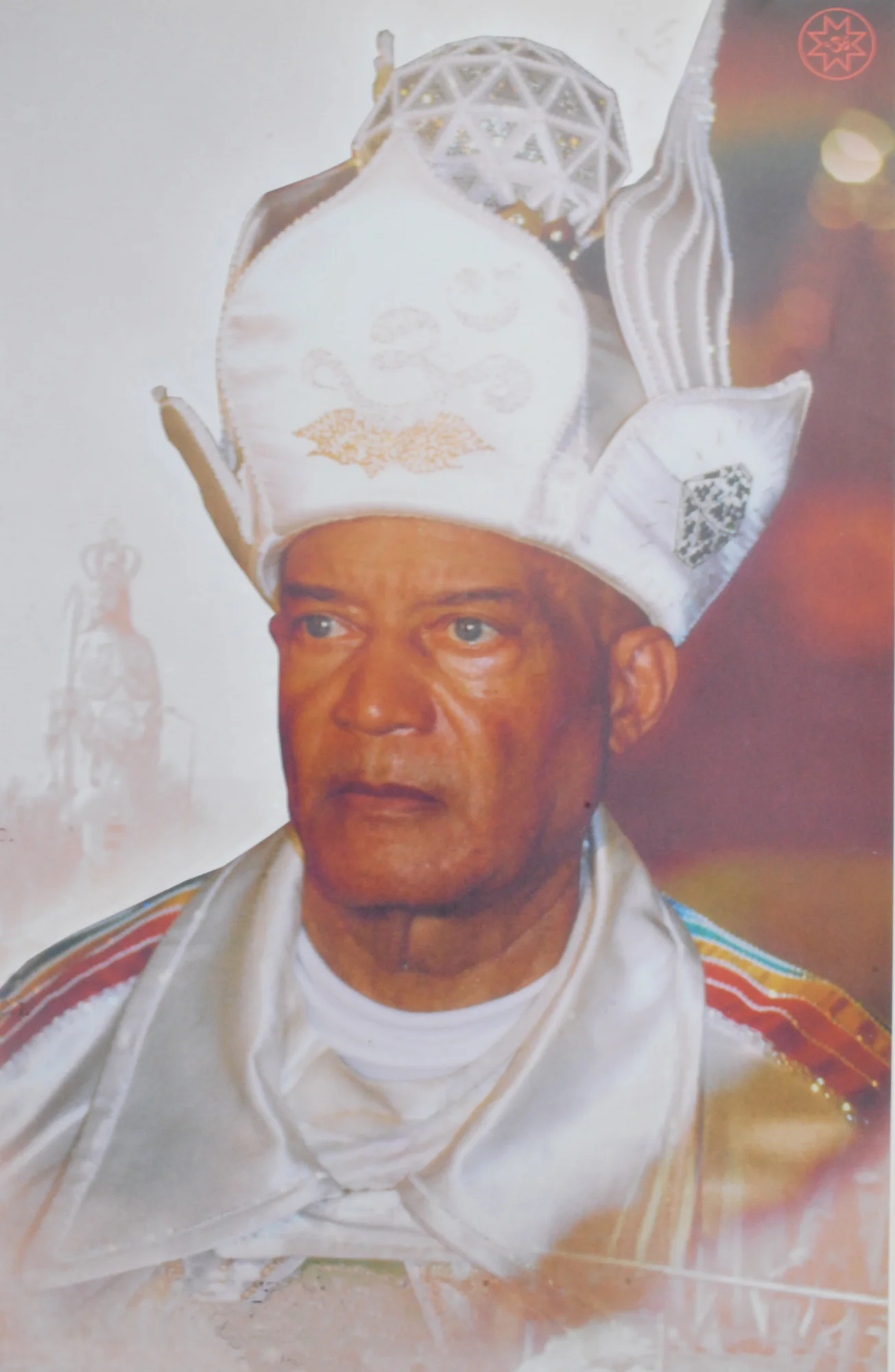
His Holiness Lord HAMSAH MANARAH wrote a Code of Honour of Man towards the Kingdoms of Nature[1]. This code has 15 articles, some of which we quote below:
“Man must:
* Know that he cannot survive without Nature.
* Learn to feed himself so as to set an example of respect for Nature and for life.
* Firmly refuse to be the puppets of scientism and of a consumer society.
* In his heart and mind, replace the right he claims with the duty to be fulfilled.
* Create a ‘Council of Sages’ responsible for censoring inventions that could endanger Mother Nature and our life on Earth.“
Since man has a more evolved consciousness than the kingdoms of nature, he has the duty to respect them and to help them in their evolution.
Putting this code of honour into practice makes it possible to solve the problems.
Science is integrated into the Aumist religion. In a book entitled Une Loi pour détruire le Mal, His Holiness Lord HAMSAH MANARAH addressed the dangers of science without conscience[2] and the benefits of science with conscience. I will recall a few important points here:
“Positive science can:
* Put an end to famines.
* Bring about a planetary awakening of consciousness that leads peoples to understand one another and almost forces them to unite so as no longer to destroy one another.
* Develop the intelligence and capacities of the human brain.
* Open the human field of vision to the realities of the Cosmos and help man find his rightful place again in the economy of the Universe.
* Help governments make good choices in medicine and the environment, and in preserving the chain of life at all costs.”
In the second part of this talk we presented positive science, with researchers mobilising to understand climate change and so propose solutions to limit this warming.
In the book La Loi d’Évolution des Âmes, His Holiness Lord HAMSAH MANARAH proposes 12 laws for building the Golden Age, an age of harmony between all human beings and Nature. One of these laws, the Law of Sharing, is essential.
Here are its three principles:
“First principle
You will share your knowledge, your learning and your material and spiritual gains with your neighbour.
Second principle
You will never be like the miser sitting on his treasure chest, leaving the world to starve or souls to take their own lives in despair.
Third principle
You will think of your neighbour more than of yourself and will help him to evolve, even to surpass you if he can.“[3]
In the third part of this talk we presented an international scientific project based on the sharing of knowledge. This project was developed within the framework of the United Nations, which works for the peaceful applications of Science.
Conclusion
The Teaching of His Holiness Lord HAMSAH MANARAH, delivered 30 years ago, has as its first aim the evolution of individual and collective consciousness. This evolution alone will guarantee the continuity of life on earth.
We have shown in this talk that human beings are increasingly aware that we must change our way of life, respect Nature and use Science wisely.
Christine Amory
Docteur d’État in physical sciences
*******
[1] L’Aumisme, la Doctrine de l’Âge d’Or, p. 206.
[2] Une Loi pour détruire le Mal, p. 201.
[3] La Loi d’Évolution des Âmes, p. 305.