SYMPOSIUMS
LECTURE
No. 1 – THE URGENT NEED TO RETURN TO BALANCE
THE URGENT NEED TO RETURN TO BALANCE
Humanity is currently facing serious problems that threaten its future and that of the planet.
With growing insistence, scientists and environmentalists are warning humanity and sounding the alarm about the disruptions and imbalances caused by human beings.
Awareness and changes in behaviour are urgently needed: the men and women of today must see themselves as citizens of the world responsible for the future of humanity.
- In the first part of this talk, we will briefly review today’s imbalances.
- In the second part, we will present the solutions proposed by the Aumist religion, and discussed at this symposium, to foster the return to balance.
I. A REVIEW OF TODAY’S IMBALANCES
Poorly controlled human activity is the cause of many imbalances: all the kingdoms of nature are suffering from it; our planet is sick; our planet needs help.
We will limit ourselves to recalling a few examples.
1) Environmental pollution
Soil pollution
Saturated with chemicals by intensive farming, soils are losing their vitality. Having entered the food chain, various agricultural and industrial pollutants contaminate plants, animals and humans.
Bees, which are indispensable for pollinating the plants that feed human beings, die after ingesting pesticides.
Water pollution
Through seepage, agricultural and industrial chemicals spread into groundwater; through runoff, they pour into rivers, lakes and oceans.
Industrial discharges of waste water into rivers, illegal oil discharges from ships and disasters such as the sinking of the Erika poison freshwater and marine life.
Air pollution and greenhouse gases
In recent years, air quality has deteriorated sharply, causing respiratory diseases and allergies.
The increase in greenhouse gases is causing the atmosphere to warm and the ice to melt and gradually disappear.
Hubert Reeves writes in Mal de Terre: “The thirty or so developed countries, which account for 20% of the world’s population, produce and consume 80% of synthetic chemicals, 80% of renewable energy and 40% of fresh water, and they emit ten times more greenhouse gases per inhabitant than the countries of the South.”[1]
This rise in temperature brings climatic instability, marked by sudden changes in temperature and an upsurge in typhoons and cyclones that cause flooding. Heatwaves dry out crops and encourage fires.
2) Imbalances on the human level
Wars continue to kill, maim and traumatise children and adults. This was discussed at the 5th symposium of Aumism, on non-violence.
Poor management of resources enriches some, impoverishes others and ultimately threatens the planet: the dwindling of forests, oil and drinking water is a cause for concern. At the current rate, with the overexploitation of marine resources, most of the life in the oceans is disappearing.
The World Bank’s 2007 annual report tells us that almost one billion people live on less than one dollar a day, that is one sixth of the world’s population. This figure is certainly falling, but it nonetheless remains very high. More than 2.6 billion people live on less than 2.5 dollars a day.
“Poverty,” writes Hubert Reeves, “is the ferment of despair and hatred and, ultimately, the breeding ground of international terrorism.”[2]
The distress of individuals
Let us add that, in the so-called developed countries, the race for immediate material gain is making values and the meaning of existence disappear. Faced with daily difficulties, feelings of loneliness and insecurity, stress and depression lead to the use of tranquillisers, alcohol and drugs.
The French Directorate for Research, Studies, Evaluation and Statistics (DREES, no. 488, May 2006) tells us that 10,700 suicides were recorded in France in 2003.
This list is far from exhaustive. We have limited ourselves to a few examples showing that human beings are currently the victims of disruptions that they themselves have caused over time.
Even if some dispute the seriousness of the situation, it is nonetheless true that humanity faces serious problems that confront it with the urgent need to return to balance.
One may ask how a religion such as Aumism can help to restore balance. This is what we will now address.
II. AUMISM AND THE RETURN TO BALANCE
As a responsible and realistic religion, Aumism cannot in any way be indifferent to the future of planet Earth and of humanity.
It is first through freely accepted education that a religion can help humanity: the purpose of the Teaching given by the Aumist religion is to foster awareness of individual and collective responsibilities.
As we have just seen, both individually and collectively we are coming up against critical situations that cannot go on. We have reached the point where the consequences of human errors affect everyone: each person feels concerned in their daily life by what is on their plate and by the air they breathe. But there is no point in sinking into passive doom-mongering.
Fortunately, awareness is growing faster. The situation is challenging more and more men and women who are striving to find solutions in various fields. Many understand the urgent need to return to balance and want to contribute to it. Individuals, associations and states are making major efforts.
But to win a lasting victory, to correct the behaviour that throws the world off balance and causes wars, pollution and poverty, a profound change in mentalities is needed: actions must be brought into line with thoughts.
It is no use saying that one is against war while constantly quarrelling with one’s family and with the people one meets every day.
Eradicating war means acting for peace, but it also means eradicating violence within oneself. Fighting the various forms of poverty means acting materially and developing within oneself a sense of justice and altruism. Fighting pollution means acting by developing respect for living nature.
One’s own thoughts, words and actions must all go in the same direction: that of the return to balance.
1) Changing one’s state of mind is a necessity
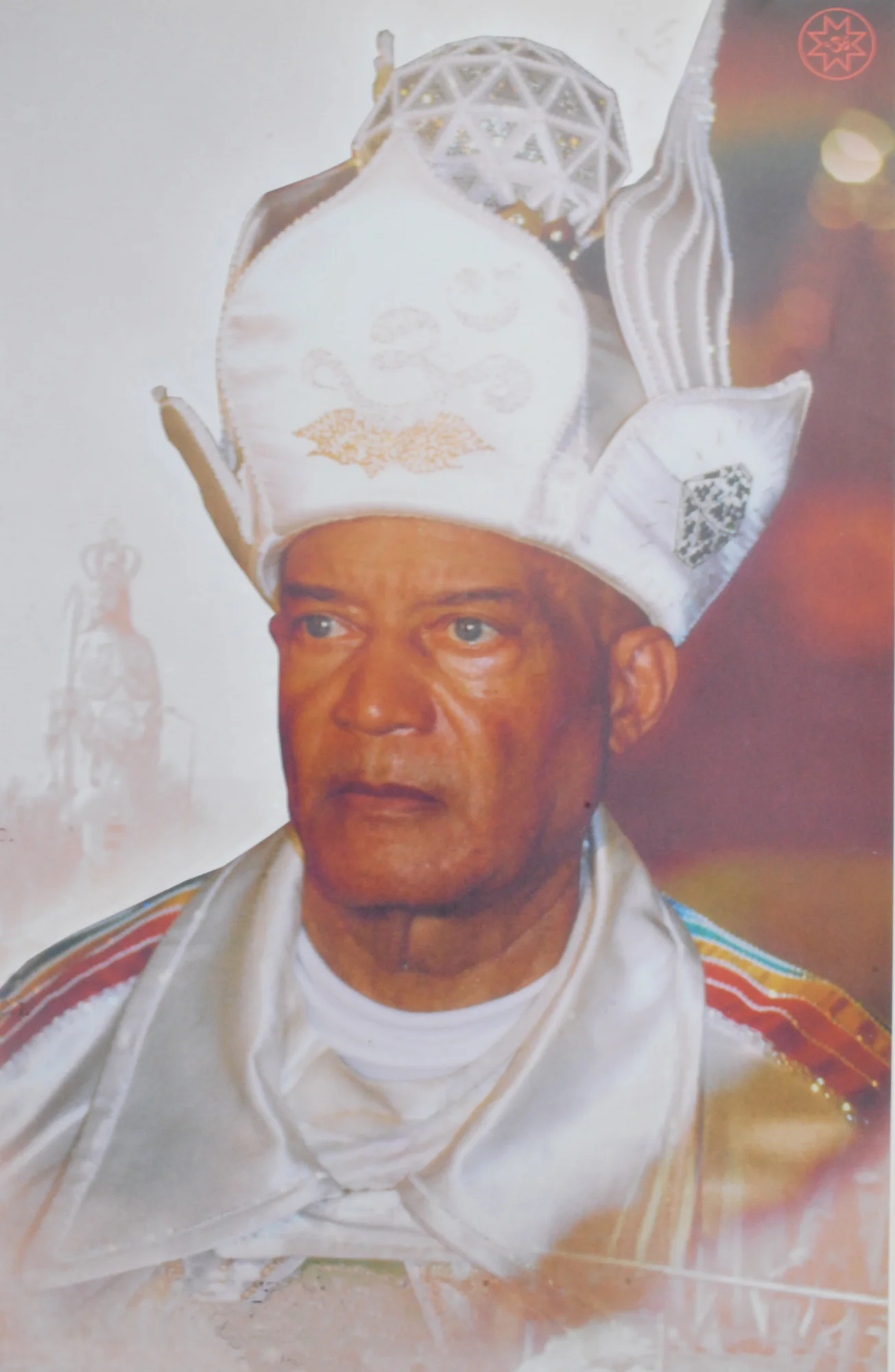
His Holiness Lord HAMSAH MANARAH, Founder of the Aumist religion, writes: “For our part, we believe that a rejuvenated religion, enlightened by the discoveries of science and adapted to the world, will help individual balance as well as the regeneration of society.”[3]
His Teaching makes us aware that we can help to stop the destructive process and move from imbalance to balance.
It helps us to leave the state of mind of division and hatred, called the Iron Age, and to regain the unity and solidarity that characterise a Golden Age state of mind.
“All too often,” says His Holiness, “people think only of their petty, short-sighted little interests. They even forget that they tread the soil of the same planet and exploit the riches of the same nourishing Earth. (…) This selfish mentality must absolutely be reformed if the peoples of the Earth are one day to live in peace, in the Golden Age regained. (…) The Golden Age is won through a right state of mind, an innate respect for others, a sincere love of one’s neighbour and a sense of the general interest that transcends all pettiness.”[4]
To help humanity move towards autonomy and take charge of its future and that of the planet, Lord HAMSAH MANARAH proposes 12 evolutionary and moral Laws intended to preserve and guarantee the future of humanity. They form a realistic and practical Code of life for progressing towards individual and collective improvement.
You will find them in the book La Loi d’Évolution des Âmes, chapter XX.
Among these Laws are those of universal Love, Unity, true Knowledge, Sharing, Forgiveness, Self-transformation and others.
The Law of Self-transformation, in particular, invites each person:
- to “renounce the selfishness of every man for himself”;
- to “cultivate love of one’s neighbour”;
- to “renounce the mirror of the past”, that is to say free oneself from all resentment;
- to “cultivate inner detachment and self-mastery”, which are necessary to take one’s destiny in hand and choose one’s direction.
This transformation is possible because the Divine resides in each of us as the principle of Unity and the Creative Force.
Returning to the Golden Age state of mind is urgent.
We no longer have time to put off our efforts; we must change our state of mind and our behaviour right now. We must mobilise to take charge of our personal balance, which will have repercussions on collective balance.
This responsibility falls on everyone, regardless of race, class or religion.
Lord HAMSAH MANARAH says to each person:
“You have the right to deny the existence of God, but you have the duty to transform yourself and improve yourself for the happiness of the world.”[5]
For this reason, His Teaching is addressed to all human beings, whether believers or atheists.
Humanity is made up of individuals who, through their choices, steer the destiny of the planet. Just as violent individuals spread hatred and intolerance, individuals capable of respect and clear-sightedness can serve the general interest.
That is why Aumism insists on personal balance, which makes it possible to act in the direction of planetary balance.
2) Here, then, are the points of the Aumist Teaching that will be addressed during this symposium
The balance of body and mind. Separating body and mind amounts to dividing oneself and leads to imbalance. Body and mind are intimately linked and influence each other. In everyday life, we must therefore pay attention to what is a source of both physical and mental balance.
The balance between secular life and spiritual life. In the whirlwind of modern life, we tend to let ourselves be taken over by material concerns. Yet individual fulfilment requires the development of every dimension of the human being: living one’s family and working life to the full without sacrificing one’s spiritual dimension brings a balance that has repercussions on social balance.
The need for planetary sharing. At a time when the disparities that generate antagonism and conflict are glaring from one continent to another, humanity is faced with the need to share resources, knowledge and prayers. The Law of Sharing is one of the 12 evolutionary and moral Laws of the Golden Age proposed by His Holiness Lord HAMSAH MANARAH.
The role of prayer as a factor of individual and planetary balance. Prayer makes it possible to develop the Divine within oneself and to foster the evolution of the world. At the monastery of the Mandarom, the monks constantly offer their prayers and actions for peace.
Life after death, a new perspective on the return to balance. Working on oneself and working for the collective interest is a duty on Earth. But for Aumism, this work does not stop: after death, souls are placed in conditions that favour speeding up the necessary change of mentality.
Aumism, the religion of balance. By helping consciousness to evolve and by explaining how to think and act in order to acquire a Golden Age state of mind, Aumism helps to reduce suffering and helps each person move towards greater fraternity and happiness.
To conclude, here is a Word of His Holiness Lord HAMSAH MANARAH that shows us the way:
“The Golden Age is love for each and every one,
whatever their language, race, religion or ethnic origin…
The Golden Age must be expressed every day, within oneself and around oneself.”[6]
*******
[1] Hubert REEVES, Mal de Terre, Paris, Seuil, 2003, p. 200.
[2] Hubert REEVES, Mal de Terre, p. 200.
[3] H.H. HAMSAH MANARAH, Yoga et Sagesse, p. 200.
[4] H.H. HAMSAH MANARAH, La Révolution du monde des vivants et des morts, p. 462.
[5] H.H. HAMSAH MANARAH, Yoga et Sagesse, p. 283.
[6] H.H. HAMSAH MANARAH, Une Loi pour détruire le Mal, p. 90.