SYMPOSIUMS
LECTURE
No. 2 – LEARNING TO FORGIVE
No. 2 – LEARNING TO FORGIVE
The news is all too often filled with national, international, religious and political conflicts. These conflicts bear witness to a spiral of revenge and escalating violence that is certainly harder to break free from if we are involved in them or directly affected by them.
What capacity do we have to forgive a genocide, incest, repeated abuse, a premeditated crime, the murder of a child, the bombing of civilians, a terrorist attack, a theft, a quarrel, an insult, a lie, a lapse, a mistake, a weakness, an infidelity, a fault, a blunder…?
Forgiveness is far more a matter of heart and courage than of morality or reasoning.
Forgiveness does not come naturally; it can only be the fruit of a journey, and that journey will be the subject of this talk.
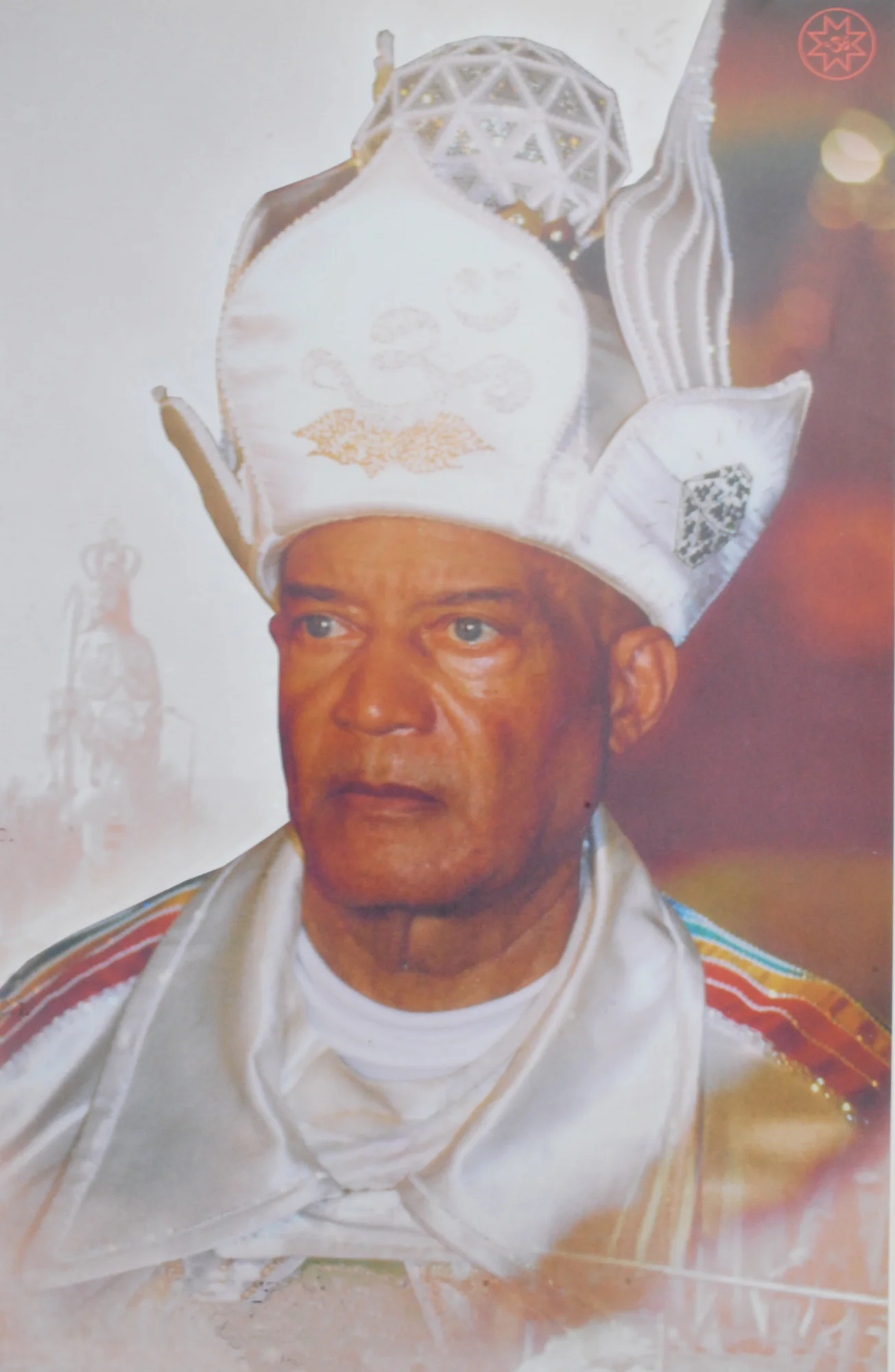
To help humanity today and in the future, His Holiness Lord HAMSAH MANARAH declares: “If people know how to forgive one another, if they know how to forget the past, border disputes will ease, civil wars will diminish, and war, the cruel expression of hatred, will disappear for ever.” [1]
I – WHY FORGIVE?
What is the aim of forgiveness, and what moves us to turn to it?
What makes it necessary is first of all the suffering experienced, which may range from hurt to shock, from a bruised ego to terror, from harm to horror, from the personal to the collective.
What is at stake in forgiveness will differ according to the context.
In the most horrific situations, it will first of all be a matter of recovering one’s humanity in the face of the intolerable, the unforgivable. The executioner has become a monster, and the victim is regarded as a being without dignity, deprived of all consideration.
According to Paul Valadier (Jesuit and philosopher), forgiveness passes from the religious domain into the political [2] when “the abominations of every kind that the twentieth century witnessed, and which do not seem to spare the new century” raise the question: “how can we overcome the past and open up a future without resorting to something like forgiveness, or at the very least reconciliation?” between peoples and nations.
Forgiveness then enters the field of philosophy, with eminent modern thinkers such as Henri Bergson, Hannah Arendt, Vladimir Jankélévitch, Jacques Derrida and Paul Ricœur.
Paul Valadier concludes that “the idea of forgiveness can act within human societies as a kind of ‘search engine’: thanks to it, people are called upon to invent original paths to emerge from a past of death and open themselves to a reconciled life in common.”
In other, more personal cases, the need to escape this spiral of suffering inflicted on ourselves and on our fellow human beings will lead us onto the path of forgiveness and allow us to find inner peace again.
Indeed, who can be happy while nursing rancour, defined as “a lasting emotional state made up of deep bitterness, resentment and hatred, linked to the memory of an injustice or a disillusionment” [3]?
Choosing to forgive is the possibility of freeing ourselves from the harmful bond that persists with the person or people who hurt us.
“Forgiveness is the only way to put an end to hatred.” [4]
Forgiveness is certainly not easy, but hatred is so exhausting.
While forgiveness does not change the facts of the past, it changes their weight; it allows us to live better in the present and ensures a better future.
We remember striking figures (the list is not exhaustive) for their capacity to forgive, famous because they did not give in to rancour:
– Pope John Paul II forgave the man who shot him in St Peter’s Square on 13 May 1981. Later, he visited him in prison.
– On 11 February 1990, after 27 years, 6 months and 6 days in prison, Nelson Mandela declared his commitment to peace and reconciliation with South Africa’s white minority.
– After the attacks of 13 November 2015 in France, in which his wife, the mother of their child, was killed at the Bataclan, the journalist Antoine Leiris posted a letter on social media entitled “You will not have my hatred”. This letter became a symbol of national resilience.
Are we capable of such resilience?
II – FORGIVENESS, AN ACT OF FULL HUMANITY
We are not all equal when it comes to undertaking this journey towards forgiveness. What it brings will differ according to our experience and our possibilities.
In any case, much has been written on the subject, and various books break it down into several stages, specifying what it can be and what it is not.
Drawing on these readings [5], here is what we might say about it.
Forgiveness is an act of full awareness, which commits only the person who decides on it.
It must be undertaken with honesty, first of all towards oneself: it is not the expression of a “Didn’t even hurt!”, so often used to mask or bury what we feel, our cracks, our fragility, our humiliation, the exact nature of our wound.
Walls put up at first against the aggressor give us some protection, but over time, without forgiveness, they become a prison.
Introspection is necessary and must, moreover, remain kind, so as not to create a double punishment: feeling guilty for having been naive, for not having defended oneself, for having provoked what happened.
Forgiveness is neither an obligation nor forgetting.
The passing of time may lessen rancour, but it does not replace forgiveness. Forgiveness requires will and determination, once we have understood that holding a grudge against someone only allows them to go on hurting us.
Forgiveness also requires courage, for it is not an expression of weakness. The natural and recurring temptation of revenge must be mastered again and again.
“Forgiveness is the mark of the courageous.” [6]
It requires clear-sightedness: it is not a matter of justice, tolerance or pity.
It is not a miracle recipe that will undo the harm done.
It cannot come about without patience, for it is often a long process. Wanting it does not necessarily mean achieving it.
On this journey, trying to understand what motivated the offender can help.
Finally, forgiveness must be exercised with discernment: it does not require reconciliation, nor even a declaration to the people concerned. We may have forgiven someone and choose not to see them any more, to have nothing more to do with them.
As we have said, forgiveness can be the miracle that restores a humanity that seems to have vanished, in executioners and victims alike, and in certain historical cases it becomes a political recourse that has its origin in a religious context.
Indeed, forgiveness is recommended by many religions and, on a more personal level, it can be seen as a path to inner peace.
III – HOW CAN WE MOVE TOWARDS FORGIVENESS?
In the Aumist religion, the emphasis is on identification with the divine Consciousness. Behind this physical envelope, beyond this character and this personality, dwells the Supreme Self within us. Our humanity is divine, and His Holiness Lord HAMSAH MANARAH tells us:
“To put a definitive end to hatred in all its forms, we must above all restore our Unity with the inner God, present in ourselves and in everyone”, for “if we feel that the other is a part of ourselves, how could we hate them for long, detest them, wish for their death?” [7]
During a great ritual, His Holiness Lord HAMSAH MANARAH granted the Great Forgiveness to the whole of humanity, to enable it to break free from the mechanisms of the past that chained it to hatred.
Humankind has received this Great Forgiveness so that it might regain the freedom to enter the Age of Peace and brotherhood called the Golden Age.
He tells us: “The Golden Age is only a state of mind to be won, and it remains within everyone’s reach.” [8]
Forgiving ourselves, regularly renewed, allows us to move forward, to dare to make mistakes and start again, to try once more, and to allow others to do the same. For there will be missteps and falls that we will still have to forgive ourselves.
“Do not ask God to have pity on you; simply have pity on yourselves.” [9]
There is no peace without forgiveness, but forgiveness according to Aumism does not serve only to erase negative thoughts and acts that each person could then repeat at will!
By lightening the conscience, forgiveness gives the energy and the freedom to transform ourselves and set out again, avoiding falling back into the same failings.
Our capacity to evolve is directly linked to our capacity to forgive.
Forgiving others must go hand in hand with forgiving ourselves, which puts an end to the aggression we may turn against ourselves.
The Aumist Teaching insists on forgiving oneself, because guilt prevents us from finding peace within ourselves and passing it on to others.
Anatole France wrote: “We must forgive ourselves a great deal in order to grow used to forgiving others a great deal.”
“The first step is Forgiveness of oneself, to avoid self-punishment. The second step is to turn towards those who have hurt us, who have hurt us the most, and say to them:
‘I forgive you all the harm done. May there be Light in your mind, Divine Love and serenity in your heart.’” [10]
This sentence can be spoken mentally, without the person to whom it is addressed even being present. Only the mental attitude of reconciliation matters, while remaining attentive to the effects that follow…
“We must take each person’s measure afresh every day,” the founder of Aumism used to tell us, “so as not to fix our mind on a situation or on one of their faults.”
The Key of Forgiveness of oneself is recommended on p. 249 of the book La Révolution du Monde des Vivants et des Morts, at most once a week and at least once a month, with this reminder:
“Remember, on this forgiveness of yourself depends your happy and luminous destiny.” [11]
To forgive is to sow and grow in our inner garden the seeds of the thoughts and feelings that will help us escape this spiral of suffering inflicted on ourselves and on our fellow human beings.
Forgiveness can remain a secular undertaking, but it can also become spiritual work that gives the goal a sacred character and amplifies its effects and repercussions.
To cultivate the spirit of reconciliation is already to acknowledge that there was once harmony and concord, and that this state must be recovered: the feeling of unity with the Whole, with all that lives, the feeling of unity with the Divine.
At the individual level, His Holiness Lord HAMSAH MANARAH warns:
“Do not judge anyone to be your mortal enemy for life, for otherwise you block any possibility of change in them.” [12]
Rancour and painful memories feed an energy of involution within us and project it onto others.
By being aware of the present moment, we can correct our course and send a thought of blessing and love to the person who was the object of our aggression, like this:
“I cancel the thought of hatred sent out against So-and-so and send back to them a thought of love, peace, harmony and unity. May their soul forgive me and be reconciled with my inner God.” [13]
Here again, regular practice is essential. Let us stress that it is far more a matter of seeking to transform ourselves by lightening our conscience and spreading thoughts of harmony than of mechanically erasing thoughts and acts only to repeat them afterwards at leisure.
It is not a matter of struggling to forgive by our will alone, displaying our superiority over the other, but rather of opening ourselves to the grace of forgiveness, of receiving through surrender this balm for the heart, abundantly, freely and regularly, from the divine Consciousness that is in us and in everyone.
Let us also note here, for all those who consider that the evolution of a soul requires several human incarnations, that death is a change of form and state: forgiveness cannot be considered solely over the span of a single life.
Forgiveness of oneself and of others can also be granted for past lives by speaking these words, sacred above all others, found in La Doctrine de l’Aumisme:
“I forgive myself the harm and the deviations committed in ignorance and momentary straying, just as I forgive all those who were part of my past karma and whom, in the present, I free from all ties and all bondage towards my person.” [14]
At the collective level, the Aumist meditation for all begins with the repetition of names of God invoked in the main religions, continues with blessings sent out by expansion into the different dimensions of space, then onto the different planes of consciousness, and includes the following passage, which I invite you to experience:
“- For the transmutation of low vibrations into high vibrations, of vibrations of hatred into the force of love. OM
- Blessings on all those who love and understand us, and on those who might not love us or understand us. OM
- Blessings on all those who have helped us. OM
- Let us forgive all those who may have harmed us. OM
- Let us bless those whom we ourselves may have harmed, consciously or unconsciously, directly or indirectly. OM”
Tirelessly, the Founder of the Aumist religion set the example of forgiving offences, ingratitude and betrayal. He breathed into each person the strength to transform themselves.
To conclude, we will listen to a text He wrote after learning of malicious acts committed by people He had helped a great deal. It is a poem addressed to the whole of humanity:
The Anger of the Wind [15]
“Man or woman, if somewhere you meet
A foolish being who calls himself my enemy,
Or who simply behaves like one
Through his words and his deeds,
Tell him that he is in me
And that I give him my Peace.
Known or unknown to my mind,
He is my brother and I am in him.
He must therefore cease to be his own enemy.
When an angry fist plunges
Into clear water,
The water moves aside, then returns to its place
When the time comes.
In the same way my defenceless soul
Follows the movements imparted
By the furious force of the wind.
Yet it does not lose its nobility,
For it lives in an ocean of bliss.
Tell him with love
That my compassion awaits him
On the path of light,
To help him, if he so wishes,
To manifest what is already within him
Without his knowing it:
The Peace of ETERNITY.”
V. SUMEDHYA
EPF engineering graduate,
Graduate in naturopathy and Hatha Yoga
*******
[1] Vers un Âge d’Or d’Unité, p. 178
[2] Paul Valadier, « Le pardon en politique », Revue Projet, 2004/4 (no. 281), pp. 67-72
[3] CNRTL
[4] Vers un Âge d’Or d’Unité, p. 178
[5] Father Jean Monbourquette, Comment pardonner ?, Bayard, 2011; Anne Ducrocq, L’art de faire la paix au quotidien, Marabout
[6] Mahatma Gandhi, Lettres à l’Ashram, 1937
[7] Vers un Âge d’Or d’Unité, p. 186
[8] Périple d’un yogi et initié d’Occident, p. 145
[9] La Doctrine de l’Aumisme, p. 113
[10] Vers un Âge d’Or d’Unité, pp. 177-178
[11] La Révolution du Monde des Vivants et des Morts, p. 256
[12] Vers un Âge d’Or d’Unité, p. 179
[13] Vers un Âge d’Or d’Unité, p. 185
[14] La Doctrine de l’Aumisme, p. 113
[15] Le Yoga de l’Amour dans la Force, p. 49