SYMPOSIUMS
LECTURE
No. 3 – THE BALANCE BETWEEN SECULAR LIFE AND SPIRITUAL LIFE
THE BALANCE BETWEEN SECULAR LIFE AND SPIRITUAL LIFE
Denying the spiritual dimension of the human being contributes to individual and collective imbalance. There are at least two good reasons to make room for spirituality in one’s life. They are the answers to the following two questions.
What am I doing on Earth?
Spirituality gives meaning to life by offering us the prospect of escaping the ups and downs of daily vicissitudes and by allowing us to express the luminous part of ourselves. “Absorbed in the daily battle of life,” says Swami Sivananda, “man has forgotten his goal. He sleeps on top of a treasure and weeps. He must be awakened.”
What can I do to help restore the balance of the world in which I live?
Let us not deceive ourselves: humanity is nothing other than the reflection of our individualities. Our thoughts are creative. So we must begin by finding a personal balance, giving our inner life the importance it deserves.
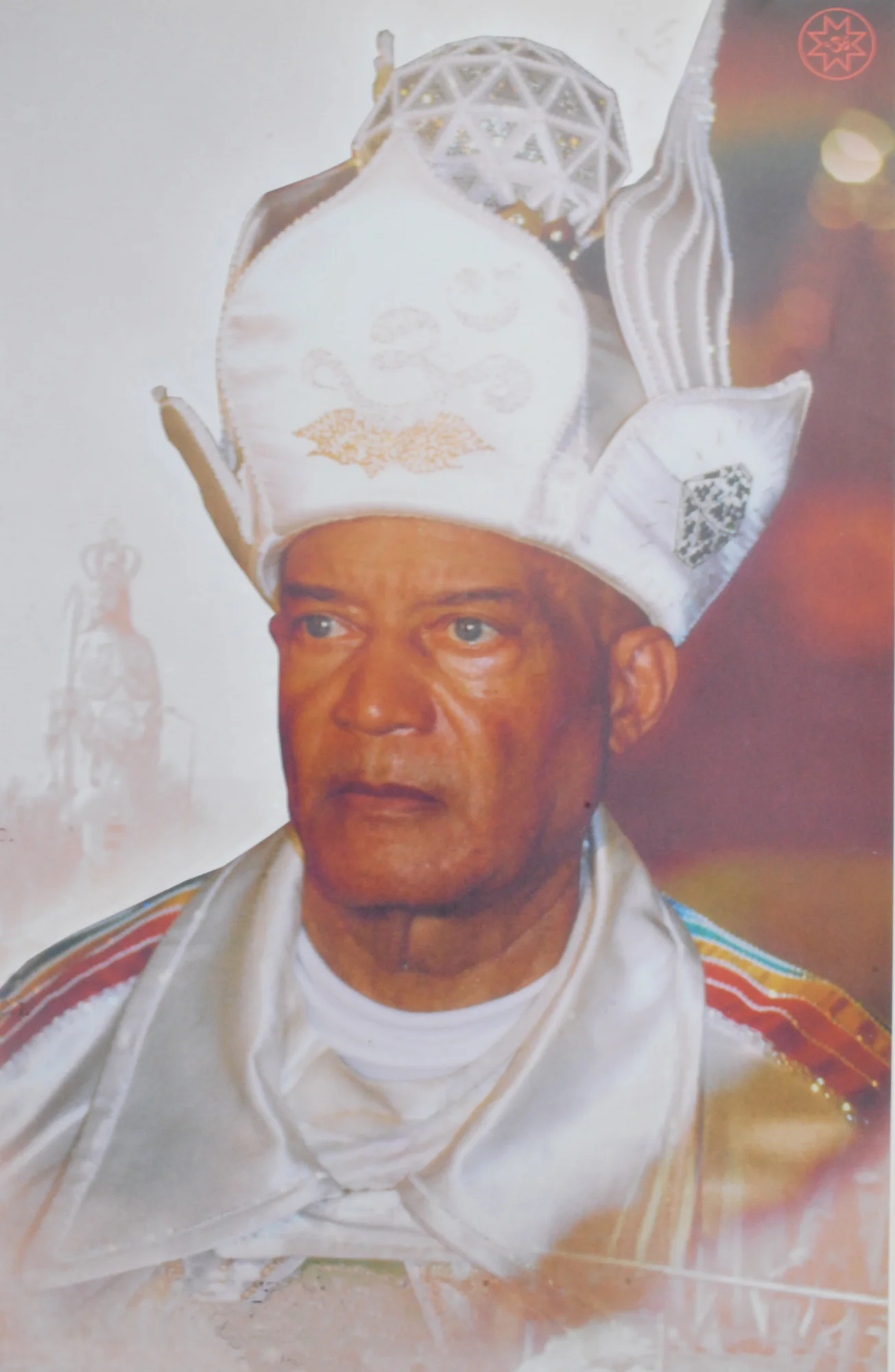
His Holiness Lord HAMSAH MANARAH encourages us to reconcile secular life and spiritual life: “The right state of mind,” He says, “means managing one’s family and working life in one’s best interests, without ever losing sight of why we are here on Earth.”[1]
We will therefore see:
- first, how the actions of daily life are a springboard for spiritual work;
- second, how prayer enriches existence.
I. FAMILY AND WORKING LIFE ARE A SPRINGBOARD FOR SPIRITUAL LIFE
Making room for religion does not mean renouncing one’s responsibilities in the world. Secular action then becomes a path of life which, on the one hand, fosters favourable material living conditions and, on the other, makes it possible to cultivate the values, skills and evolutionary principles that are indispensable on the spiritual path.
Life is a school. It is important that we learn to use every opportunity to progress and to develop qualities that are useful for our spiritual journey.
Our mental attitude towards each event of the day matters.
The most apparently insignificant things can become a source of enrichment and constant progress. On this subject, Lord HAMSAH MANARAH reminds us: “If you are victorious in the small acts of everyday life, you will be victorious in the major and decisive acts of your destiny, and your future will be the result of your everyday acts, that is to say victorious, orderly, filled with the fragrance of success.”[2]
The divinisation of works
The divinisation of works consists in dedicating each action to the Divine. It cannot be improvised. It results from a deliberate and conscious attitude. More than a simple approach, it is a philosophy of life in its own right.
Looking after one’s children, feeding them, following their schoolwork, doing the housework or the washing-up, preparing meals, caring for an animal, lending neighbours a hand: everything can be offered, whether it is pleasant or difficult to do.
“Each act of daily life that costs an effort must be divinised,” says His Holiness, “that is to say offered to God and to humanity for the salvation of the whole world.”[3]
Thus, throughout a day full of prosaic acts, we can give thanks to the Divine, whether situations appear good or bad: the efforts we make to get out of difficulties and to bear our trials take on meaning when they are offered to God.
Offering one’s actions to the Divine means doing one’s best and acting with respect for oneself and for others. We are led to overcome our failings and to develop qualities that are useful in social life and in spiritual life.
Developing various qualities
Striving to respect the Divine in each person requires developing human qualities.
In family life
As we had the opportunity to discuss at the 2004 Aumist symposium, married life, the birth and upbringing of children, facing the difficulties this involves, and responsibilities all help to form one’s character and to bring about personal transformation, and therefore balance and well-being.
Love for the members of one’s family is a stage on the path to universal Love. Thus, out of love for one’s family, one learns to become patient and persevering, preferring to control one’s reactions and words rather than say hurtful or humiliating things to young children. One learns to question oneself, to negotiate, to make concessions, to forgive oneself, and to help one another when a member of the family is in difficulty. Here is a fine opportunity to shape our mind gradually and strive to eliminate (or at least lessen!) any form of selfishness incompatible with spiritual aspiration. Seen in this way, family life is a path that leads to God.
In working life
We will strive to develop better and better:
- respect for those we work with, whatever their nationality, race or beliefs;
- mastery of our gestures and thoughts, and courtesy;
- kindness, expressed through words of thanks and encouragement at the right moment, through listening and attention to others;
- a spirit of mutual help;
- a spirit of self-denial that puts the success of the team before one’s own;
- the clear-sightedness and discernment to entrust a task to the people best able to carry it out;
- the courage and tenacity to stay focused on the objectives set despite constraints, to resolve conflicts, to overcome inevitable tensions and to achieve reconciliation.
In social life
In social life in all its forms, within cultural or sports associations or various groups, let us keep the following questions in mind:
“What good do my actions bring to others?”
“Are my actions and thoughts truly in keeping with an evolutionary aspiration?”
In secular life, one can succeed in various fields: the athlete crowned Olympic champion, the scholar honoured with the Nobel Prize, the politician who becomes head of state all have in common a culture of effort. But what Lord HAMSAH MANARAH proposes in addition is the effort of moral progress.
Likewise, it is essential to express solidarity with those who suffer and to contribute as far as possible to humanitarian actions, but we must not neglect working on ourselves so that our actions match our intentions.
II. THE PLACE OF PRAYER IN SECULAR LIFE
To rebalance a life taken up with material concerns, the Lord tells us: “If you want the right mental attitude, you will build yourself a balanced timetable, setting aside part of the day for communion in God. (…)”[4]
To pray is to live with God, to converse with one’s inner God. We should set aside the received ideas spread in our modern Western societies, which instil in our minds the notion that praying is old-fashioned or backward, something done by naive, easily influenced individuals or by people fleeing their daily responsibilities. On the contrary, including prayer in one’s life is a voluntary act, a deliberate choice and a sign of balance.
“Prayer is the moment when the consciousness of the body enters into communication with the consciousness of the spirit, and when the energies of success are forged for a brighter future…”[5]
Prayer is directed towards a goal. In Aumism, thought is creative: to pray is to act.
First of all, it means acting on one’s own life. Praying for oneself is legitimate if our objectives are free of any desire for possession or harm. A student will combine prayer with their efforts to pass an exam; parents will not hesitate to pray for their child. But when we pray, we must strive to reduce our “bad inclinations” in favour of aspects that are more harmonious for ourselves and others, and in particular free ourselves from selfishness. Praying contributes to a positive evolution of one’s being.
Next, it means acting in one’s immediate surroundings, with our family, our friends and our colleagues. Sincere prayer helps to unblock situations, to settle conflicts and to help others in times of need. But let us be quite clear: whoever prays to foster harmony around them must strive to transform themselves.
Praying for humanity also means acting for planetary balance, because prayer has no borders and is suited to every situation. If, for example, we learn from the newspaper, the radio or the television that populations are suffering because of acts of violence or natural disasters, we can bring them the help of prayer. Let us remember that “praying for the universe bears far more fruit and opens up, to the soul that gives everything to others, horizons that remain closed to those who think only of their personal evolution”.[6]
1) Individual prayer
Prayer allows us to recharge on a personal level, to release the physical and nervous tension and stress accumulated throughout a day’s work, and to regain our balance. It is an inexhaustible source of energy (free and environmentally friendly!), more than necessary to meet our daily obligations. The regularity with which we pray is a guarantee of success.
The Lord asks us: “Would you drive a car without petrol? No!” This could well inspire the following slogan: “Prayer is life!”
A basic prayer: repeating the Sound OM (which gave its name to Aumism)
The Sound OM is the shortest and most powerful prayer; it is the divine Word, the first Name of God. Its benefits will be discussed in various talks. I also refer you to the book L’Aumisme, la Doctrine de l’Âge d’Or.
The techniques for repeating the Sound OM developed in the Teaching of Lord HAMSAH MANARAH are unique and of great use to anyone who wishes to flourish harmoniously. For example:
- OM repeated aloud purifies the atmosphere of a room or of the place where one is, and fosters good vibrations;
- OM repeated softly calms the mind and sharpens concentration;
- repeated mentally, it restores unity between body and mind and helps to develop the Divine within oneself.
Where and when to pray?
Let us not hesitate to set aside times of prayer at home, in a calm and peaceful place, in front of a temple or in any place conducive to concentration and to communion with our inner God, far from the agitation of the world around us. Regularity is very important. Of course, the Lord encourages us to keep to the right measure: someone who has never prayed cannot launch into hours of prayer overnight without psychological or mental harm.
But beyond the private space we keep for our daily prayer time, it is useful to pray everywhere and in all circumstances. In nature, for example, we can pray for the evolution of the minerals, plants and animals around us. In a supermarket, a stadium, on a train, in the car: everywhere we can place our prayers at the service of others, known and unknown.
Meditation
Although different from prayer, it is nonetheless a precious complement to it. The practice of meditation usually requires calm or solitude. Like prayer, it brings benefits that are indispensable to a balanced and dynamic life. It makes it possible to achieve a deep inner balance, calms the spirit, soothes the mind and makes the luminous consciousness grow within. Mastery of oneself, of one’s emotions and of one’s feelings: these are the essential foundations offered by regular and enlightened meditation for reaching one’s inner summits.
Blessings
To pray is also to bless every form of life on Earth. It is to bless one’s food, as we saw in a previous talk, and to ask that everyone on Earth may have enough to eat. It is to bless one’s friends, one’s relatives and those who love us, but also those who may not love us or understand us.
2) Collective prayer and the Public Worship of Aumism
Collective prayer
It is very important. It creates a synergy whose effects are greater than one might expect from the sum of individual prayers. People who wish to unite their efforts by praying for world peace will be keen to come together, ideally in a place dedicated to prayer.
Aumists who live in the world gather to pray in Centroms. When they can, they go to pray with the Community of monks at the Monastery of the Mandarom, which will be discussed in the talk entitled “Prayer, a factor of personal and planetary balance”.
They also meet at Public Worship services in various regions.
The Public Worship of Aumism
It is open to all. It offers the practice of the “Aumist Meditation for all”. This worship is characterised by a spirit of tolerance and peace; its basic Teaching is: “God is the same for all and present in each one.”
God is the same for all religions: if He incarnated in different aspects, it was to bring His message of fraternity to people of various eras and cultures. The Names given to God in the different Traditions are therefore chanted, expressing love of God in all His Faces and the respect due to all religions. The Public Worship of Aumism is a pause in daily life in which to refocus on the Divine present within oneself and to develop Love and Wisdom ever more fully. The OM prayer and the blessings for all beings spread out over the planet.
IN CONCLUSION
In this talk, we have seen together how important it is to devote a share to God at the very heart of our sometimes very prosaic daily concerns. This balance between secular life and spiritual life is fundamental in Aumism.
His Holiness Lord HAMSAH MANARAH tells us: “Many people believe in good faith that only those who have not taken on family or social obligations, and heroes or supermen, can devote themselves to a spiritual quest. Nothing could be further from the truth.”[7]
Everyone, whatever their way of life, can move towards their divinisation.
I will recall a few of the pieces of advice given by the Lord to help reconcile secular life and spiritual life. They are taken from the text entitled “The healthy Path that I show”.[8]
“Do not renounce outward action on the pretext that you are seeking God (…)
Keep your feet on the ground while contemplating the star of your ideal (…)
Look after your husband, your wife, your children,
like anyone wearing the blinkers of prosaism,
but act as a person awakened to the realities of the inner universe (…)
Remember that everything you do can be spiritualised. (…)
Pray often.
Cultivate love, kindness, forgiveness of offences, generosity of heart, tolerance and the feeling of Unity. (…)”
*******
[1] H.H. HAMSAH MANARAH, La Révolution du monde des vivants et des morts, p. 452.
[2] H.H. HAMSAH MANARAH, Vers un Âge d’Or d’Unité, p. 140.
[3] H.H. HAMSAH MANARAH, Vers un Âge d’Or d’Unité, p. 141.
[4] H.H. HAMSAH MANARAH, La Révolution du monde des vivants et des morts, p. 453.
[5] H.H. HAMSAH MANARAH, Vers un Âge d’Or d’Unité, p. 142.
[6] H.H. HAMSAH MANARAH, La Doctrine de l’Aumisme, fondement de l’Âge d’Or, La Baume de Castellane, Éditions du Mandarom, 1990, p. 307.
[7] H.H. HAMSAH MANARAH, La Réintégration divine par le Yoga, p. 203.
[8] H.H. HAMSAH MANARAH, La Réintégration divine par le Yoga, p. 162.