SYMPOSIUMS
LECTURE
No. 4 – CULTIVATING THE SPIRIT OF RECONCILIATION
CULTIVATING THE SPIRIT OF RECONCILIATION
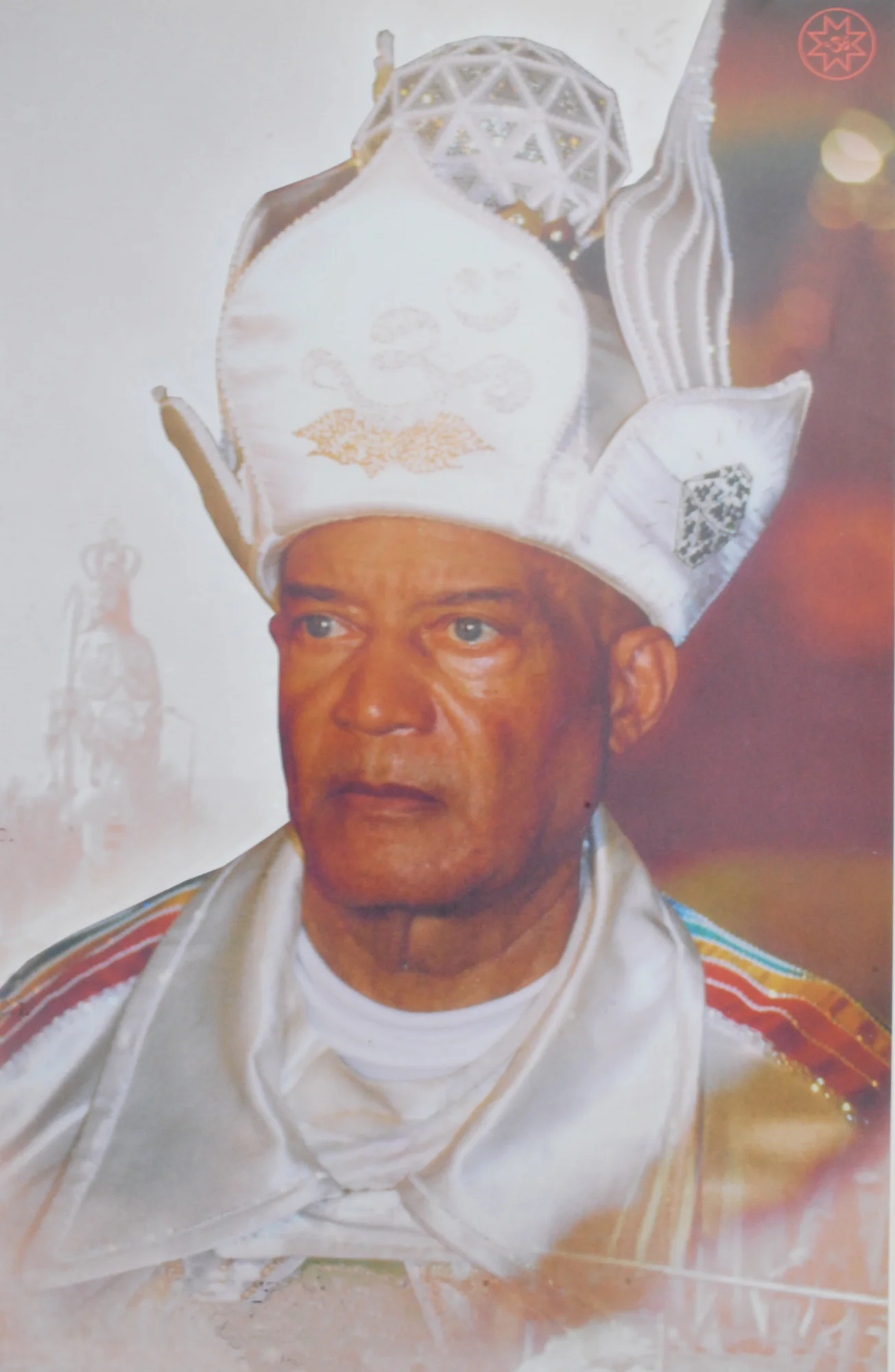
Reconciliation is a fundamental theme in the Teaching of His Holiness Lord HAMSAH MANARAH, who came to establish an ideal of Peace and Unity, breaking down the artificial barriers between races, peoples and religions. “Unity,” He tells us, “is not the crushing of opposites but their reconciliation, their unification into one united and fraternal whole.”[1]
Cultivating the spirit of reconciliation means sowing and growing the seeds of the thoughts and feelings that will help us emerge from the suffering inflicted on ourselves and on our fellow human beings.
Cultivating the spirit of reconciliation means wanting Peace within and around oneself and continuing to want it, wanting Peace over time through mental hygiene.
Cultivating the spirit of reconciliation can remain a secular task, but it can also become a spiritual work that gives the goal a sacred character and amplifies its effects and repercussions.
Cultivating the spirit of reconciliation means accepting that there was once understanding and harmony, and that this state must be regained: the feeling of unity with the Whole, with all that lives, the feeling of Unity with the Divine.
We will therefore discuss the need to:
- I. Change our mental state;
- II. Go beyond the limitations of human love in order to move towards true Love, Divine Love.
I. CHANGING OUR MENTAL STATE
Hatred is above all a spiral, a psychological complex that disproportionately amplifies the negative acts committed. It is the logic of “an eye for an eye and a tooth for a tooth”, in which yesterday’s victim becomes today’s executioner: those who have suffered want in turn to make others suffer, first individually, then collectively. To break out of this spiral, we must change our mental state: we must enter the Age of Peace and fraternity called the Golden Age.
His Holiness Lord HAMSAH MANARAH tells us: “The Golden Age is only a mental state to be conquered, and it remains within everyone’s reach.”[2]
Let us keep in mind three key points that can enable us to reach this mental state:
- the path of the Great Forgiveness;
- detachment from the past;
- mental hygiene.
1) The path of the Great Forgiveness
All religions urge their followers to forgive, but very few people put this precept into practice. Wars of religion sadly prove it. Yet “forgiveness is the only way to put an end to hatred”.[3]
Tirelessly, the Founder of the Aumist religion set the example of forgiving offences, ingratitude and betrayal. He breathed into each person the strength to transform themselves. How could we fail to recognise that God is within us when the kindly gaze of His Holiness Lord HAMSAH MANARAH rests upon us?
The gaze that makes one beautiful: the gaze of the One who knows, who knows everything about human nature.
The gaze of the One who sees even what our consciousness cannot yet reach, what we do not know, or have forgotten or buried.
The gaze of the One who sees right through us and perceives, beyond our faults, our divine essence.
And this gaze was the same for everyone, at every moment.
Yet we are only a small sample of humanity, with all the faults and failings it is capable of. But the experience of accepting this Love and this Forgiveness is radical and unforgettable; it multiplies our strength and our enthusiasm tenfold and sets us free. It leads to Forgiveness of oneself, which, regularly maintained, allows us to move forward, to dare to make mistakes, to start again, to try again, and to allow others to do the same. However, forgiveness according to Aumism does not serve only to erase negative thoughts and acts that each person could then repeat at will! By lightening the conscience, forgiveness gives the energy and the freedom, and therefore the duty, to transform oneself and set out again, avoiding falling back into the same failings over and over. Our capacity for evolution is directly linked to our capacity for forgiveness.
“The first step,” the Lord tells us, “is Forgiveness of oneself, to avoid self-punishment. The second step is to turn towards those who have hurt us, who have hurt us the most, and say to them: ‘I forgive you all the harm you have done. May the Light be in your mind and Divine Love in your heart.’”[4]
This sentence can be said mentally, even without the presence of the person to whom it is addressed. Only the mental attitude of reconciliation matters, while paying attention to the effects it generates… “My friends, you must take everyone’s measurements again every day,” His Holiness used to tell us, so as not to fix our mind on a situation or a fault in the other person.
I would like to add that our motto used to be: “Love, serve, forgive, meditate, realise the divine within oneself.”
It has become: “Love, forgive, serve, meditate, realise the divine within oneself.”
Forgive has taken second place, just after Love and just before Serve. The nuance is worth meditating on: I cannot forgive without loving, but if I have not forgiven myself and others, the rest cannot follow: serving, meditating, realising the divine within oneself.
The founder of Aumism recommends practising the Key of Forgiveness of oneself at least once a month and at most once a week, specifying: “Remember, your happy and luminous destiny depends on this forgiveness of yourself.”[5]
I will end on Forgiveness by stressing what was said in an earlier talk: during a great ritual, His Holiness Lord HAMSAH MANARAH granted the Great Forgiveness to the whole of humanity, to allow it to break with the spirals of the past that chained it to hatred, and to give it back the freedom to build the peace of the Golden Age by changing its mentality.
Here is the second key point that makes this change of mental state possible.
2) Detachment from the past
The past permeates our thoughts and actions, shaping our prejudices, our conditioned reflexes and our herd reactions. Conflicts are perpetuated from century to century through attachment to the past and to memories of painful experiences. From childhood we may be conditioned to see peoples in terms of what previous generations went through.
At the individual level, Lord HAMSAH MANARAH warns:
“Do not judge anyone to be your mortal enemy for life, for otherwise you block any possibility of change in them.”[6]
Resentment and heavy memories feed an energy of involution within us and project it onto others. In the same way, at the collective level, “attachment to the memory of the crimes committed by this or that people blocks the possibility of change in the guilty people”.[7]
In the book Vers un Âge d’Or d’Unité, we read: “One day every nation will have to draw a final line under its history of past wars. Resentment will have to disappear along with all the bad memories; only thus, and at this price, will wars and the seeds of hatred disappear.”[8]
One of the great riches of our spiritual Master’s teaching lies in a simple and saving principle: once the obstacles have been analysed, He offers us practical solutions for freeing ourselves from these chains. The daily practice of techniques that involve every plane of our being is the key to each person’s evolution, which brings us to the 3rd point.
3) Mental hygiene
Psychoanalysis reveals the psychological process by which the world we live in is not only the projection of our unconscious but also the response to our unconscious reactions. “We can therefore obtain nothing unless we want it with both the conscious and the unconscious mind.” It is no surprise, then, that Aumism offers a wealth of techniques for positive mental training. Their aim is to feed our unconscious, seen as a recording machine.
It is the positive training of the subconscious that will allow us to detach ourselves from the past and help us to go on wanting Peace. For there is a part of us that wants it and another that does not: the latter is called inertia, laziness, jealousy, pride, selfishness, fear, lack of self-confidence, attachment to the past… “The fundamental key to the highest evolution lies in the positive training of the subconscious.”[9]
We can also react positively if we happen to be in conflict with someone. This exercise requires being aware of the present moment, so as to transmute our thoughts by replacing them with a blessing sent to the person who was the target of our aggressiveness, affirming:
“I cancel the thought sent against So-and-so and send back to them a thought of love, peace, harmony and unity. May their soul forgive me and be reconciled with my inner God.”[10]
Here again, regular practice is essential. Let us stress once more that it is much more a matter of seeking to transform oneself by lightening one’s conscience than of mechanically erasing thoughts and acts only to repeat them at leisure. By exercising vigilance, we can gradually (for one, two, three days) avoid attacking anyone in deed, word or thought, until this attitude becomes part of our life.
II. GOING BEYOND THE LIMITATIONS OF HUMAN LOVE TO MOVE TOWARDS DIVINE LOVE
Love within a small group allows us to experience non-possessiveness, service to others, solidarity and self-transcendence. For example, out of love for our family, we learn to become patient and generous; we become able to set ourselves aside for the happiness of those we love. But this human love is only one step on the ladder of love.
Human love has its limits
Indeed, fraternity within subgroups often turns into the exclusion of difference. Through this limited, restricted love, what shows itself is the self-centred character of a love reserved for those who appreciate us and resemble us in their way of thinking and living. Human love then becomes sectarian and exclusive, reserved for a limited number of individuals.
This is why His Holiness Lord HAMSAH MANARAH constantly urges us to develop the feeling of Unity with all that lives, in order to make the conquest of true happiness possible in this life. He tells us: “When we love someone, we love the Divine Image they carry within them. Otherwise, it is not Love.”[11]
How, then, can we move towards true love, the love that goes beyond the limits of self-centredness and opens up to unity?
Through identification with the divine Consciousness: by seeking the deep source of Love in the Supreme Self within us. To restore peace, we must above all restore our Unity with the inner God, present in ourselves and in everyone. For if we feel that the other is a part of ourselves, how can we hate them for long or wish them dead? If love cannot be invented or commanded, it is nonetheless true that it can be cultivated and educated throughout a lifetime so as to express itself better. We come back to mental hygiene and the positive training of the subconscious, but also to the practice of hatha yoga, martial arts and pranayama, in order to master our emotions and reactions better and better.
Aumists also take care to practise meditation and prayer regularly by repeating the Sound OM. Every prayer, meditation, hatha yoga session, meal, meeting and so on begins and ends with beneficial and harmonising thoughts for all sentient beings and in all directions of space.
His Holiness Lord HAMSAH MANARAH remains for us the finest example of Compassion for all that lives, the One who reached the summits of Divine Love and fused His soul in the heart of GOD.
Many techniques developed in His 22 books make it possible, if one practises them, to develop this feeling of Unity and to glimpse God in everyone, while avoiding the pitfall of weakness and naive romanticism.
In conclusion, here is a text written by His Holiness after learning of malicious acts committed by people whom He had nevertheless greatly helped and loved. It is a poem addressed to the whole of humanity:
THE ANGER OF THE WIND
“Man or woman, if somewhere you meet
A foolish being who calls himself my enemy,
Or who simply behaves as such
Through his words and his deeds,
Tell him that he is in me,
And that I give him my Peace.
Known or unknown to my mind,
He is my brother and I am in him.
He must therefore cease to be his own enemy.
When an angry fist plunges
Into the clear water,
The water moves aside, then returns to its place
When the time comes.
So too my defenceless soul
Follows the movements imparted
By the furious force of the wind.
Yet it does not lose its nobility,
For it lives in an ocean of bliss.
Tell him with love
That my compassion awaits him
On the path of light,
To help him, if he so wishes,
To manifest what is already within him
Without his knowing it:
The Peace of ETERNITY.”[12]