SYMPOSIUMS
LECTURE
No. 5 – ACCEPTING CHANGE: WORK ON ONESELF
ACCEPTING CHANGE: WORK ON ONESELF
SUMMARY
We may choose to change in order to escape suffering, to develop at last abilities neglected until now, to express our highest aspirations fully, and so on. In every case, it is a matter of making a fresh start in order to live in a more fulfilling way.
After courageous introspection, creating new habits will allow gradual improvement, but what matters is to persevere.
A “cleansing of the doubles” (the unconscious), linked to a work of forgiveness, is indispensable to free us from the past. Using our imagination positively, transmuting our faults, praying, repeating the Sound OM: all this work leads us to find the Divine within and around us. It sets us on the path of Unity, which allows us to experience inner happiness.
TALK
At one time or another, we have all been dissatisfied with our life and decided to take our destiny into our own hands in order to live more happily. But were we going to change jobs, move to the countryside, change our car or buy a bicycle? Perhaps such outer changes will be the consequence of our inner transformation.
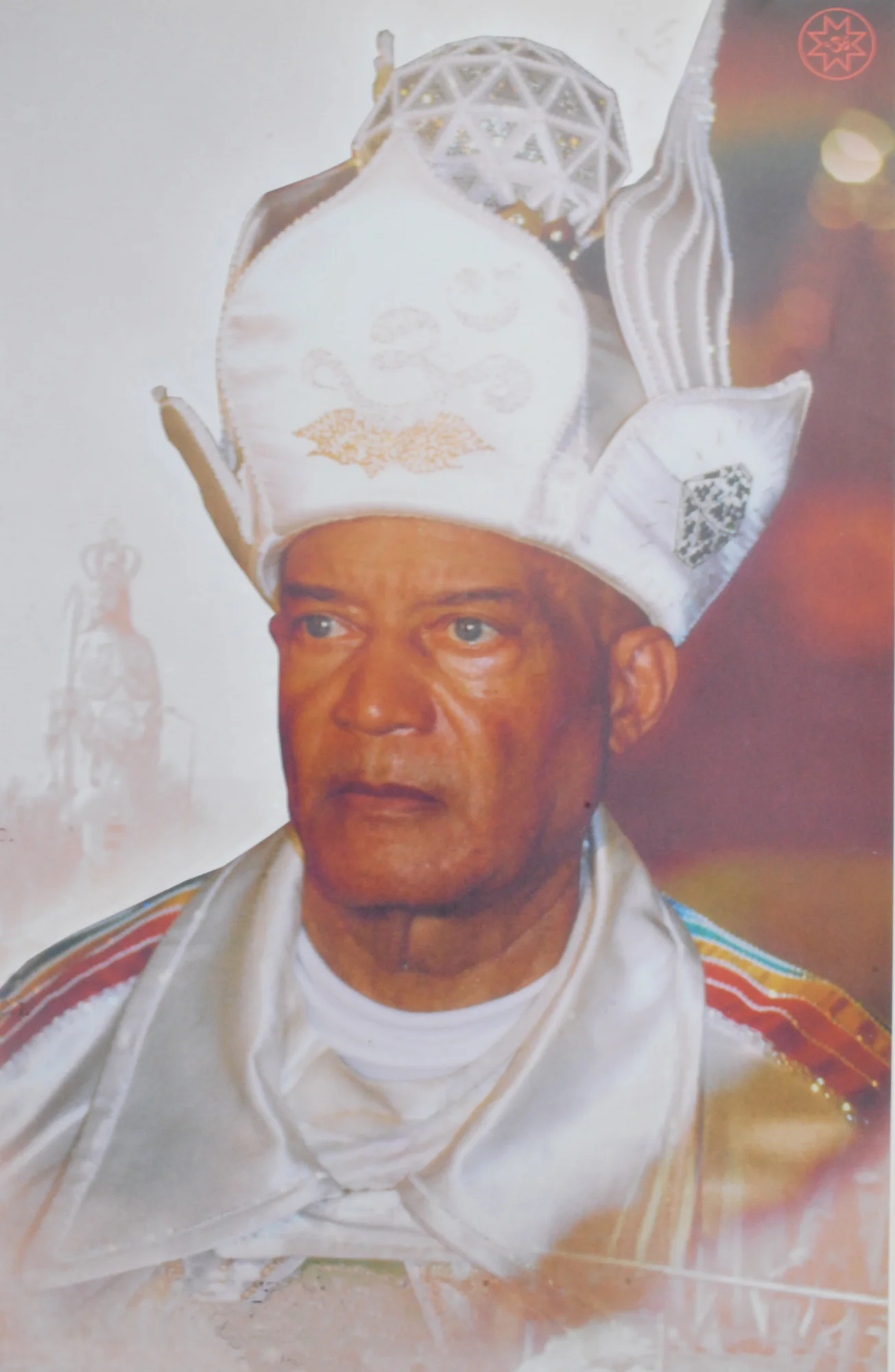
Lord HAMSAH MANARAH reminds us that we have the duty to transform ourselves:
“Transform yourselves!… Open your heart and your mind to this new Age, which puts an end to all suffering” (L’Aumisme, la Doctrine de l’Age d’Or, p. 66).
It is enough to set out, to take one step and then another, while also accepting falls. We get up again and set off again; the essential thing is to start walking towards true happiness.
We will approach this talk in three parts:
- I. TAKING STOCK: WHAT ARE WE LIKE?
- II. THE MEANS OF ACTION FOR TRANSFORMING OURSELVES IN LINE WITH OUR ASPIRATIONS
- III. THE OUTCOME OF THIS WORK OF TRANSFORMATION: THE INNER GOLDEN AGE
I. TAKING STOCK: WHAT ARE WE LIKE?
What will make us decide to change one aspect or another of ourselves? Often it is suffering of greater or lesser intensity. “Courageous, intelligent and painstaking introspection fosters awareness, the basis of all improvement” (Le Yoga de la Vie Pratique, p. 215). For example: I want to stop smoking, I am fed up with this dependence and I am afraid of illness, so I am going to take effective steps to stop; I no longer want to lose my temper at the wheel or with my children; I work too much, I am too stressed, I cannot take any more… so I am going to act and find solutions to manage daily life better and feel better; or else I am going through a deep shock (illness, divorce, unemployment, the loss of a loved one), I am suffering too much and I want to become stronger, and so on.
Awareness is a first step towards action. This first step must be accompanied by great indulgence and by the acceptance, without guilt, of what we are. It is by allowing others and ourselves to have limits, weaknesses, fears and sufferings that our process of transformation begins.
For example, if I am touchy, impatient, quick to judge and condemn, sometimes jealous and selfish, then there is work ahead, for it is a matter, as the Lord says, of “purifying oneself of the black stones that stifle the soul”. Change can only come from a personal decision, because we have had enough of conflicts and tensions with ourselves and with others. Others cannot decide for us, and it is ourselves we want to change, not others. Wanting to change others is a dead end, an illusion, a trap to avoid working on oneself.
Moreover, what others say or think of us can be positive and help us, but it can also be negative and block us. Take this remark: “You haven’t changed!” It can be positive, implying: “You are still good, courageous, willing, determined”… fortunately we have qualities to keep! Or it can be negative: “You are still as hard, rigid or spineless, weak, self-serving”… well, fortunately we have faults to work on! The same goes for the phrase “You have really changed”, which can be a wonderful encouragement in the positive sense and a salutary shock in the negative.
The best thing is to entrust ourselves to God, thanking Him for the strength to accept what cannot be changed (for example the loss of a loved one or a child leaving home) and the strength to change what can be changed (anger, intolerance, weakness). It is important to know the difference between what we can change and what we must have the courage to accept, even if at first we feel that it is beyond our strength!
II. THE MEANS OF ACTION FOR TRANSFORMING OURSELVES IN LINE WITH OUR ASPIRATIONS
In the previous talks, fundamental elements have already been dealt with: diet, work on the body to act on the mind and emotions, positive thoughts and autosuggestion. So let us look at what other means Aumism places at our disposal, in addition to simple but effective means that everyone can put into practice: for example, preparing one’s schedule the evening before, getting up an hour earlier, eating half as much sugar, watching less television, doing a quarter of an hour of yoga every morning… These are means that allow gradual improvement. Still, one must find within oneself the will and strength to succeed by creating new habits. That is the decisive step: creating other habits and keeping them up over time. What matters is to persevere: “Those who have succeeded have not come to tell you about their past failures in the intermediate periods” (Le Yoga de la Vie Pratique, p. 221). Indeed, the energy set in motion for our transformation comes up against the fear of change and the resistance of our unconscious. It is a struggle between our shadow side, which will, for example, want to keep us in suffering, and our Light side, which wants to change and evolve. Accepting our own resistance and inner turmoil, but also acting to free ourselves from the shackles that prevent us from evolving, is the only solution: “The battle is waged by confronting oneself with tenacity” (L’Aumisme, p. 72).
1. To change, we must first free ourselves from the past. Lord HAMSAH MANARAH tells us: “Each person must fight their double. It is an incessant battle between the Light Consciousness, the Great Self, the Supreme Self, and the double, the little self, the ego” (L’Aumisme, p. 166).
What is the double?
The Lord gives us a definition: “The double is a crystallisation of negative energy specific to each individual. It is each person’s dark counterpart, created during past incarnations” (L’Aumisme, p. 168). We have a “plantar” double, which, as its name indicates, is beneath our feet, and an “aerial” double made up of spheres above our head. These spheres contain the memories of our journey through our past lives, while the plantar double is made up of everything negative: apprehension, fear, pessimism, guilt, self-punishment, attachment to suffering and to the past…
“Cleanse your doubles often with the sound AUM” (L’Aumisme, p. 167), advises Lord HAMSAH MANARAH, for this cleansing allows us to free ourselves from the shackles of the past. By chanting the sound OM, the mother sound of all sounds, while visualising a white light, we can cleanse our double beneath our feet and our double above our head, our various spheres.
Cleansing the chakras is a further step towards freeing ourselves from the past and putting every chance on our side to transform ourselves, for, as the Lord reminds us, “what you call the unconscious and the subconscious have their seat in the chakras”, the chakras being centres of force related to the plexuses of the physical body. It is a matter of purifying two of our chakras by chanting the sound OM: the Ajna chakra, or centre of Knowledge, located between the eyebrows, and the Heart chakra. But this work must be done with caution and under the guidance of a priest of Aumism.
Freeing ourselves from the shackles of the past also means no longer punishing ourselves, that is, no longer playing the role of victim in order supposedly to atone for our past faults. For this is an infernal spiral! To change the way we look at the past, we can use this beautiful affirmation: “Everything that happened in the past is unimportant, except for the love I have lived.” Some people are afraid of happiness, believe they have no right to it, or else do not want to heal and unconsciously want to go on suffering. This is where forgiveness comes in.
Freeing oneself from a burdensome past by forgiving oneself and others is the key to transformation and the key to happiness. Those who do not forgive are troubled and prey to fear. They are sure of their perception of others and of their interpretation of it. They are certain, for example, that their anger is justified and that their critical judgement is correct… In its rigidity, the mind that refuses to forgive sees the future as the past and resists change. Only forgiveness can free us completely from fear, guilt and resentment.
“The key is to see God in the other…”
“Pray for him in the silence of your sanctuary. Address his Soul of Light mentally…” (La Loi d’Évolution des Âmes, pp. 226 and 229)
Forgiving someone does not mean agreeing with the offence committed. It means seeing beyond the offence with the eyes of the heart. Forgiving others makes it possible to forgive oneself. Here is an extract from the prayer of sincere repentance recommended by the Lord:
“I forgive myself the faults of the past. I forgive myself the crimes of the past… as I forgive all the visible and invisible beings who have harmed me from life to life…” (La Loi d’Évolution des Âmes, p. 73)
“Knowing how to forgive oneself is the first true and sincere step into the True Light that a soul can take, whether it has been executioner or consenting victim for millennia” (L’Aumisme, p. 61). A technique of self-forgiveness will be presented to you tomorrow.
This process also allows us to stop judging others; it is thus a way of accepting the other completely without wanting to change them, and of refocusing firmly on our own transformation.
2. To change, we have another tool that we must use positively: our imagination. “The force of positive imagination is as powerful as a steamroller. It sets itself a goal, an objective, and always reaches it, whatever mountains of obstacles stand in its way” (La Loi d’Évolution des Âmes, p. 412).
All too often, the monsters of our imagination block our desire to evolve. For example, someone dear to you is half an hour late and you get into an impossible state. Full of fear and anxiety, you imagine this or that, when you would so much like to let go and be serene… It is your imagination that you must tame in order to develop confidence, more inner strength and serenity. This is why the Lord gives us a Technique for mastering the imagination, which you will find in the Book La Loi d’Évolution des Âmes, pages 414 and 415.
3. We can also strive to transmute our faults. Fortunately, we all have some! The principle is to “use one’s faults as a driving force to move forward… for example, pride can be changed into a sense of dignity. Ambition can help one to surpass oneself…” (Le Yoga de la Vie Pratique, p. 115).
In this work on oneself, prayer and the repetition of the sound OM, our basic prayer, or of other sacred formulas, the mantras, are indispensable. The sound OM is the white light, the white tornado that cleanses our impurities and makes it possible (sometimes after serious turmoil and some unpleasant cleaning work) to clear away what blocks us and to change truly and deeply, so as to live more at the level of the heart and with a more luminous mind.
We do not become patient, indulgent, fraternal, harmonious, serene and full of love without a struggle of greater or lesser length. What matters is always to want to move forward despite falls and temporary stagnation, for there are thresholds to cross.
III. THE OUTCOME OF THIS WORK OF TRANSFORMATION: THE INNER GOLDEN AGE
If we persevere, our progress and our changes lead us step by step towards a transformation that may also bring a change of job, of living environment, or new friends. For if, for example, we have swept away envy and jealousy, if we no longer look for the faults of others but, on the contrary, see the Divine in them, our heart, which had shrivelled, can become immense, and our surroundings are transformed too.
This work on oneself has necessarily led us to experience discipline and letting go, without which the path is unbearable, for example through the affirmation: “I place all things in the hands of Infinite Love and Wisdom”, and it becomes easier and easier to raise one’s consciousness towards God.
Even if there have been periods of stagnation and thresholds that were hard to cross, the satisfaction of reaching the goal, or goals, makes change rewarding, linked to a better life: less tension and conflict with oneself and with others, more assurance, self-confidence and self-esteem, and therefore more inner well-being.
The overall goal, the conquest of true happiness, necessarily involves a more even temper, more humour, knowing how to be a spectator of oneself and how to defuse situations…
And if, through forgiveness, affirmations, the cleansing of the unconscious, prayer and the practice of the techniques given by Lord HAMSAH MANARAH, we have achieved a certain erosion of the little self, we draw closer to the feeling of Unity. “Love leads to the growth of the feeling of Unity. In loving others, one loves an aspect of oneself” (L’Aumisme, p. 57).
The other is a part of me: this is integrated perhaps for a quarter of a second at first, and then more and more often or for longer. The joy of others is also our joy: we meet a friend who is experiencing a happy event, and it is a great happiness that brightens our whole day! This happiness comes from further away: it springs from contact with the Divine in oneself and in the other.
The feeling of Unity fills the heart with happiness and brings peace and deep inner joy. We can experience it, for example, during a walk in nature. The feeling of symbiosis with the trees, the plants, the animals, the people passing along the paths and the laughing children connects us to them; it is God who lives in them and expresses Himself in His infinite richness. This is an extraordinary opening that allows us to draw closer to the inner Golden Age.
Through putting into practice the Teaching of His Holiness Lord HAMSAH MANARAH, a deep change takes place within us. It certainly takes a great deal of patience and perseverance, and we have not yet reached the proposed goal, which is to realise God, but we are certain that it is possible.
We will therefore conclude with these two key ideas of Lord HAMSAH MANARAH:
“If you want to change the world, begin by reforming yourself.”
“The only lasting happiness can come only from the effort to realise God.”
(L’Aumisme, p. 287)
Bibliography:
The Books of His Holiness Lord HAMSAH MANARAH, Éditions du MANDAROM, in particular:
Le Yoga de la vie pratique
L’Aumisme, la Doctrine de l’Age d’Or
La Loi d’Évolution des Âmes
Nathalie Pacout: Changer pour mieux vivre, Éditions Ambre