SYMPOSIUMS
LECTURE
No. 5 – HOW TO PREPARE FOR DEATH, HOW TO HELP THE DYING
HOW TO PREPARE FOR DEATH, HOW TO HELP THE DYING
This is a subject that concerns us all, but it is also one of the most emotionally charged, for death is, or was, our greatest fear. I say “was” because some people, in particular those who have had an NDE (near-death experience), no longer have this fear… All our other fears refer us back to this fear of death. So I invite you to relax and to spend 30 seconds not only in silence but with a Buddha smile… to bring more serenity to your face. Relax the muscles of your face…, your lips loosen, you form a slight smile, you are calmer, and this allows you to take a little distance from your body and from your emotions concerning our subject… Most of us are attached to life: leaving it, letting go, causes suffering, and we are afraid of the unknown, hence also the usefulness of this Colloquium.
In this talk we will not speak about sudden and accidental deaths. We prepare for a birth; we must, as far as possible, prepare for our death, the end of this earthly life, when the door will open onto another world…
There are 3 aspects to consider:
– we are afraid of suffering in our own death, in what is called “the death throes”;
– we are also afraid of the departure of loved ones, whether human beings or animals;
– and we are afraid of dying without having “succeeded” in our life.
That is why, during this colloquium, we are reflecting on “living well”, and we must also look at “dying well”. “There is an art of dying as there is an art of living. But the men and women of our time seem to have forgotten both: life is spent running faster and faster, and one arrives at the grave without having had time to live…”[1] We must prepare ourselves to leave our physical body and to help others: for Aumists, knowing how to assist a dying person is one of the greatest services we can render to others. However, to help others better, one must free oneself from the fear of death and integrate the mental attitude that fosters a certain serenity: the more one has prepared oneself, the more one has also prepared those one loves.
We will therefore deal with 2 parts, which are linked:
1 – How to prepare oneself for death
2 – How to help a dying person
I – HOW TO PREPARE ONESELF
To put things into perspective, allow me to quote this advice from our Spiritual Master, universal common-sense advice that we need to recall constantly:
“Become aware of the impermanent nature of things. Man will not take into the other world his car, his dog, his palace, his house or any riches he may have. Attachment to what is perishable, to objects, paralyses evolution and generates suffering…
– throughout his life, man must consider himself the temporary manager of the goods that Providence and destiny have granted him to possess…
– consider the brevity of a life and its fragile nature. Compared with the life cycle of the stars, a human existence is the blink of an eye in the universe.
– free oneself from attachment to beings, to objects, to the pleasures of the senses.”[2]
This is a lifetime’s work on oneself, and we are on the way, since life can be considered a school of perfection.
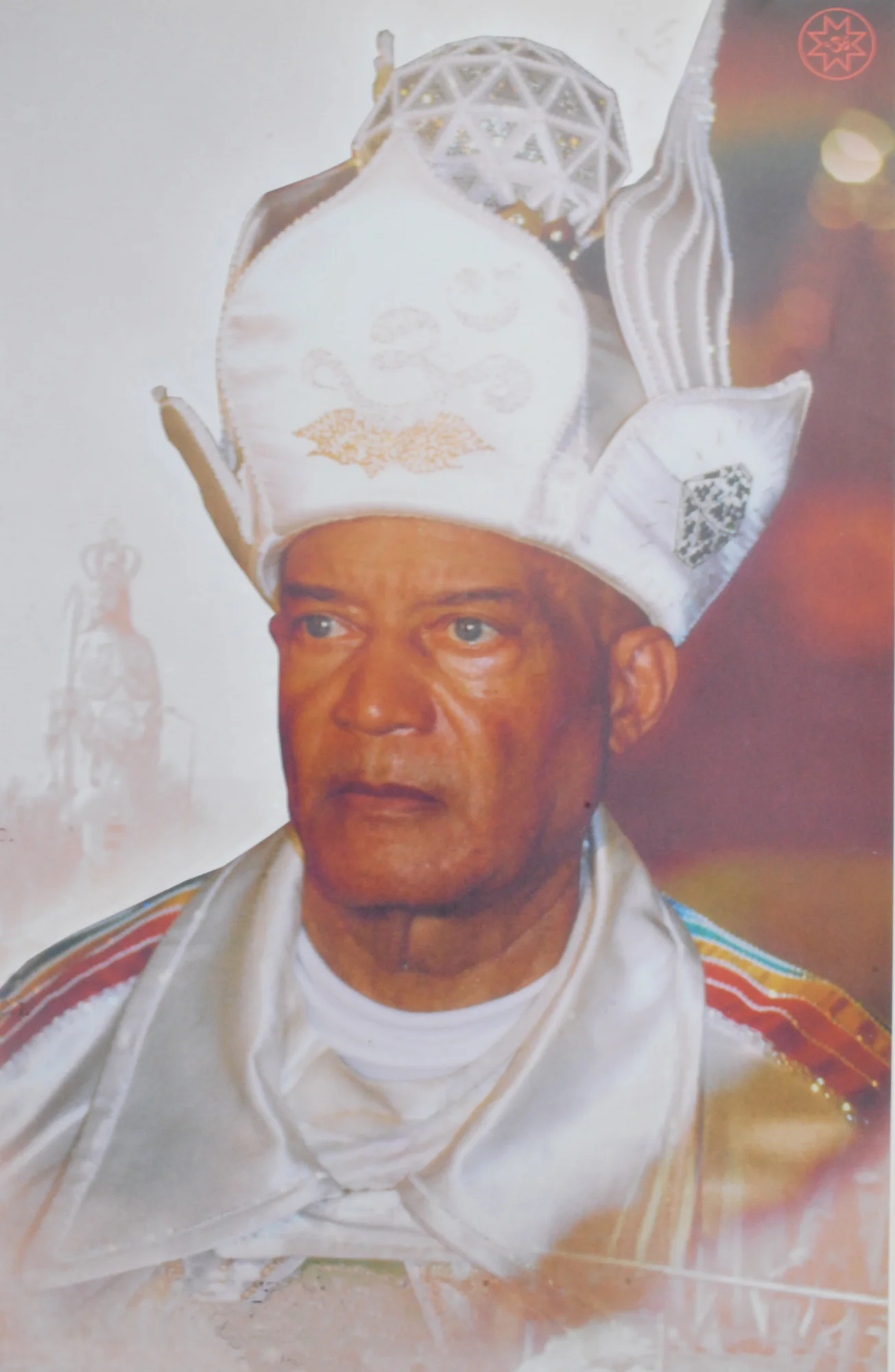
The Lord HAMSAH MANARAH reminds us of certain points for developing more serenity: for example, cultivating benevolence. According to a Buddhist text: “The man who has cultivated benevolence, who has meditated on benevolence, sleeps happily, wakes happily, lives happily and dies happily.” Cultivating benevolence and compassion, seeking Unity behind apparent diversity and often repeating the sound OM will help us every day of our lives. Very concretely, in addition to the prayer of the OM, Aumists do autosuggestion work inspired by the philosophy of Vedanta: the aim is to leave the process of identification with our physical self, with our personality, and to identify with the great Self within us, the reflection of the absolute Consciousness.
Here are a few extracts from the affirmation that we can repeat (it is based on NETI NETI, “neither this nor that”, on the one hand, and on ETI ETI, the reverse, on the other):
“I am not this body. This body is only my working instrument… I am not these thoughts, I am not this personality, I am not this little self. I am the Great SELF, the True Self, I am the Supreme SELF in unity with the Divine consciousness, which is Peace, Love, Light, Felicity and infinite Beatitude…”[3]
Perseverance is necessary, but this does not make us forget that our body of flesh is a precious body. It is not a matter of rejecting it: it is a tool useful for our evolution, which serves as a support for other, subtler bodies, and we must keep it in good health and seek longevity.
Our breathing, and all the pranayama work we do to absorb energy, are therefore very important. Breathing exercises are a basic tool for re-centring ourselves in our body and, if need be, for working on the emotions, which will be useful to us at the end of life…
So: have the right perspective on the purpose of life on this earth, namely to express our divinity, to sweep away our mediocrity and to become, little by little, victorious over the diseases of the soul such as jealousy, selfishness, malicious gossip, etc.; and above all to live the present moment in all its depth and intensity, free of the past and without fear of the future. This may seem demanding, but of course everyone goes at their own pace. We are on this earth, in this incarnation, to learn to love better and better, selflessly. However, learning implies the possibility of falling; the essential thing is to get back up and carry on, accepting ourselves where we are, without feeling guilty but without giving up. Along the way, we develop a strength that allows us to help others at the threshold of death.
II – HOW TO HELP A DYING PERSON
I would like to quote these words of Xavier Emmanuelli, founder of the Samusocial: “We are sometimes afraid of a body that is falling apart. But that is not where a being’s dignity lies. It lies in the moral attitude of this brother in humanity. We will share the same fate as him, sooner or later. So let us not be afraid to stay beside him, to hold his hand, to say to him the words that come to us.”
If you have to help a dying person
Trust yourself: the Divine within you will help you and give you the necessary strength and love. The most important thing is to be present and to listen.
In the book L’Aumisme, la Doctrine de l’Âge d’Or, His Holiness the Lord HAMSAH MANARAH guides us: “Few people in the room… no raised voices… make the room cheerful (flowers, candles, images corresponding to the religious tradition). Avoid displays of grief, remain calm…” This is advice to keep in mind, but the more attached to and dependent on the person who is leaving we are, the more intense the suffering. So, if need be, a friend, a relative, a carer, a religious person or someone able to remain serene can take over. Fear, anger, sadness and distress may overwhelm us; unresolved problems may resurface. Being sincere with oneself and with the other, recognising one’s feelings, accepting our sensitivity as human beings and accepting that suffering passes through us is fundamental. This brings us back to working on the emotions and on breathing.
The person who is about to die picks up our inner state, our words and our thoughts, even if they are in a coma. That is also why letting go on the part of the loved one or loved ones is necessary, so that the dying person is not held back because of those around them. When one has the impression that the dying person is suffering a great deal physically, it can help, even in death throes without trauma, to know that their convulsive movements are purely mechanical and unconscious reflexes.
It is not too late to express our feelings to the person who is about to die, to say what we may never have dared to say, for example: “I love you” or “we love you”. It is good to help the dying person forgive others, ask forgiveness for themselves and forgive themselves, and to help them see all the positive aspects of their life so as to spare them regrets. We can also remind them mentally that it is important for the soul to leave the body through the top of the head…
According to Sarada Devi, a mystic of India: “The dominant thought that occupies our mind just before we lose consciousness determines the direction the soul takes after death.”
So, to prepare for a good “transition”, men and women must refrain:
“From any evil thought likely to predestine their future life in the direction of evil. From any excessive attachment to a pet… From any excessive attachment to family and in general to everything one leaves behind on earth.”[4] “Our thoughts and our feelings act upon us in the present and influence our future,” says the Lord HAMSAH MANARAH.
For these reasons, after this awareness, it is necessary to put into practice as early as possible in our life the observation of our thoughts and the gradual control of the mind in the direction of our evolutionary aspirations… Otherwise we risk being helpless and the plaything of our thoughts and emotions at the moment of departure (of course, this is easy to say!). At the moment of passing, when the soul leaves the body, those present must reassure the dying person, be positive and raise their vibratory rate by having them recite the sound OM or any other prayer of evolution, according to their religious tradition. The OM can also be chanted softly. “Adapting to circumstances is essential; for example, in a hospital ward one cannot do or say whatever one likes. Mental assistance then takes precedence. It is effective…”[5]
In Yoga et Sagesse, His Holiness the Lord Hamsah Manarah gives prayers He composed to help each person while respecting their Tradition: “They will be of great service,” He says, “for often even the best informed, driven by the best intentions, lose their composure and do not know how to be effective in these painful moments.”
I will quote a few sentences from these prayers:
– Prayer for a dying Christian (page 144): “I cast every burden upon the Christ; I go forward, free, on the path of departure…”
– For a non-practising person who wishes to be assisted (page 145): “I commit myself to the assistance of all good forces, of all the guides of the higher planes sent by your infinite clemency…”
– Addition for a convinced believer in reincarnation:
“I want my spiritual liberation; I renounce in advance prolonged heavenly bliss in order to return to earth and resume my efforts… I give thanks to the Celestial Powers for the assistance granted…” “The man who, at the moment of passing, thinks of GOD… will reach GOD…
The last thoughts of a human life will determine the level of evolution we reach in the Column of Light. The purer these thoughts, the less we will have to suffer in the sub-planes of the Column of Light, and the better we will be able to prepare for a swift and happy reincarnation to continue the work begun and left unfinished.”[6] We will not address here the current medical aspect, “painkilling” drugs and their effects on the dying person’s consciousness. Nevertheless, how to soothe anguish is a fundamental question.
It is also possible to help a person who is about to die from a distance. The Lord Hamsah Manarah gives us the procedure in 6 points on pages 283-284 of the book Le Yoga de l’Amour dans la force, which I invite you to read. I will quote only point 3, which is also very important to say when we are beside a dying person: tell them of the help of entities who will assist them and watch over them.
To help someone who has just died
After death, there is an Aumist prayer (pages 147-148 of Yoga et Sagesse) entitled “For one who has just died”, which also does us, the living, good. We can also help from a distance a person who has just died by following the various points given in Le Yoga de l’Amour dans la force under the title “To help a person who has left their vehicle of flesh”. It is very practical and reassuring: we are no longer helpless, we can act.
In Aumism, there is a sacrament called Transition (the name given to death), whose purpose is to help the deceased “better understand what is happening to them, to reassure them about their journey and the ascent of their soul in the Column of Light, the kingdom of Evolution in the afterlife.”
IN CONCLUSION
At the end of this talk, if you wish, we can do a practical exercise together.
After closing your eyes, I invite you to think intensely of a loved one who has passed to the other side. You can visualise them as you knew them, as you loved them, and surround them with white light… And now we will all together send these loved ones thoughts of peace, love, harmony and better spiritual evolution. And to make this thought-prayer even stronger, we will chant the sound OM together 3 times:
OM OM OM
*******
[1] L’Aumisme, la Doctrine de l’Âge d’Or, p. 104.
[2] L’Aumisme, la Doctrine de l’Âge d’Or, p. 103.
[3] Le Yoga de la Divinisation, p. 99.
[4] L’Aumisme, la Doctrine de l’Âge d’Or, p. 107.
[5] Ibid.
[6] L’Aumisme, la Doctrine de l’Âge d’Or, p. 108.