SYMPOSIUMS
LECTURE
No. 5 – RECONCILING SCIENCE AND CONSCIENCE
No. 5 – RECONCILING SCIENCE AND CONSCIENCE
A few definitions are needed in order to understand the subject properly.
Definitions
Science, in the general sense, refers to the body of human knowledge “that relates to facts obeying objective laws (or considered as such) and whose development requires systematisation and method”.
Consciousness / conscience: a subject’s apprehension of what is happening within and outside himself. That which is apprehended by consciousness: the whole of the phenomena of a subject’s mental life in the waking state. (Moral sense) The capacity to make moral judgements, to tell good from evil.
Etymology
The word “science” comes from the Latin scientia (“knowledge”), itself from the verb scire (“to know”), which originally referred to the mental faculty proper to knowledge. The word “conscience” comes from the Latin conscientia, which naturally breaks down into cum scientia (“with knowledge”). This etymology suggests not only the knowledge of the object by the subject, but also that this object always refers back to the subject itself.
Mental: that which belongs to the mechanism of the mind and calls on the intellectual faculties. Mental calculation, effort, level, test, work; mental activity, construction, organisation, structure, synthesis; mental faculties, functions.
The different facets of knowledge
- The problem of the origin of knowledge is whether it proceeds from experience (empiricism) or from reason (rationalism).
- The problem of the nature of knowledge, which leads us to distinguish various forms of knowledge, notably those that belong to the intuitive mind (psychology, for example) and those that belong to the mathematical mind (mathematics, for example).
- The problem of the scope of knowledge: is our knowledge absolute (the dogmatic position, at work in Hegel or Plato) or is it limited to the world of phenomena (the critical position, at work in Kant, for example)?
The Tao of Physics (Fritjof Capra)
“The famous Cartesian dictum cogito ergo sum, ‘I think, therefore I am’, has led Western man to identify with his mind instead of with his whole organism. One consequence of the Cartesian division is that most individuals see themselves as isolated egos existing ‘inside’ their bodies. The Cartesian division and the mechanistic view of the world have thus proved both beneficial and harmful: they made possible the development of technology and of classical physics, but have had harmful consequences for our civilisation… In contrast to the mechanistic Western view, the Eastern view of the world is ‘organic’. For Eastern spirituality, all the things and events perceived by the senses are interrelated and are only different aspects or manifestations of the same ultimate reality.”
Aumism holds the organic conception of the world. In Part I we will look at the different planes of consciousness. Part II will deal with the use of the applications of science, and Part III with the unity of science and conscience.
I – The different planes of consciousness
The diagram below shows the different planes of consciousness (L’Aumisme, la Doctrine de l’Âge d’Or, p. 91):
- At the top, plane 1, that of the Absolute, of divine consciousness or universal consciousness, the divine principle
- Plane 2 corresponds to the Soul, the divine part in each of us
- Plane 3 is that of spiritual intuition
- At the bottom, plane 7, the material plane, that of the body
- Planes 4 and 5 are the planes of the intellect, and plane 6 that of elementary feelings
|
1. Plane of the Absolute: HAMSAH MANARAH / MANARAHLOKA or SATYALOKA |
|
2. Plane of the creative energies / TAPALOKA 3. Plane of spiritual intuition (formless contemplation) / JANALOKA or DHYANALOKA |
|
4. Higher mental plane: abstract intelligence / MAHARLOKA |
|
5. Lower mental plane: concrete intelligence / SVARLOKA |
|
6. Astral plane: plane of elementary feelings / BHUVARLOKA |
|
7. Earthly plane: material plane / BHULOKA |
All these planes are intertwined. To these planes correspond the different bodies of man, from the etheric body (material body) up to the Soul, passing through the astral body, the causal body and the body of bliss. The actions carried out on the material plane depend on the plane on which the mind is situated. Samadhi for a sage, like transfiguration for a Saint, is a state in which the being unites his soul (plane 2) with divine consciousness (plane 1). Example: in 1954 Abbé Pierre spoke out to alert public opinion to the death of a woman from cold in the street. His action was guided by his soul (plane 2). In our everyday actions we must try to remain in the higher states of consciousness.
II – Science and the use of science (the Western system)
Science is a system of knowledge about a subject. Sciences (physics, biology, etc.): observation of creation through experiment, leading to the same definitions for all: principle, forces, energy, etc. Definitions can change according to scientific discoveries. Pluto was recently reclassified. It is no longer considered a planet of our solar system but a dwarf planet. This reclassification was decided by the International Astronomical Union. Recent discoveries had shown that a large number of objects the size of Pluto orbit the Sun. Our lives are completely shaped not by science but by technologies, which are derived from science. Science cannot be ignored; it is useful.
Gandhi said: “Poverty cannot be eliminated without the help of science and technology.” Science is above all linked to the scientist and to his level of consciousness.
An example of spiritual intuition: Jean-Jacques Dortous de Mairan explained the physical process that creates the northern lights (1730s) long before satellites (1957) came to confirm his explanations. In the 1730s auroras were visible in Paris. The academician Jean-Jacques Dortous de Mairan explained the phenomenon by particles coming from the Sun that would fall into the upper atmosphere and, by colliding with the atoms of the atmosphere, produce the auroral lights. This explanation could be verified later with the advent of satellites in 1957, which were able to detect this solar wind.
Science carries no value of good or evil; it is its use that can be good or bad. The property of radioactivity can be used for war (the bomb); the property of radioactivity can be used in medicine. We may also mention drone technology, which is used by armies to kill without sending soldiers onto the ground. Drones are now also used for many applications, such as delivering parcels without a postman in isolated areas of the United States. But we will develop the example of GPS (Global Positioning System), set up by the US Air Force to guide missiles, which is now part of everyone’s life. Everyone knows the GPS system for guiding cars.
In the section “The dangers of science without conscience” (Une Loi pour détruire le Mal, pp. 201-207), His Holiness the Lord HAMSAH MANARAH presents the negative and the positive aspects of science.
Let us quote some of the negative points of science mentioned by His Holiness the Lord HAMSAH MANARAH:
- Disrupting the climate
- Making species mutate at an accelerated rate
- Creating inferior races and superior races
- Destroying the protective atmosphere
- Creating new diseases and new viruses and spreading them
- Increasing global imbalances between rich and poor countries
- Robotising young people through different types of mental programming introduced from childhood into manipulated brains, etc.
Let us quote some positive points:
- Putting an end to famines
- Giving water to those who thirst in the desert and irrigating hundreds of hectares of desert so that the crops necessary for human survival can grow there
- Prolonging life
- Safeguarding the climatic balance, protecting the North and South Poles from an industrialisation that could only destroy them slowly, century after century
- Developing the intelligence and capacities of the human brain
- Opening the human field of vision to the realities of the Cosmos and helping man to put himself back in his rightful place in the economy of the Universe
Scientists must be responsible. In “Science and spiritual Evolution” (L’Aumisme, la Doctrine de l’Âge d’Or, pp. 171-189, here p. 175), the Golden Age scientist will avoid:
- Harmful experiments that could damage life on Earth in the short and long term
- Abusing his power over matter
- Denying life after death
The Golden Age scientist will undertake (p. 176) to respect a certain moral code:
- The wise man of science will seek above all the happiness of his fellow beings, while respecting the balance of the kingdoms of nature
- The true Golden Age scientist will not be the slave of his own discoveries. If he judges that publishing the results of his work alone could cause a great imbalance, he will have the courage to renounce honours and possible prizes rather than be the unwitting cause of what might happen
III – The unity of science and conscience
As we pointed out in the first two parts of this talk, science and conscience derive etymologically from the same word, knowledge. In Aumism, the different planes of consciousness, from the material plane to the plane of the soul, interpenetrate, and so science and Conscience are in Unity. In the West, and very particularly in France, the homeland of Descartes, the Cartesian approach to the world has led to a dehumanisation of the world, for man believed himself to be outside everything that surrounds him and sought to dominate everything around him: the mineral kingdom, the plant kingdom and the animal kingdom. Descartes, moreover, considered animals to be machines without consciousness.
The evolutionary Pyramid, on the contrary, shows that consciousness evolves from the mineral to the plant, to the animal and to the human, in order to reach the Divine. We are therefore all linked through consciousness with all the kingdoms of nature and with universal consciousness. We must not reject all the technological advances brought about by a Cartesian approach to the world, but we must think about putting consciousness back at the heart of our system. Today the Cartesian approach, useful for technological development, is not rejected, but it is entirely called into question as regards our conception of the kingdoms of nature, and particularly our relationship with animals. It is now accepted that animals, like plants, have a consciousness.
Scientists have become aware of the deterioration of the climate and, within the IPCC (Intergovernmental Panel on Climate Change), they have been alerting governments for many years. Politicians began to take up the issue at COP21. But the problem is not solved, because the lobbies against change are strong. Nevertheless, more and more people in the West are aware that we must change our way of life, which is damaging our planet. The men and women who are aware of the danger must act; it is a question of survival. It is through the evolution of individual consciences that the collective conscience will evolve. Before concluding, let us recall the founding act of the Republic: we note that in the beginning there were Rights and Duties, and now we speak only of Rights, and that is what leads to violence. The Human Being must once again become the driving force of the future of our planet by developing his duties towards all the kingdoms: mineral, plant, animal and human. He must not see himself as outside everything (“I think, therefore I am”) but, on the contrary, as part of the great whole.
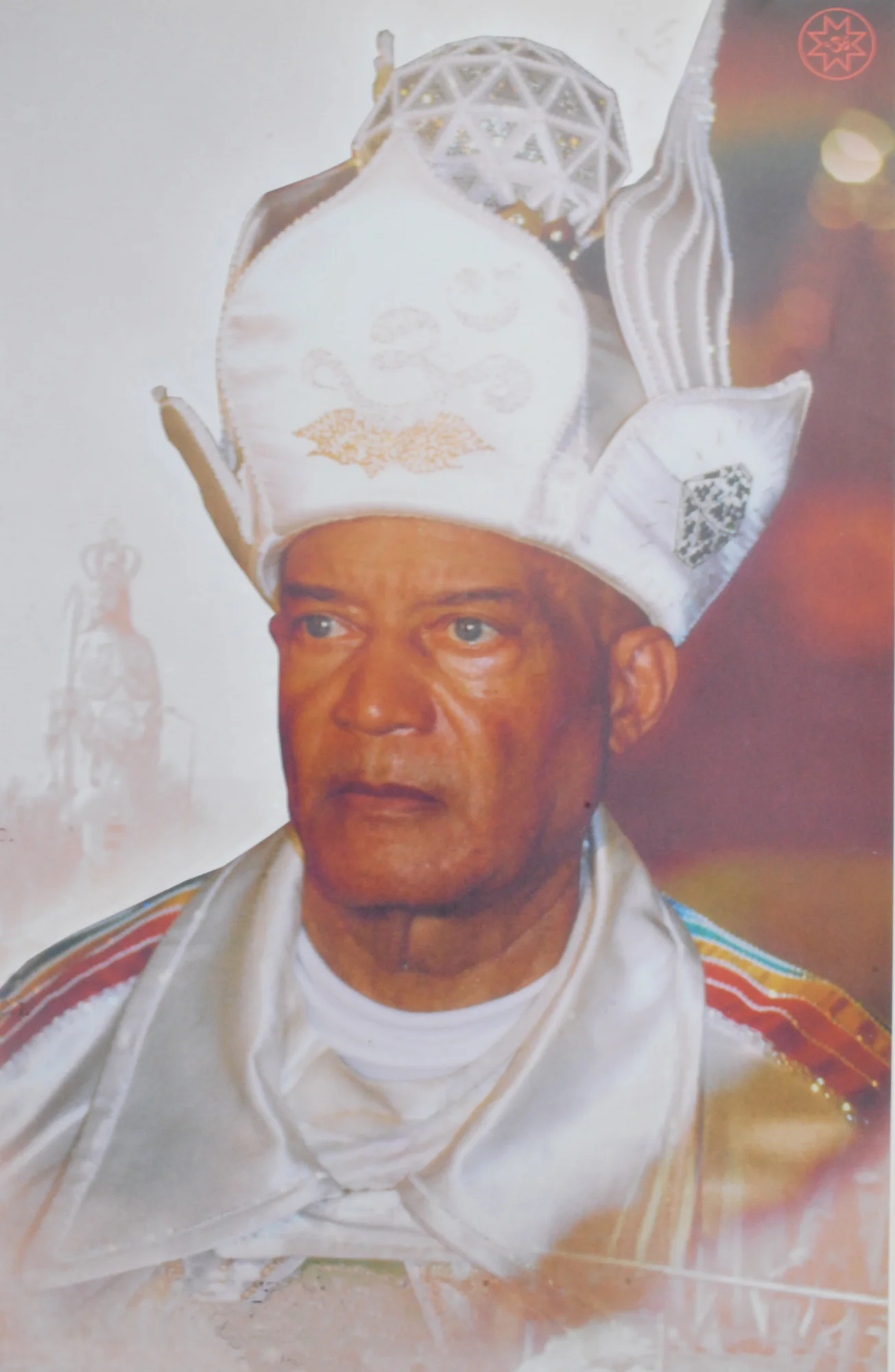
To conclude, you are going to see a film, Sur les pas du Messie (“In the Footsteps of the Messiah”), and you will see that our spiritual Master, His Holiness the Lord HAMSAH MANARAH, shows how we should act by mastering our different planes of consciousness and developing an evolutionary attitude in our lives.
Each of us is Master of our destiny and of the choices we make for the happiness of all.
V. Vishti
*****